Loading...
Edward V of England vs Petru Rares
Petru Rares leads by 5.8 pts · 2 figures compared
…
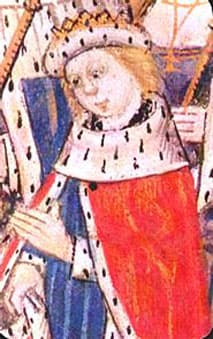
Edward V of England
Emperor · Medieval
47.5Total

Petru Rares
Emperor · Medieval
53.3Total
Basic Information
Born
1470
1483
Died
1483
1546
Era
Medieval
Medieval
Nationality
England
Moldavia
Occupation
Emperor
Emperor
Civilization
Western
Western
Score Comparison
Military (10%)
16.6
50.0
Political (20%)
68.0
68.0
Influence (20%)
45.5
52.5
Legacy (20%)
37.5
45.0
Leadership (15%)
70.4
53.2
Strategy (15%)
43.0
57.5
TOTAL
47.5
53.3
Edward V of England — Complete Timeline
1483 AD
Accession to the ThronePolitical Action◆ Major
Edward V became king of England at age 12 after the death of his father, Edward IV. His reign was brief and dominated by his uncle Richard, Duke of Gloucester, who acted as Lord Protector.
SuccessionMinor KingYorkist
Impact: national
Deposition by Richard IIIPolitical Action
Edward V was declared illegitimate by Parliament under the Titulus Regius, and his uncle Richard was crowned as Richard III. Edward and his brother Richard were placed in the Tower of London, where they disappeared.
DepositionPrinces in the TowerUsurpation
Impact: nationaltragic
Disappearance of the Princes in the TowerOther◆ Major
Edward V and his brother Richard, Duke of York, vanished from the Tower of London after being declared illegitimate. Their fate remains unknown, but they are widely believed to have been murdered, likely on orders of Richard III.
MysteryMurderPrinces in the Tower
Impact: nationaltragic
Petru Rares — Complete Timeline
1527 AD
Became Prince of MoldaviaPolitical Action◆ Major
Petru Rares ascended to the throne of Moldavia as the illegitimate son of Stephen the Great. His rule was initially recognized by the Ottoman Empire, but he later pursued an independent policy, leading to conflicts with both the Ottomans and Poland.
SuccessionPrinceMoldavia
Impact: regional
1530 AD
Patron of the Arts and Church BuildingCultural
Petru Rares was a notable patron of the arts, commissioning the construction and decoration of several churches and monasteries in Moldavia. He continued the tradition of his father, Stephen the Great, in supporting the Moldavian Orthodox Church and its architecture.
PatronageChurch BuildingOrthodox Church
Impact: regionalconstructive
1531 AD
Battle of ObertynWar◆ Major
Petru Rares defeated the Polish army at the Battle of Obertyn, securing control over the Pokuttya region. The victory was a major military success, but it did not lead to lasting territorial gains as Poland later regained the area.
BattlePoland-Moldavia WarMilitary Victory
Impact: regionalconstructive
1538 AD
Deposed by the Ottoman EmpirePolitical Action◆ Major
Petru Rares was deposed by the Ottoman Sultan Suleiman the Magnificent after refusing to comply with Ottoman demands. He fled to Transylvania, and the Ottomans installed a more loyal ruler,
DepositionOttoman InterventionExile
Impact: regionaldestructive
1541 AD
Regained the Throne of MoldaviaPolitical Action◆ Major
Petru Rares regained the Moldavian throne with the help of the Ottoman Empire, after pledging loyalty and increased tribute. He ruled for another five years, but his power was significantly reduced, and he remained an Ottoman vassal.
RestorationOttoman VassalComeback
Impact: regional
Expert Analysis
Origins
Edward V was born in 1470 to King Edward IV of England and Elizabeth Woodville, into the tumultuous House of York during the Wars of the Roses. His early life was marked by political upheaval: his father was briefly deposed in 1470-71, forcing Edward to flee to Burgundy. He received a princely education but was never prepared for kingship. Petru Rares, born around 1483, was an illegitimate son of Stephen the Great of Moldavia. His mother was a noblewoman, but his illegitimacy barred him from direct succession. He grew up in relative obscurity, likely in the court of his half-brother Bogdan III, and later served as a courtier and military commander.
Rise to Power
Edward V became king at age 12 upon his father's death on April 9, 1483. His uncle Richard, Duke of Gloucester, was appointed Lord Protector. Richard quickly moved to neutralize the Woodville faction, arresting Edward's maternal relatives and taking control of the young king. On June 22, 1483, Parliament passed the Titulus Regius, declaring Edward IV's marriage invalid and Edward V illegitimate. Richard was crowned Richard III on July 6, 1483. Edward and his brother Richard disappeared into the Tower of London, their fate unknown. Petru Rares ascended to the Moldavian throne in 1527, after the death of his half-brother Stephen IV. He was initially recognized by the Ottoman Empire, paying tribute and maintaining a delicate balance between the Ottomans and Poland. His rise was facilitated by his father's legacy and his own military experience.
Leadership & Governance
Edward V never exercised power; his reign lasted only 86 days. The government was run by Richard and the Council. Edward's only act as king was to issue a proclamation against his uncle's seizure of power, but it was ineffective. His leadership score of 70.4 is hypothetical, based on his father's reputation and the hope he represented. Petru Rares ruled Moldavia from 1527 to 1538 and again from 1541 to 1546. He pursued an independent foreign policy, resisting Ottoman suzerainty when possible. He allied with the Habsburgs and fought against Poland. He reformed the army, emphasizing cavalry and fortifications. His political score of 68.0 reflects his adeptness at navigating between great powers, though his defiance led to Ottoman deposition in 1538.
Triumph & Tragedy
Edward V's greatest triumph was his peaceful accession, but his tragedy was his disappearance and likely murder at age 12. The Princes in the Tower case remains one of history's great mysteries, with Richard III or Henry VII as prime suspects. Edward's legacy is one of lost potential. Petru Rares's greatest triumph was the Battle of Obertyn in 1531, where he defeated a Polish army of 7,000 with 5,000 Moldavians, securing the Pokuttya region. His tragedy was his deposition by the Ottomans in 1538 after refusing to cede fortresses and increase tribute. He fled to Transylvania, but his son Stephen V was installed as a puppet. He regained the throne in 1541 by pledging loyalty and paying a huge tribute, but his power was diminished.
Character & Destiny
Edward V was a child whose fate was sealed by his family's ambitions and his uncle's ruthlessness. His character is obscure, but he was likely intelligent and well-mannered. His destiny was to be a pawn in the power struggle between the Woodvilles and Richard. Petru Rares was ambitious and resilient, willing to fight and negotiate to preserve his rule. His illegitimacy drove him to prove himself. He was a capable commander and diplomat, but his defiance of the Ottomans was ultimately unsustainable. His character shaped his fate: he regained his throne but at the cost of subservience.
Legacy
Edward V's legacy is symbolic: he represents the tragedy of child kings and the fragility of dynastic power. His disappearance fueled centuries of speculation and the vilification of Richard III. He scored 37.5 in legacy, reflecting his short reign and lack of achievements. Petru Rares left a more tangible legacy: he was a patron of the arts, commissioning the painted churches of Moldavia, including the Voronet Monastery, a UNESCO World Heritage site. He defended Moldavian independence and maintained Stephen the Great's traditions. His legacy score of 45.0 reflects his cultural and political contributions, though his reign was overshadowed by his father's.
Conclusion
Petru Rares had greater impact than Edward V. Edward's total score is 47.5, while Petru Rares scores 53.3, a gap of 5.8 points. Edward's reign was a footnote, a tragic interlude that ended before it began. Petru Rares, despite his illegitimacy, ruled for 16 years, won a major battle, and left cultural monuments that endure. While Edward's story fascinates, it is a story of what might have been. Petru Rares actually shaped Moldavia's history, even if his independence was curtailed. Thus, Petru Rares is the more significant historical figure.
Rankings
🥇
Petru RaresLeader
Mil: 50.0Pol: 68.0Inf: 52.5
53.3
🥈
Edward V of England
Mil: 16.6Pol: 68.0Inf: 45.5
47.5
+5.8 behind
How This Comparison Works
Algorithm
Each figure is scored on 6 dimensions (0—100 scale) based on structured historical data: Military (10%), Political (20%), Influence (20%), Legacy (20%), Leadership (15%), Strategy (15%). The weighted total produces the final ranking.
Data Sources
Scores are computed from structured sub-indicators in the database. Scale factors adjust for era (Ancient ×0.85, Modern ×1.0) and civilization size (Eastern ×1.05, Other ×0.80) to account for differences in population and military scale.
Maximum 3 Figures
Comparisons are limited to 2—3 figures to ensure readability and statistical meaningfulness.
Error Margins
±5 points per dimension — Sub-scores are derived from historical records with inherent uncertainty. Two figures within 5 points on a dimension should be considered roughly equivalent in that area.
Total Score Accuracy
±3 points overall — The weighted combination of 6 dimensions produces a total score with approximately ±3 points of uncertainty. Differences of less than 3 points are not statistically significant— the figures are effectively tied.
Known Limitations
- Historical records are incomplete and uneven across civilizations
- Figures from oral-tradition societies may be underrepresented
- Occupation labels can misclassify multi-role figures
- Scores measure capability and impact, not moral character
- Quantitative scoring is a comparison tool, not absolute truth
Capability Radar
Military (10%) — Battles & Warfare
Battles
8
55
Win Rate
11
60
Expansion
9
45
Political (20%) — Governance & Reform
Reform
51
45
Diplomacy
52
55
Economy
56
40
Influence (20%) — Cultural & Global Reach
Cultural
5
35
Global
5
20
Legacy (20%) — Historical Impact
Historical
15
40
Longevity
10
30
Leadership (15%) — Power & Stability
Tenure
46
60
Stability
58
40
Strategy (15%) — Tactics & Innovation
Strategy
14
50
Tactics
19
55
Reform
19
40
Similar Comparisons
Comments & Discussion
No comments yet. Be the first to share your thoughts!