Loading...
Edward III of England vs Napoleon Bonaparte
Napoleon Bonaparte leads by 10.0 pts · 2 figures compared
…
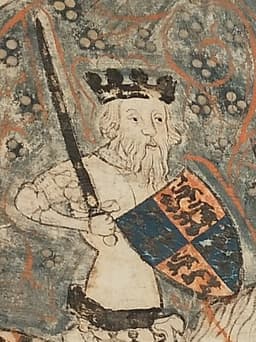
Edward III of England
Emperor · Medieval
60.9Total

Napoleon Bonaparte
General · Modern
70.9Total
Basic Information
Born
1312
1769
Died
1377
1821
Era
Medieval
Modern
Nationality
England
France
Occupation
Emperor
General
Civilization
Western
Western
Score Comparison
Military (10%)
72.0
94.0
Political (20%)
55.0
72.0
Influence (20%)
65.0
40.0
Legacy (20%)
40.0
80.0
Leadership (15%)
79.8
78.0
Strategy (15%)
72.0
90.0
TOTAL
60.9
70.9
Edward III of England — Complete Timeline
1337 AD
Start of the Hundred Years' WarWar
Edward III declared himself King of France, challenging Philip VI's claim. This began the Hundred Years' War, a prolonged conflict over the French throne and English territories in France.
WarFranceSuccession
Impact: global
1346 AD
Battle of CrécyWar◆ Major
Edward III's English army defeated a larger French force at the Battle of Cr
BattleLongbowFrance
Impact: regional
Siege of CalaisWar◆ Major
Edward III besieged the French port of Calais for nearly a year. The city surrendered, and Edward took control, making it an English stronghold for over two centuries.
SiegeCalaisFrance
Impact: regional
1356 AD
Battle of PoitiersWar◆ Major
Edward III's son, the Black Prince, defeated and captured King John II of France at the Battle of Poitiers. This victory led to the Treaty of Br
BattleCapture of KingTreaty
Impact: regional
1360 AD
Treaty of BrétignyPolitical Action◆ Major
Edward III signed the Treaty of Br
TreatyPeaceTerritorial Gains
Impact: regionalconstructive
Napoleon Bonaparte — Complete Timeline
1799 AD
Coup of 18 BrumaireOther◆ Major
Napoleon Bonaparte, with support from his brother Lucien and key political figures, overthrew the Directory in a bloodless coup. He established the Consulate with himself as First Consul, effectively becoming the ruler of France. This event ended the French Revolution's most unstable period.
French RevolutionCoupRise to Power
Impact: regional
1804 AD
Promulgation of the Napoleonic CodeOther◆ Major
Napoleon enacted the Civil Code of the French, known as the Napoleonic Code, a comprehensive set of laws that replaced the fragmented feudal legal systems. The code established legal equality, protected property rights, and secularized law. It became the basis for legal systems in many European and world countries.
Legal ReformNapoleonic CodeCivil Law
Impact: globalconstructive
1805 AD
Battle of AusterlitzWar◆ Major
Napoleon's Grande Arm
Napoleonic WarsBattleDecisive Victory
Impact: global
1812 AD
Invasion of RussiaWar◆ Major
Napoleon led the Grande Arm
Napoleonic WarsInvasionDisaster
Impact: globaldestructive
1815 AD
Battle of WaterlooWar◆ Major
Napoleon's French army was defeated by the combined forces of the Duke of Wellington's Anglo-Allied army and Gebhard Leberecht von Bl
Napoleonic WarsBattleFinal Defeat
Impact: globaldestructive
Expert Analysis
edward-iii-of-england-vs-napoleon-bonaparte
The Conqueror and the King
On a June morning in 1815, Napoleon Bonaparte watched the sun rise over a muddy field near Waterloo, his grand army arrayed for what would be his final gamble. Four centuries earlier, on an October afternoon in 1346, Edward III of England stood atop a ridge near Crécy, watching French knights charge into a rain of arrows. Both men sought to redraw the map of Europe. One would reshape an entire continent and leave a legal code that outlasted his empire; the other would start a war that dragged on for a century and die a king whose greatest victory belonged to his son. Why did these two Western military leaders—each commanding armies, each claiming a foreign throne—follow such diverging paths? The answer lies not in their ambitions, which were equally vast, but in the worlds they inherited and the choices they made within them.
Origins
Napoleon Bonaparte, born in 1769 on the Mediterranean island of Corsica, entered a world in upheaval. His family were minor nobles, but Corsica had only become French the year before his birth, and he grew up speaking Italian, not French. The French Revolution, which erupted when he was twenty, shattered the old order and opened doors that had been locked for centuries. A young artillery officer with no connections could rise on talent alone—and Napoleon had talent in abundance.
Edward III, born in 1312 at Windsor Castle, inherited a world of fixed hierarchies. His father, Edward II, was a weak king deposed by his own nobles, and the young prince watched his mother and her lover seize power. When Edward III finally took control at age seventeen, he understood that kingship meant balancing the ambitions of powerful barons, not overturning the social order. His England was a feudal kingdom where land and loyalty bound men together, and where a king’s authority rested on his ability to lead in war.
The difference in their origins was fundamental. Napoleon came of age in a world where everything could be remade; Edward came of age in a world where everything had to be preserved.
Rise to Power
Napoleon’s rise was meteoric. At twenty-four, he drove the British out of Toulon and became a brigadier general. At twenty-six, he crushed a royalist uprising in Paris with a “whiff of grapeshot.” At twenty-seven, he led a brilliant campaign in Italy, defeating larger Austrian armies and dictating peace terms. By 1799, at age thirty, he staged a coup and made himself First Consul of France. In 1804, he crowned himself Emperor. The entire ascent took just eleven years.
Edward III’s path was slower and more traditional. He claimed the French throne in 1337 because his mother, Isabella, was the daughter of Philip IV of France, and when the direct male line died out, Edward argued that his claim through a woman was valid. The French rejected this, choosing Philip VI instead. So Edward did what medieval kings did: he went to war. But he did not lead his greatest victory. At Crécy in 1346, Edward’s army won decisively, but the English longbowmen—not the king’s personal heroics—carried the day. And at Poitiers in 1356, it was Edward’s son, the Black Prince, who captured the French king. Edward III was a competent commander, but his military score of 75.0 reflects a man who won through systems and subordinates, not personal genius.
Napoleon, by contrast, scored 94.0 in military ability and 93.0 in strategy. He wasn’t just present at his victories—he designed them. At Austerlitz in 1805, he lured the Austrians and Russians into a trap and crushed them. At Jena in 1806, he destroyed the Prussian army in a single day. He moved armies faster than anyone had ever done, living off the land and striking where his enemies least expected.
Leadership & Governance
Here the divergence becomes stark. Napoleon’s political score of 75.0 and leadership score of 80.0 show a man who was brilliant but brittle. He centralized power, created a new nobility from his generals, and imposed the Napoleonic Code across Europe—a legal system that abolished feudalism, protected property rights, and established equality before the law. It was his most lasting achievement, a reform that outlived his empire.
Edward III’s political score of 66.9 and leadership score of 84.8 reveal a different style. He was not a reformer but a manager. He worked with Parliament, granted concessions to win support for his wars, and built alliances through marriage and diplomacy. His leadership was about persuasion and patience, not domination. The Treaty of Brétigny in 1360 gave England vast territories in France, but Edward knew when to stop and consolidate. Napoleon never knew when to stop.
Triumph & Tragedy
Napoleon’s greatest moment came in 1805, when he stood at the summit of Europe, his empire stretching from Spain to Poland. His greatest failure came in 1812, when he invaded Russia with 600,000 men and returned with fewer than 100,000. The disaster broke his aura of invincibility. Exiled to Elba in 1814, he escaped in 1815, raised another army, and met his final defeat at Waterloo. He died in 1821 on the remote island of Saint Helena, abandoned and alone.
Edward III’s tragedy was more subtle. He won the first phase of the Hundred Years’ War, but his later years saw his gains slip away. His son and heir, the Black Prince, died before him. His grandson, Richard II, was a child when Edward died in 1377. The war he started would drag on for another seventy-six years, bankrupting England and devastating France. Edward’s triumph at Crécy was real, but the peace he secured at Brétigny did not last. He built a kingdom, not an empire.
Character & Destiny
Napoleon was driven by an insatiable hunger for glory. “I live only for posterity,” he once said. He believed that a man’s destiny was what he made of it, and he made of it a story that still dazzles. But his pride was his undoing. He could not share power, could not accept limits, could not step back from the edge.
Edward III was more pragmatic. He understood that kingship required performance—he held tournaments, built castles, and cultivated the cult of chivalry. But he also understood that power had to be shared. He was a great leader of men, not a solitary genius. His tragedy was that he started a war he could not finish, and his legacy became the conflict itself, not the peace he briefly achieved.
Legacy
Napoleon’s legacy score of 78.0 reflects a man who changed the world. His Napoleonic Code still shapes European law. His military innovations—mass conscription, the corps system, rapid movement—became the template for modern warfare. He is remembered as both a liberator and a tyrant, a genius and a megalomaniac.
Edward III’s legacy score of 60.0 reflects a king remembered mostly for starting a war. His military innovations—the use of the longbow, the combination of infantry and archers—were real but overshadowed. He is a footnote in the story of the Hundred Years’ War, not its star.
Conclusion
Standing on those two battlefields, separated by four centuries, Napoleon and Edward III faced the same question: how far can ambition take a man? Napoleon answered with conquest, reform, and eventual ruin. Edward answered with patience, compromise, and a war that outlived him. One remade the world and burned out; the other managed the world and faded away. In the end, Napoleon’s total score of 82.4 surpasses Edward’s 69.8, but the comparison is not merely numerical. It is about what each man’s life reveals: that genius without restraint becomes tragedy, and that even steady competence can start a fire that burns for a hundred years. History remembers the brilliant flame, but it is the slow burning that changes the landscape.
Rankings
🥇
Napoleon BonaparteLeader
Mil: 94.0Pol: 72.0Inf: 40.0
70.9
🥈
Edward III of England
Mil: 72.0Pol: 55.0Inf: 65.0
60.9
+10.0 behind
How This Comparison Works
Algorithm
Each figure is scored on 6 dimensions (0—100 scale) based on structured historical data: Military (10%), Political (20%), Influence (20%), Legacy (20%), Leadership (15%), Strategy (15%). The weighted total produces the final ranking.
Data Sources
Scores are computed from structured sub-indicators in the database. Scale factors adjust for era (Ancient ×0.85, Modern ×1.0) and civilization size (Eastern ×1.05, Other ×0.80) to account for differences in population and military scale.
Maximum 3 Figures
Comparisons are limited to 2—3 figures to ensure readability and statistical meaningfulness.
Error Margins
±5 points per dimension — Sub-scores are derived from historical records with inherent uncertainty. Two figures within 5 points on a dimension should be considered roughly equivalent in that area.
Total Score Accuracy
±3 points overall — The weighted combination of 6 dimensions produces a total score with approximately ±3 points of uncertainty. Differences of less than 3 points are not statistically significant— the figures are effectively tied.
Known Limitations
- Historical records are incomplete and uneven across civilizations
- Figures from oral-tradition societies may be underrepresented
- Occupation labels can misclassify multi-role figures
- Scores measure capability and impact, not moral character
- Quantitative scoring is a comparison tool, not absolute truth
Capability Radar
Military (10%) — Battles & Warfare
Battles
85
95
Win Rate
80
90
Expansion
85
95
Political (20%) — Governance & Reform
Reform
70
95
Diplomacy
75
80
Economy
70
85
Influence (20%) — Cultural & Global Reach
Cultural
70
85
Global
70
90
Legacy (20%) — Historical Impact
Historical
80
95
Longevity
75
90
Leadership (15%) — Power & Stability
Tenure
85
85
Stability
65
70
Strategy (15%) — Tactics & Innovation
Strategy
90
95
Tactics
85
98
Reform
75
92
Similar Comparisons
Comments & Discussion
BLACK PRINCE'S GHOST6/17/2026
A classic case of Dunning-Kruger on stilts. Napoleon conquered Europe with artillery and bureaucracy, but Edward III's real genius was delegation—letting his son win at Poitiers while he took the credit. The French peasant who paid for Crécy's arrows? He never saw England's prosperity. Napoleon at least gave France the Code.
铁血史官6/17/2026
拿皇改革法典统欧洲,爱德华只会射箭打法国。你看法制现代化对世界的影响!拿破仑的民法典至今是各国蓝本,爱德华三世除了百年战争留下啥?光荣革命?那是他孙子的事。讲真,英格兰国王吹这种战功就像暴发户炫耀祖产——过时了。