Loading...
This comparison has not been analyzed yet.
One-time AI generation (~1 minute). Scores and timeline are already available below.
Edgar Lungu vs Hon Sui Sen
Hon Sui Sen leads by 9.3 pts · 2 figures compared
…
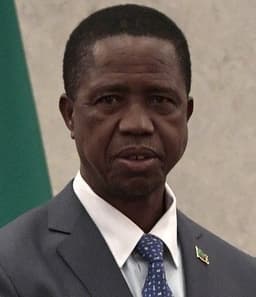
Edgar Lungu
Politician · Modern
44.9Total

Hon Sui Sen
Politician · Modern
54.2Total
Basic Information
Born
1956
1916
Died
—
1983
Era
Modern
Modern
Nationality
Zambia
Singapore
Occupation
Politician
Politician
Civilization
Other
Eastern
Score Comparison
Military (10%)
38.0
16.1
Political (20%)
39.4
72.0
Influence (20%)
47.9
59.0
Legacy (20%)
38.3
52.0
Leadership (15%)
62.2
75.0
Strategy (15%)
42.9
27.7
TOTAL
44.9
54.2
Edgar Lungu — Complete Timeline
2015 AD
Elected President of ZambiaPolitical Action◆ Major
Edgar Lungu won the presidential by-election following the death of President Michael Sata. He defeated Hakainde Hichilema in a close race, becoming the 6th President of Zambia.
ElectionPresidency
Impact: national
2016 AD
Re-elected President of ZambiaPolitical Action◆ Major
Lungu won a full five-year term in the general election, again defeating Hakainde Hichilema. The election was marked by opposition allegations of irregularities and a disputed constitutional court ruling.
ElectionPresidency
Impact: national
2017 AD
Arrested Hakainde HichilemaPolitical Action◆ Major
Lungu's government arrested opposition leader Hakainde Hichilema on charges of treason after his convoy failed to give way to the presidential motorcade. Hichilema was held for several months before the charges were dropped.
Political RepressionOpposition
Impact: nationaldestructive
2021 AD
Lost Presidential Election to HichilemaPolitical Action
Lungu was defeated by Hakainde Hichilema in the general election, receiving 38.3% of the vote against Hichilema's 59%. He conceded defeat, marking the first peaceful transfer of power to an opposition candidate in Zambia since 1991.
ElectionDefeatDemocracy
Impact: national
Hon Sui Sen — Complete Timeline
1968 AD
Established the Development Bank of SingaporeReform◆ Major
Hon Sui Sen played a key role in founding the Development Bank of Singapore to provide long-term industrial financing. The bank became a major financial institution supporting Singapore's industrialization drive.
BankingIndustrial FinanceDevelopment
Impact: nationalconstructive
1970 AD
Served as Singapore's Longest-Serving Finance MinisterPolitical Action◆ Major
Hon Sui Sen served as Minister for Finance from 1970 to 1983, the longest tenure in Singapore's history. He oversaw rapid economic growth, fiscal discipline, and the development of the financial services sector.
Finance MinisterEconomic GrowthFiscal Policy
Impact: nationalconstructive
1973 AD
Oversaw the Creation of the Singapore Stock ExchangeReform◆ Major
Hon Sui Sen oversaw the establishment of the Stock Exchange of Singapore, which replaced the joint exchange with Malaysia. This move strengthened Singapore's capital markets and attracted international investors.
Stock ExchangeCapital MarketsFinance
Impact: globalconstructive
1977 AD
Introduced the Central Provident Fund ReformsReform◆ Major
Hon Sui Sen expanded the Central Provident Fund to include healthcare savings through the Medisave scheme. This reform allowed Singaporeans to use CPF savings for medical expenses, enhancing social security.
HealthcareSocial SecurityCPF
Impact: nationalconstructive
This comparison has not been analyzed yet.
One-time AI generation (~1 minute). Scores and timeline are already available below.
Rankings
🥇
Hon Sui SenLeader
Mil: 16.1Pol: 72.0Inf: 59.0
54.2
🥈
Edgar Lungu
Mil: 38.0Pol: 39.4Inf: 47.9
44.9
+9.3 behind
How This Comparison Works
Algorithm
Each figure is scored on 6 dimensions (0—100 scale) based on structured historical data: Military (10%), Political (20%), Influence (20%), Legacy (20%), Leadership (15%), Strategy (15%). The weighted total produces the final ranking.
Data Sources
Scores are computed from structured sub-indicators in the database. Scale factors adjust for era (Ancient ×0.85, Modern ×1.0) and civilization size (Eastern ×1.05, Other ×0.80) to account for differences in population and military scale.
Maximum 3 Figures
Comparisons are limited to 2—3 figures to ensure readability and statistical meaningfulness.
Error Margins
±5 points per dimension — Sub-scores are derived from historical records with inherent uncertainty. Two figures within 5 points on a dimension should be considered roughly equivalent in that area.
Total Score Accuracy
±3 points overall — The weighted combination of 6 dimensions produces a total score with approximately ±3 points of uncertainty. Differences of less than 3 points are not statistically significant— the figures are effectively tied.
Known Limitations
- Historical records are incomplete and uneven across civilizations
- Figures from oral-tradition societies may be underrepresented
- Occupation labels can misclassify multi-role figures
- Scores measure capability and impact, not moral character
- Quantitative scoring is a comparison tool, not absolute truth
Capability Radar
Military (10%) — Battles & Warfare
Battles
20
17
Win Rate
25
15
Expansion
27
18
Political (20%) — Governance & Reform
Reform
30
85
Diplomacy
35
80
Economy
25
95
Influence (20%) — Cultural & Global Reach
Cultural
15
40
Global
10
55
Legacy (20%) — Historical Impact
Historical
20
70
Longevity
10
60
Leadership (15%) — Power & Stability
Tenure
40
75
Stability
20
90
Strategy (15%) — Tactics & Innovation
Strategy
32
24
Tactics
34
29
Reform
35
29
Similar Comparisons
Comments & Discussion
No comments yet. Be the first to share your thoughts!