Loading...
Eannatum vs Julius Caesar
Julius Caesar leads by 23.1 pts · 2 figures compared
…
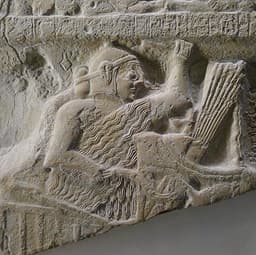
Eannatum
Emperor · Ancient
59.7Total

Julius Caesar
General · Ancient
82.8Total
Basic Information
Born
-2450
-100
Died
-2400
-44
Era
Ancient
Ancient
Nationality
Lagash
Roman Republic
Occupation
Emperor
General
Civilization
Middle Eastern
Western
Score Comparison
Military (10%)
61.7
88.0
Political (20%)
68.0
78.0
Influence (20%)
56.4
85.0
Legacy (20%)
56.0
82.0
Leadership (15%)
68.0
80.0
Strategy (15%)
50.0
85.0
TOTAL
59.7
82.8
Eannatum — Complete Timeline
2450 BC
Victory over Umma at the Boundary CanalWar◆ Major
Eannatum defeated the forces of Umma in a battle near the boundary canal between Lagash and Umma. The victory was commemorated on the Stele of the Vultures, which shows vultures carrying away the heads of the defeated. This established Lagash's dominance over Umma.
BattleUmmaLagash
Creation of the Stele of the VulturesCultural
Eannatum, king of Lagash, commissioned the Stele of the Vultures, the first known historical document. The stele depicts his victory over Umma and records the boundary treaty between the two city-states. It is a key source for early Sumerian warfare and diplomacy.
Historical DocumentSteleSumerian Art
Impact: global
2440 BC
Subjugation of Elam and SubartuWar
Eannatum campaigned against Elam and Subartu, extending Lagash's influence beyond Sumer. Inscriptions record his victories and the tribute he exacted from these regions. This expansion made Lagash a major power in Mesopotamia during his reign.
Military CampaignElamSubartu
Impact: regional
Julius Caesar — Complete Timeline
58 BC
Gallic WarsWar◆ Major
Caesar, as proconsul of Gaul, launched a series of campaigns that conquered all of Gaul (modern France, Belgium, and parts of Switzerland). He fought numerous battles, including against the Helvetii, the Belgae, and the Gallic chieftain Vercingetorix. The wars brought immense wealth and a loyal army to Caesar.
Gallic WarsConquestRoman Expansion
Impact: regional
49 BC
Crossing the RubiconPolitical Action◆ Major
Caesar led Legio XIII across the Rubicon River into Italy, defying the Roman Senate's order to disband his army. This act triggered a civil war against Pompey and the Optimates, ultimately leading to Caesar's dictatorship and the end of the Roman Republic.
Roman Civil WarEnd of RepublicPower Struggle
Impact: global
48 BC
Battle of PharsalusWar◆ Major
Caesar's outnumbered army defeated the larger forces of Pompey the Great at Pharsalus in Greece. Caesar's tactical use of a reserve line to counter Pompey's cavalry charge proved decisive. Pompey fled to Egypt, where he was assassinated, leaving Caesar as the undisputed master of the Roman world.
Roman Civil WarBattleDecisive Victory
Impact: regional
44 BC
Appointment as Dictator for LifePolitical Action◆ Major
The Roman Senate appointed Caesar dictator perpetuo (dictator for life), granting him unprecedented personal power. This move concentrated military, legislative, and judicial authority in one person, effectively ending the Roman Republic's traditional system of checks and balances and alarming many senators.
DictatorshipEnd of RepublicPower Consolidation
Impact: regionaldestructive
Assassination on the Ides of MarchPolitical Action◆ Major
A group of Roman senators, led by Marcus Junius Brutus and Gaius Cassius Longinus, stabbed Caesar to death at a meeting of the Senate in the Theatre of Pompey. The assassination was intended to restore the Republic, but instead triggered another civil war that led to the rise of the Roman Empire.
AssassinationRoman PoliticsEnd of Republic
Impact: globaldestructive
Expert Analysis
eannatum-vs-julius-caesar
# The First Conqueror and the Last Republican
On a spring morning in 44 BCE, Julius Caesar fell beneath sixty dagger strokes in the Senate chamber, his blood pooling on the marble floor where Pompey’s statue once stood. The assassins believed they were saving the Republic. Instead, they sealed its doom. Nearly twenty-four centuries earlier, another conqueror—Eannatum of Lagash—ordered his scribes to carve the first known historical document, a stele that depicted vultures tearing the flesh of his enemies. One man’s story opened the age of recorded history; the other’s closed the age of the Roman Republic. Between them stretches a chasm not merely of time, but of what it means to build and to destroy.
Origins
Eannatum was born around 2450 BCE into a world that had only recently invented writing. The Sumerian city-state of Lagash, nestled between the Tigris and Euphrates, was a patchwork of irrigation canals and mud-brick temples. His people worshipped Ningirsu, the god of war, and their politics were tribal, brutal, and intimate. Eannatum inherited a throne that rested on the loyalty of a few thousand spearmen. His era knew nothing of philosophy, history, or even the concept of a republic—only survival, honor, and the favor of the gods.
Julius Caesar, by contrast, entered a world saturated with Greek thought, Roman law, and two centuries of civil strife. He was born in 100 BCE to a patrician family that had fallen into obscurity. The Roman Republic was already dying, choked by senatorial corruption, landless veterans, and the ambitions of men like Marius and Sulla. Caesar’s uncle by marriage was Marius; his father-in-law was Cinna. From childhood, he understood that power in Rome was won not by birth alone, but by money, rhetoric, and the willingness to break the rules.
Rise to Power
Eannatum’s path was straightforward. As king of Lagash, he faced a perennial enemy: the neighboring city-state of Umma, which had encroached on Lagash’s fertile boundary canal. In a battle near that canal around 2450 BCE, Eannatum led his phalanx of heavy infantry—men armed with long spears and covered in copper helmets—and crushed the Ummaites. The victory was commemorated on the Stele of the Vultures, which shows Eannatum marching at the head of his army, his soldiers trampling the fallen. He did not negotiate; he conquered. Then he turned east, subjugating Elam and Subartu, extending Lagash’s influence beyond Sumer itself. His rise was a matter of military might and divine mandate.
Caesar’s rise was far more intricate. He climbed the *cursus honorum*—the ladder of Roman offices—through a combination of military command, political alliances, and staggering debt. His conquest of Gaul between 58 and 50 BCE was not merely a war; it was a business enterprise. He slaughtered, enslaved, and settled hundreds of thousands of people, amassing wealth that made him the most powerful man in Rome. When the Senate ordered him to disband his army, he crossed the Rubicon River in 49 BCE with a single legion, triggering a civil war. “The die is cast,” he reportedly said. Unlike Eannatum, Caesar did not inherit a throne; he built one from the ruins of a constitution.
Leadership & Governance
As a ruler, Eannatum was a warlord who understood the power of symbols. The Stele of the Vultures is not merely a battlefield trophy; it is a legal document. In its inscriptions, Eannatum defines the boundary between Lagash and Umma, invokes the gods as witnesses, and curses anyone who dares to cross it. This was governance by divine decree, etched in stone. He reformed nothing, built no new institutions, and left no philosophy. His legacy was a boundary line and a monument.
Caesar governed with a radically different vision. As dictator, he reformed the calendar, granted citizenship to provincials, established colonies for veterans, and initiated public works that employed the urban poor. He centralized power in his own hands but never abolished the Senate—he simply filled it with his supporters. His reforms were aimed at solving the Republic’s structural problems: landlessness, debt, and corruption. Yet he also behaved like a king, accepting a golden chair and a statue among the gods. The Senate, stripped of real power, turned to daggers.
Triumph & Tragedy
Eannatum’s greatest triumph was the Battle of the Boundary Canal, where he secured Lagash’s water supply and carved his name into history. His tragedy is that we know almost nothing else. He died around 2400 BCE, probably in battle or of old age, and his kingdom soon faded into the shadow of Akkad. His stele survived, but his dynasty did not. The first conqueror left a monument, not an empire.
Caesar’s triumph was the conquest of Gaul, a feat that doubled Rome’s territory and made him immortal. His tragedy was the Ides of March. He was stabbed to death in 44 BCE by men he had pardoned, including Brutus, whom he had treated like a son. “*Et tu, Brute?*” the legend says—though the real Caesar likely died in silence. His assassination did not restore the Republic; it unleashed another civil war, and his adopted heir Octavian became Augustus, the first emperor. Caesar’s tragedy was that his ambition destroyed the very system he sought to master.
Character & Destiny
Eannatum was a man of his time: religious, ruthless, and parochial. He saw the world in terms of city-states and gods, not continents and philosophies. His personality is opaque to us, visible only through the vultures on his stele and the curses he carved. He believed in the permanence of stone.
Caesar was a man of the future: secular, strategic, and universal. He wrote his own commentaries, cultivated his image, and understood that power in a literate society required narrative control. He gambled constantly, from the pirates who captured him as a young man (he told them he would crucify them, and did) to the civil war that staked everything on a single crossing of a river. His character was his destiny: magnanimous in victory, arrogant in power, careless in security.
Legacy
Eannatum’s legacy is the Stele of the Vultures, the first historical document. It marks the moment when human beings decided to record their deeds for posterity. Every historian since owes a debt to that impulse. But his political legacy is zero. No one today invokes the king of Lagash as a model of governance.
Caesar’s legacy is the Roman Empire, and through it, the entire Western world. His name became a title: *Kaiser* in German, *Tsar* in Russian. His reforms shaped law, language, and administration for two millennia. He is remembered as a tyrant by republicans and as a genius by realists. The question he posed—can a republic survive its own success?—remains unanswered.
Conclusion
Standing at the boundary canal of Lagash, Eannatum carved his victory into stone so that no one would forget. Standing at the Rubicon, Caesar crossed a river and dared the world to remember. One man invented history; the other became it. Their differences are not merely of scale but of kind: the first conqueror fought for a city, the last republican for an empire of the mind. In the end, both were destroyed by what they built. Eannatum’s stele survives, but his city is dust. Caesar’s empire fell, but his name still echoes. Perhaps the true measure of a leader is not whether he wins, but whether he leaves behind a question that later ages cannot escape.
Rankings
🥇
Julius CaesarLeader
Mil: 88.0Pol: 78.0Inf: 85.0
82.8
🥈
Eannatum
Mil: 61.7Pol: 68.0Inf: 56.4
59.7
+23.1 behind
How This Comparison Works
Algorithm
Each figure is scored on 6 dimensions (0—100 scale) based on structured historical data: Military (10%), Political (20%), Influence (20%), Legacy (20%), Leadership (15%), Strategy (15%). The weighted total produces the final ranking.
Data Sources
Scores are computed from structured sub-indicators in the database. Scale factors adjust for era (Ancient ×0.85, Modern ×1.0) and civilization size (Eastern ×1.05, Other ×0.80) to account for differences in population and military scale.
Maximum 3 Figures
Comparisons are limited to 2—3 figures to ensure readability and statistical meaningfulness.
Error Margins
±5 points per dimension — Sub-scores are derived from historical records with inherent uncertainty. Two figures within 5 points on a dimension should be considered roughly equivalent in that area.
Total Score Accuracy
±3 points overall — The weighted combination of 6 dimensions produces a total score with approximately ±3 points of uncertainty. Differences of less than 3 points are not statistically significant— the figures are effectively tied.
Known Limitations
- Historical records are incomplete and uneven across civilizations
- Figures from oral-tradition societies may be underrepresented
- Occupation labels can misclassify multi-role figures
- Scores measure capability and impact, not moral character
- Quantitative scoring is a comparison tool, not absolute truth
Capability Radar
Military (10%) — Battles & Warfare
Battles
65
95
Win Rate
70
92
Expansion
60
97
Political (20%) — Governance & Reform
Reform
45
90
Diplomacy
50
85
Economy
40
82
Influence (20%) — Cultural & Global Reach
Cultural
55
88
Global
45
94
Legacy (20%) — Historical Impact
Historical
70
95
Longevity
60
96
Leadership (15%) — Power & Stability
Tenure
55
75
Stability
50
60
Strategy (15%) — Tactics & Innovation
Strategy
65
94
Tactics
60
96
Reform
40
88
Similar Comparisons
Comments & Discussion
No comments yet. Be the first to share your thoughts!