Loading...
Dutugamunu vs Napoleon Bonaparte
Napoleon Bonaparte leads by 15.9 pts · 2 figures compared
…
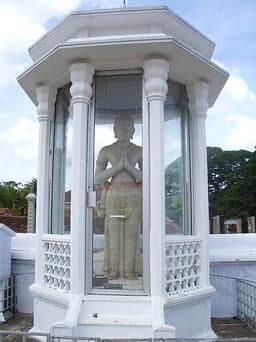
Dutugamunu
Emperor · Ancient
55.0Total

Napoleon Bonaparte
General · Modern
70.9Total
Basic Information
Born
-161
1769
Died
-137
1821
Era
Ancient
Modern
Nationality
Sri Lanka
France
Occupation
Emperor
General
Civilization
Indian
Western
Score Comparison
Military (10%)
63.3
94.0
Political (20%)
48.0
72.0
Influence (20%)
54.1
40.0
Legacy (20%)
49.2
80.0
Leadership (15%)
71.0
78.0
Strategy (15%)
50.0
90.0
TOTAL
55.0
70.9
Dutugamunu — Complete Timeline
161 BC
Defeated King Elara at the Battle of VijithapuraWar
Dutugamunu defeated the Tamil king Elara in a decisive battle at Vijithapura, ending Elara's 44-year rule over Anuradhapura. The victory unified the island under Sinhalese rule and is celebrated as a heroic achievement in Sri Lankan history.
BattleUnificationElara
Impact: regionalconstructive
Unified Sri Lanka under One RulePolitical Action◆ Major
After defeating Elara, Dutugamunu unified the entire island of Sri Lanka under his rule for the first time. He established his capital at Anuradhapura and consolidated his control over the northern and southern regions.
UnificationAnuradhapuraSinhalese Rule
Impact: regionalconstructive
150 BC
Constructed the Mirisaveti StupaCultural
Dutugamunu built the Mirisaveti Stupa in Anuradhapura after his victory over Elara. The stupa was built on the site where he planted his spear, which was believed to contain a relic of the Buddha. It became an important religious monument.
StupaVictory MonumentBuddhist Relic
Impact: regionalconstructive
Commissioned the Lovamahapaya (Brazen Palace)Cultural
Dutugamunu commissioned the construction of the Lovamahapaya, a nine-story monastic building in Anuradhapura. The structure was built for Buddhist monks and was covered with bronze tiles, giving it the name 'Brazen Palace'. It served as a major center for Buddhist learning.
Monastic BuildingBuddhist LearningAnuradhapura
Impact: regionalconstructive
140 BC
Built the Ruwanwelisaya StupaCultural◆ Major
Dutugamunu built the Ruwanwelisaya Stupa in Anuradhapura, one of the largest and most revered stupas in Sri Lanka. The stupa was constructed to enshrine relics of the Buddha and became a major center of Buddhist worship.
StupaBuddhist ArchitectureAnuradhapura
Impact: regionalconstructive
Napoleon Bonaparte — Complete Timeline
1799 AD
Coup of 18 BrumaireOther◆ Major
Napoleon Bonaparte, with support from his brother Lucien and key political figures, overthrew the Directory in a bloodless coup. He established the Consulate with himself as First Consul, effectively becoming the ruler of France. This event ended the French Revolution's most unstable period.
French RevolutionCoupRise to Power
Impact: regional
1804 AD
Promulgation of the Napoleonic CodeOther◆ Major
Napoleon enacted the Civil Code of the French, known as the Napoleonic Code, a comprehensive set of laws that replaced the fragmented feudal legal systems. The code established legal equality, protected property rights, and secularized law. It became the basis for legal systems in many European and world countries.
Legal ReformNapoleonic CodeCivil Law
Impact: globalconstructive
1805 AD
Battle of AusterlitzWar◆ Major
Napoleon's Grande Arm
Napoleonic WarsBattleDecisive Victory
Impact: global
1812 AD
Invasion of RussiaWar◆ Major
Napoleon led the Grande Arm
Napoleonic WarsInvasionDisaster
Impact: globaldestructive
1815 AD
Battle of WaterlooWar◆ Major
Napoleon's French army was defeated by the combined forces of the Duke of Wellington's Anglo-Allied army and Gebhard Leberecht von Bl
Napoleonic WarsBattleFinal Defeat
Impact: globaldestructive
Expert Analysis
dutugamunu-vs-napoleon-bonaparte
# The Emperor and the King: Napoleon Bonaparte and Dutugamunu
A Question of Scale
One stands at the edge of a battlefield in Belgium, watching his empire crumble in a single June afternoon. The other kneels before a gleaming white stupa, his life's work etched in stone and prayer. Napoleon Bonaparte and Dutugamunu never met, never could have met—they lived two thousand years and half a world apart. Yet both men took up the sword to unify fractured lands, and both left monuments that outlasted their bodies. The question is not who was greater—that is a child's game—but what drove them, and why their paths diverged so sharply.
Origins
Napoleon was born in 1769 on Corsica, an island that had just been sold to France by Genoa. His family was minor nobility, proud and poor. He spoke Italian before French, and throughout his life carried a sense of being an outsider. The French Revolution, which erupted when he was twenty, shattered the old order and created a vacuum that a brilliant young officer could fill. Napoleon's era was one of chaos and opportunity—a world being remade by gunpowder and ideology.
Dutugamunu was born in 161 BCE in the ancient kingdom of Ruhuna, in what is now southern Sri Lanka. His father was King Kavantissa, his mother Queen Viharamahadevi, a woman of legend who had been sent to sea as a sacrifice and miraculously returned. Dutugamunu grew up in a world of dharma and war, where kings were judged by their patronage of Buddhism and their ability to protect the faith. Unlike Napoleon, he inherited a throne—but a contested one. The northern capital of Anuradhapura had been ruled for forty-four years by Elara, a Tamil king from the Chola dynasty who, though just in his own way, was a foreigner to the Sinhalese people.
Rise to Power
Napoleon's ascent was meteoric and ruthless. At twenty-four, he drove the British out of Toulon. At twenty-six, he crushed a royalist uprising in Paris with a "whiff of grapeshot." At twenty-seven, he was given command of the Army of Italy, where he transformed starving, mutinous troops into a conquering force. He was not a product of birth but of talent and timing—the Revolution had killed the old generals, and the Directory needed victories. Each success gave him more power, more men, more glory. He was, in the words of one contemporary, "a man who believes he is destined to overturn everything."
Dutugamunu's rise was slower, more traditional, and bound by duty. As a young prince, he was said to have refused his father's command to make peace with Elara, declaring that he would not sleep on the same pillow as the Tamil king. When his father died, Dutugamunu assembled an army—including a corps of elephants trained for war—and marched north. His turning point came at the Battle of Vijithapura in 161 BCE, where he faced Elara in single combat on elephant-back. He killed the old king, and with that single stroke, ended forty-four years of foreign rule. The chronicle *Mahavamsa* records that Dutugamunu wept at Elara's funeral, ordering a monument built for his fallen enemy—a gesture of respect that Napoleon, who exiled his enemies to remote islands, would have found incomprehensible.
Leadership & Governance
Napoleon governed through genius and terror. He reformed French law with the Napoleonic Code, which abolished feudalism, guaranteed religious freedom, and established meritocracy—principles that spread across Europe. He built roads, standardized education, and created the Bank of France. But he also censored the press, reestablished slavery in the colonies, and crowned himself Emperor in 1804, betraying the Revolution that had made him. His military brilliance was unmatched: at Austerlitz in 1805, he destroyed a combined Austrian and Russian army with a feigned retreat that remains a textbook maneuver. But he could not stop. Victory demanded more victory, conquest demanded more conquest.
Dutugamunu ruled as a Buddhist king, which meant his legitimacy came from protecting the Sangha—the monastic community. After unifying Sri Lanka, he did not expand outward but inward: he built the Mirisaveti Stupa in 150 BCE, the Lovamahapaya (Brazen Palace), and finally the Ruwanwelisaya Stupa, one of the largest monuments in the ancient world. His governance was about consolidation, not expansion. He did not seek to conquer India or beyond. He sought to make Anuradhapura a center of Buddhist civilization, a city of white stupas that would draw pilgrims for millennia. His military score of 60.1 reflects a commander who fought one great battle, not a hundred campaigns.
Triumph & Tragedy
Napoleon's greatest moment was Austerlitz, where the sun rose over a frozen battlefield and he crushed two empires. His greatest tragedy was the invasion of Russia in 1812, where he lost half a million men to winter, hunger, and guerrilla attacks—a disaster from which he never recovered. He was exiled to Elba, escaped, raised another army, and met his final defeat at Waterloo in 1815. He died six years later on Saint Helena, a British prisoner, dictating his memoirs and insisting he had been a liberator, not a tyrant.
Dutugamunu's triumph was the unification of Sri Lanka and the building of the Ruwanwelisaya, a stupa said to be 300 feet high. His tragedy was subtler: the *Mahavamsa* records that he felt remorse for the lives lost in his war against Elara. Buddhist monks comforted him by saying that he had killed only one and a half people—one who had taken refuge in the Three Jewels, and one who had not. The king was tormented by the bloodshed his unification required. He died in 137 BCE, before his greatest stupa was completed, and legend says the gods finished it in a single night.
Character & Destiny
Napoleon was driven by ambition without limit. "Impossible is a word to be found only in the dictionary of fools," he said. He believed he could shape history by sheer will, and for a time, he did. But his personality—arrogant, restless, unable to delegate—led him to overreach. He conquered Europe but could not hold it. His character was his destiny: a man who could win any battle except the one against his own hunger for more.
Dutugamunu was driven by duty and faith. He fought because his religion and his people required it, not because he loved war. His character was defined by remorse and devotion. He built stupas, not empires. His destiny was to be remembered not as a conqueror but as a unifier and a builder—a king who brought the island together under the dharma.
Legacy
Napoleon's legacy is written in law codes, military academies, and the borders of modern Europe. He is studied in every war college, debated in every history department. His name is synonymous with genius and hubris. But his empire died with him.
Dutugamunu's legacy is written in stone that still stands. The Ruwanwelisaya Stupa is a pilgrimage site today, more than two thousand years after his death. He is a national hero in Sri Lanka, a symbol of Sinhalese identity and Buddhist pride. His unification of the island has shaped political and ethnic tensions that persist into the present. He left no empire, but he left a civilization.
The Silence of the Stupas
Napoleon's last words were about France, his army, and his son. Dutugamunu's last words, according to the chronicles, were about the Ruwanwelisaya: "I have built the Great Stupa. Let those who wish to see it go and see it."
One man tried to conquer the world and failed. The other tried to build a monument to his faith and succeeded. Both were warriors. Both were kings. But they understood power differently: Napoleon saw it as something to be seized; Dutugamunu saw it as something to be used. In the end, the emperor's bones lie in a Parisian tomb, visited by tourists. The king's stupa still rises above the Sri Lankan plain, white as a cloud, silent as prayer.
Rankings
🥇
Napoleon BonaparteLeader
Mil: 94.0Pol: 72.0Inf: 40.0
70.9
🥈
Dutugamunu
Mil: 63.3Pol: 48.0Inf: 54.1
55.0
+15.9 behind
How This Comparison Works
Algorithm
Each figure is scored on 6 dimensions (0—100 scale) based on structured historical data: Military (10%), Political (20%), Influence (20%), Legacy (20%), Leadership (15%), Strategy (15%). The weighted total produces the final ranking.
Data Sources
Scores are computed from structured sub-indicators in the database. Scale factors adjust for era (Ancient ×0.85, Modern ×1.0) and civilization size (Eastern ×1.05, Other ×0.80) to account for differences in population and military scale.
Maximum 3 Figures
Comparisons are limited to 2—3 figures to ensure readability and statistical meaningfulness.
Error Margins
±5 points per dimension — Sub-scores are derived from historical records with inherent uncertainty. Two figures within 5 points on a dimension should be considered roughly equivalent in that area.
Total Score Accuracy
±3 points overall — The weighted combination of 6 dimensions produces a total score with approximately ±3 points of uncertainty. Differences of less than 3 points are not statistically significant— the figures are effectively tied.
Known Limitations
- Historical records are incomplete and uneven across civilizations
- Figures from oral-tradition societies may be underrepresented
- Occupation labels can misclassify multi-role figures
- Scores measure capability and impact, not moral character
- Quantitative scoring is a comparison tool, not absolute truth
Capability Radar
Military (10%) — Battles & Warfare
Battles
60
95
Win Rate
75
90
Expansion
55
95
Political (20%) — Governance & Reform
Reform
45
95
Diplomacy
40
80
Economy
35
85
Influence (20%) — Cultural & Global Reach
Cultural
55
85
Global
30
90
Legacy (20%) — Historical Impact
Historical
60
95
Longevity
55
90
Leadership (15%) — Power & Stability
Tenure
50
85
Stability
40
70
Strategy (15%) — Tactics & Innovation
Strategy
70
95
Tactics
65
98
Reform
30
92
Similar Comparisons
Comments & Discussion
CorsicaConqueror6/17/2026
Scale matters here, and it’s not even close. Napoleon fought across three continents, reformed law across Europe, and his shadow lasted centuries for Europe and the Americas. Dutugamunu fought a few guerrilla engagements in one jungle kingdom. One unified a subcontinent, the other built a stupa. Call it cultural bias if you want, but Napoleon reshaped the modern world, while Dutugamunu only reshaped Sri Lanka.
数据暴君6/17/2026
现代历史学把“伟大”和“被记得”混为一谈。拿破仑输了滑铁卢就逃跑,然后在圣赫勒拿岛花六年写回忆录,这更像是公关专家而非统帅。杜图加穆努的记录来自《大史》,是僧侣写的赞歌,不是瑞典炮兵军官的日记。如果我们只看数字——控制领土面积、军队规模和推进速度——拿破仑碾压,但这不叫历史,这叫计量学考试。
DharmaArrow6/17/2026
From a martial tradition perspective, Dutugamunu’s triumph at Vijithapura was a decisive siege that broke Elara’s 44-year rule, using war elephants and psychological warfare against a Tamil king who himself was a just ruler. Napoleon’s best victories—Austerlitz, Jena—came against crumbling coalitions, not entrenched power. Dutugamunu fought a mortal enemy directly, Napoleon exploited a dying system. The Sinhalese king had more at stake: his entire kingdom’s survival, not just his ambition.
竹简考据6/17/2026
《大史》记载杜图加穆努修建的鲁万维利萨亚佛塔高55米,而拿破仑建造的凯旋门高49米——技术上矮了点,但凯旋门有税基和殖民地补贴支撑。区别在于意图:拿破仑搞建筑是为了纪念军功,杜图加穆努为了供养僧伽。一个是帝国广告牌,一个是宗教承诺。当你比较这两座建筑时,你比较的是两个截然不同的文明优先顺序。
HerringboneGeneral6/17/2026
Let’s get real: Napoleon lost his army twice—in Russia and at Waterloo. He started twelve wars, bankrupted France, and died in exile on a British rock. Dutugamunu died in his capital, having built a religious center that stands today. One wrote his name in blood across a continent, the other in stone across a generation. I know who I’d rather have as a king, and it’s not the one who got exiled and called it "history."