Loading...
Du Yu vs Tariq ibn Ziyad
Du Yu leads by 1.1 pts · 2 figures compared
…
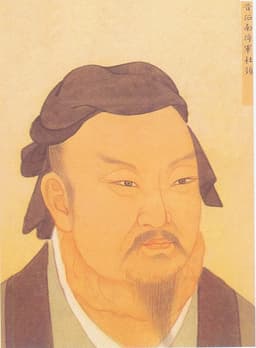
Du Yu
General · Ancient
56.8Total

Tariq ibn Ziyad
General · Ancient
55.7Total
Basic Information
Born
222
-670
Died
285
—
Era
Ancient
Ancient
Nationality
China
Umayyad Caliphate
Occupation
General
General
Civilization
Eastern
Middle Eastern
Score Comparison
Military (10%)
77.5
77.5
Political (20%)
43.7
32.2
Influence (20%)
53.3
61.0
Legacy (20%)
47.5
58.0
Leadership (15%)
65.0
43.8
Strategy (15%)
75.0
68.1
TOTAL
56.8
55.7
Du Yu — Complete Timeline
279 AD
Appointed as commander of the Jin invasion of WuPolitical Action◆ Major
Du Yu was appointed as the overall commander of the Jin forces for the invasion of Eastern Wu, following Yang Hu's recommendation. He was given command of the central army group.
Jin DynastyEastern WuMilitary Command
Impact: nationalconstructive
280 AD
Led the conquest of Eastern WuWar
Du Yu's forces captured key Wu cities, including Jiangling, and advanced toward the Wu capital Jianye. The campaign culminated in the surrender of Wu's emperor Sun Hao, ending the Three Kingdoms period.
Conquest of WuJin DynastyUnification
Impact: globalconstructive
Authored the 'Commentary on the Spring and Autumn Annals'Cultural◆ Major
Du Yu wrote a comprehensive commentary on the Confucian classic 'Spring and Autumn Annals', which became a standard reference for later scholars. His work influenced Chinese historiography.
ScholarshipConfucianismHistoriography
Impact: nationalconstructive
Tariq ibn Ziyad — Complete Timeline
711 AD
Battle of GuadaleteWar
Tariq ibn Ziyad led a Berber army across the Strait of Gibraltar and defeated the Visigothic King Roderic at the Battle of Guadalete. This victory opened the way for the Islamic conquest of the Iberian Peninsula, marking the beginning of Al-Andalus.
Islamic ConquestAl-AndalusVisigothic Kingdom
Impact: global
Capture of ToledoWar◆ Major
After the Battle of Guadalete, Tariq ibn Ziyad's forces captured Toledo, the Visigothic capital, without significant resistance. This secured the central Iberian Peninsula for the Umayyad Caliphate and facilitated further conquests.
Islamic ConquestAl-AndalusToledo
Impact: regional
Burning of the ShipsWar
According to legend, Tariq ibn Ziyad ordered his ships burned upon landing in Spain to motivate his troops to fight or die. This story, though disputed, symbolizes his determination and is a key part of his legacy.
LegendMotivationConquest
Impact: regional
712 AD
Recall to DamascusPolitical Action
After his initial conquests, Tariq ibn Ziyad was recalled to Damascus by the Umayyad caliph al-Walid I, possibly due to tensions with his superior Musa ibn Nusayr. He spent the remainder of his life in obscurity, with no further military commands.
Umayyad CaliphateRecallEnd of Career
Impact: regional
Expert Analysis
Origins
Du Yu (222-284 AD) was born into a scholarly family in the State of Wei during the Three Kingdoms period. His grandfather Du Ji served as a senior official, and his father Du Shu was a governor. Du Yu received a Confucian education and showed early aptitude for both civil and military affairs. He began his career as a minor official in the Wei bureaucracy, eventually rising to become a key strategist for the Jin dynasty.
Tariq ibn Ziyad (c. 670-720 AD) was a Berber Muslim commander from North Africa. His exact birth date is uncertain, but he likely came from a Berber tribe in the region of present-day Algeria or Morocco. He converted to Islam and joined the Umayyad army, serving under Musa ibn Nusayr, the governor of Ifriqiya. His early military experience included campaigns against the Berbers and the Byzantine Empire.
Rise to Power
Du Yu's rise came through his association with Sima Zhao, the regent of Wei. He served as a military advisor and participated in campaigns against Shu Han in 263 AD. After the Jin dynasty was established in 265 AD, Du Yu was appointed as a regional commander. His major opportunity came when Yang Hu, the architect of the plan to conquer Eastern Wu, recommended Du Yu as his successor. In 278 AD, Du Yu was appointed as the commander of the Jin invasion of Wu.
Tariq ibn Ziyad rose to prominence as a subordinate of Musa ibn Nusayr. In 711 AD, Musa sent Tariq with a small force of about 7,000 Berbers to raid the southern coast of Hispania. Taking advantage of internal Visigothic conflicts, Tariq landed at Gibraltar (named after him, Jabal Tariq) and defeated King Roderic at the Battle of Guadalete in July 711. This victory opened the way for the rapid conquest of the Visigothic kingdom.
Leadership & Governance
Du Yu's leadership style combined meticulous planning with decisive action. During the Wu campaign, he coordinated multiple army groups and used deception to confuse the enemy. He also implemented effective logistics, ensuring supplies reached his troops. After the conquest, Du Yu was appointed as governor of the conquered territories and worked to integrate Wu into the Jin Empire. He reduced taxes and promoted Confucian education, scoring 65.0 in leadership.
Tariq ibn Ziyad's leadership was charismatic and inspirational. The legendary burning of the ships—though historically disputed—illustrates his psychological acumen: by removing the option of retreat, he forced his troops to fight with maximum commitment. He also employed effective combined-arms tactics, using light cavalry and infantry in coordination. However, his political skills were weaker, scoring 32.2, as evidenced by his recall to Damascus after conflicts with Musa.
Triumph & Tragedy
Du Yu's greatest triumph was the successful conquest of Eastern Wu in 280 AD, which unified China under the Jin dynasty. He captured key cities like Jiangling and advanced to the capital Jianye, leading to the surrender of the Wu emperor. His commentary on the Spring and Autumn Annals became a standard reference for centuries. However, his political influence waned after the conquest, and he died in 284 AD, before seeing the full consequences of the Jin reunification, which eventually led to the War of the Eight Princes.
Tariq ibn Ziyad's triumph was the rapid conquest of most of Hispania (711-714 AD), establishing Umayyad rule that lasted for centuries. The victory at Guadalete and capture of Toledo were pivotal. His tragedy was his recall to Damascus and subsequent obscurity. He was sidelined by Musa and the caliph, and his later life is poorly documented. He scored 77.5 in military but only 43.8 in leadership, reflecting his inability to navigate court politics.
Character & Destiny
Du Yu was a methodical strategist who valued careful planning. He wrote extensively on military and Confucian texts, showing a scholarly bent. His character led him to prioritize long-term stability over personal glory. This allowed him to complete the conquest but limited his post-war influence. Historical assessments note his integrity and competence.
Tariq ibn Ziyad was bold and decisive, willing to take enormous risks. The ship-burning story, whether true or not, captures his ethos. His character inspired loyalty among his Berber troops but also created friction with Arab superiors. His destiny was shaped by his inability to manage his relationship with Musa, leading to his recall.
Legacy
Du Yu's legacy is twofold: as the general who unified China and as a scholar who contributed to Confucian classics. His military campaign is studied for its logistical and strategic brilliance. The Jin unification, however, was short-lived, and his personal influence faded. He scored 47.5 in legacy.
Tariq ibn Ziyad's legacy is more enduring. He is a national hero in Morocco and the broader Islamic world. The name Gibraltar (Jabal Tariq) commemorates his landing. His conquest initiated 800 years of Muslim rule in Spain, profoundly shaping European history. He scored 58.0 in legacy.
Conclusion
While Du Yu achieved a more complete and strategically sound conquest, Tariq ibn Ziyad's impact was more transformative and long-lasting. Du Yu's unification of China was reversed within decades due to internal strife, whereas Tariq's conquest permanently altered the course of Spanish and European history. Tariq ibn Ziyad had greater overall impact, despite scoring slightly lower in total (55.7 vs 56.8). His military and political achievements, though less methodical, had far-reaching consequences that persist in cultural memory. Therefore, Tariq ibn Ziyad is the more significant figure in world history.
Rankings
🥇
Du YuLeader
Mil: 77.5Pol: 43.7Inf: 53.3
56.8
🥈
Tariq ibn Ziyad
Mil: 77.5Pol: 32.2Inf: 61.0
55.7
+1.1 behind
How This Comparison Works
Algorithm
Each figure is scored on 6 dimensions (0—100 scale) based on structured historical data: Military (10%), Political (20%), Influence (20%), Legacy (20%), Leadership (15%), Strategy (15%). The weighted total produces the final ranking.
Data Sources
Scores are computed from structured sub-indicators in the database. Scale factors adjust for era (Ancient ×0.85, Modern ×1.0) and civilization size (Eastern ×1.05, Other ×0.80) to account for differences in population and military scale.
Maximum 3 Figures
Comparisons are limited to 2—3 figures to ensure readability and statistical meaningfulness.
Error Margins
±5 points per dimension — Sub-scores are derived from historical records with inherent uncertainty. Two figures within 5 points on a dimension should be considered roughly equivalent in that area.
Total Score Accuracy
±3 points overall — The weighted combination of 6 dimensions produces a total score with approximately ±3 points of uncertainty. Differences of less than 3 points are not statistically significant— the figures are effectively tied.
Known Limitations
- Historical records are incomplete and uneven across civilizations
- Figures from oral-tradition societies may be underrepresented
- Occupation labels can misclassify multi-role figures
- Scores measure capability and impact, not moral character
- Quantitative scoring is a comparison tool, not absolute truth
Capability Radar
Military (10%) — Battles & Warfare
Battles
70
75
Win Rate
85
80
Expansion
75
85
Political (20%) — Governance & Reform
Reform
55
30
Diplomacy
60
60
Economy
50
35
Influence (20%) — Cultural & Global Reach
Cultural
40
65
Global
30
60
Legacy (20%) — Historical Impact
Historical
55
70
Longevity
40
65
Leadership (15%) — Power & Stability
Tenure
65
40
Stability
55
40
Strategy (15%) — Tactics & Innovation
Strategy
80
80
Tactics
75
85
Reform
60
30
Similar Comparisons
Comments & Discussion
No comments yet. Be the first to share your thoughts!