Loading...
Droupadi Murmu vs Mikhail Gorbachev
Mikhail Gorbachev leads by 14.0 pts · 2 figures compared
…
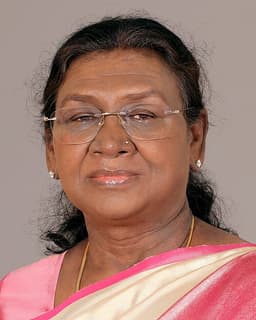
Droupadi Murmu
Politician · Modern
45.8Total

Mikhail Gorbachev
Politician · Modern
59.8Total
Basic Information
Born
1958
1931
Died
—
—
Era
Modern
Modern
Nationality
India
Russia
Occupation
Politician
Politician
Civilization
Indian
Western
Score Comparison
Military (10%)
21.4
10.0
Political (20%)
36.5
70.3
Influence (20%)
56.4
68.0
Legacy (20%)
42.5
65.0
Leadership (15%)
62.2
74.0
Strategy (15%)
41.1
38.6
TOTAL
45.8
59.8
Droupadi Murmu — Complete Timeline
2000 AD
Served as a minister in the Odisha governmentPolitical Action
Murmu served as a minister in the Odisha state government, holding portfolios including Fisheries and Animal Resources. She was one of the few tribal women in the state cabinet.
State MinisterOdishaTribal Politics
Impact: regionalconstructive
Elected to the Odisha Legislative AssemblyPolitical Action
Murmu was elected to the Odisha Legislative Assembly from the Rairangpur constituency. She served two terms, focusing on development issues in her tribal-dominated constituency.
MLAOdisha AssemblyTribal Constituency
constructive
2015 AD
Served as Governor of JharkhandPolitical Action
Murmu was appointed Governor of Jharkhand, the first woman to hold the office in the state. She served until her election as President, focusing on tribal welfare and education.
GovernorJharkhandTribal Welfare
Impact: regionalconstructive
2022 AD
Elected President of IndiaPolitical Action◆ Major
Murmu was elected as the 15th President of India, becoming the first tribal person and the second woman to hold the office. Her election was hailed as a milestone for tribal representation and gender equality.
PresidencyTribal RepresentationGender Equality
Impact: nationalconstructive
Mikhail Gorbachev — Complete Timeline
1985 AD
Became General Secretary of the Communist Party of the Soviet UnionPolitical Action◆ Major
On March 11, 1985, Mikhail Gorbachev was elected General Secretary of the Communist Party of the Soviet Union, succeeding Konstantin Chernenko. This position made him the de facto leader of the USSR, and he immediately began advocating for reforms to address economic stagnation and political corruption.
Soviet UnionLeadershipReform
Impact: global
1986 AD
Introduced GlasnostReform◆ Major
In 1986, Gorbachev introduced glasnost, a policy of openness and transparency in government institutions and media. This allowed for public discussion of previously taboo topics, criticism of officials, and the release of political prisoners, but also fueled nationalist movements and demands for independence in Soviet republics.
GlasnostOpennessPolitical Reform
Impact: globalconstructive
Introduced PerestroikaOther◆ Major
In 1986, Gorbachev launched perestroika, a series of economic reforms aimed at restructuring the Soviet economy by introducing elements of market mechanisms and decentralization. The reforms sought to increase efficiency and productivity but led to economic disruption and shortages, contributing to the eventual collapse of the Soviet system.
PerestroikaEconomic ReformSoviet Union
Impact: global
1987 AD
Signed the Intermediate-Range Nuclear Forces TreatyOther◆ Major
On December 8, 1987, Gorbachev and U.S. President Ronald Reagan signed the Intermediate-Range Nuclear Forces (INF) Treaty in Washington, D.C. This treaty eliminated an entire class of nuclear missiles (land-based intermediate-range) and marked a major step in ending the Cold War arms race.
Cold WarNuclear DisarmamentArms Control
Impact: globalconstructive
1991 AD
Resigned as President of the Soviet UnionOther◆ Major
On December 25, 1991, Gorbachev resigned as President of the Soviet Union, acknowledging the dissolution of the USSR into 15 independent republics. His resignation followed the failed August 1991 coup by hardliners and the declaration of independence by several republics, ending 74 years of Soviet rule.
Soviet CollapseEnd of Cold WarResignation
Impact: globaldestructive
Expert Analysis
Origins
Droupadi Murmu was born on June 20, 1958, in the Santhal tribal community in Odisha, India. Her father, Biranchi Narayan Tudu, was a farmer. She studied at the local government school and later earned a BA degree from Ramadevi Women's College in Bhubaneswar. Her early life was marked by poverty and the challenges of being a tribal woman in a hierarchical society. She worked as a junior assistant in the Odisha government's irrigation department before entering politics.
Mikhail Gorbachev was born on March 2, 1931, in Privolnoye, Stavropol Krai, Russian SFSR, into a peasant family. His father was a combine operator. Gorbachev studied law at Moscow State University, graduating in 1955. He joined the Communist Party in 1952 and quickly rose through the ranks. His early career included work in the Komsomol and as First Secretary of the Stavropol Regional Committee.
Rise to Power
Murmu entered politics in 1997 when she was elected as a councilor in Rairangpur. In 2000, she became a minister in the Odisha government under the Biju Janata Dal-BJP coalition, handling Fisheries and Animal Resources, and later Transport and Commerce. She was elected to the Odisha Legislative Assembly in 2000 and 2004. In 2015, she was appointed Governor of Jharkhand, the first woman to hold that office. Her tenure was noted for her focus on tribal welfare and education. In 2022, she was nominated as the presidential candidate of the National Democratic Alliance and won, becoming the first tribal President of India.
Gorbachev's rise was meteoric within the Soviet system. He became a member of the Politburo in 1980 and was appointed General Secretary of the Communist Party on March 11, 1985, succeeding Konstantin Chernenko. He was the first Soviet leader born after the Russian Revolution. His rise was aided by his youth, energy, and reformist ideas, which appealed to a party seeking change after a period of stagnation under Brezhnev.
Leadership & Governance
As President of India, Murmu holds a largely ceremonial role with limited executive power. She has emphasized issues of tribal rights, women's empowerment, and education. Her leadership style is that of a figurehead who uses her position to highlight social causes. She has been praised for her dignity and accessibility. In contrast, Gorbachev wielded substantial power as General Secretary and later as President of the Soviet Union. He introduced perestroika (restructuring) and glasnost (openness) in 1986, reforms that aimed to revitalize the Soviet economy and political system. Perestroika decentralized economic decision-making and allowed limited market mechanisms, while glasnost increased freedom of speech and press. These policies inadvertently accelerated the unraveling of the Soviet bloc.
Triumph & Tragedy
Murmu's greatest triumph is her election as President, symbolizing the empowerment of India's tribal communities. She has used her office to promote education for tribal children and to advocate for the rights of marginalized groups. Her tragedy lies in personal losses: she lost her husband and two sons in quick succession, showing resilience in the face of grief. Her political impact is limited by the ceremonial nature of her office.
Gorbachev's triumphs include ending the Cold War, signing the Intermediate-Range Nuclear Forces Treaty in 1987 with Ronald Reagan, and allowing the peaceful dissolution of the Soviet Union without massive bloodshed. He also withdrew Soviet troops from Afghanistan. His tragedy is that his reforms led to the collapse of the Soviet state, economic turmoil, and a loss of superpower status. He is blamed by many Russians for the ensuing chaos and decline. In terms of scores, Gorbachev's political score is 70.3 compared to Murmu's 36.5, reflecting his direct impact on global politics.
Character & Destiny
Murmu is known for her humility, resilience, and dedication to social causes. Her character, shaped by her tribal background and personal tragedies, has made her a symbol of perseverance. Her destiny as a ceremonial president limits her capacity for transformative change.
Gorbachev was idealistic, reform-minded, and pragmatic, but he underestimated the forces he unleashed. His character—open to dialogue and compromise—was instrumental in ending the Cold War, but it also contributed to the Soviet collapse. He believed in reforming the system, not destroying it, but events outpaced his control.
Legacy
Murmu's legacy is primarily symbolic: she has broken barriers for tribal people and women in India. Her long-term impact will be measured by how she inspires future generations. She scores 42.5 in legacy, reflecting her still-developing historical footprint.
Gorbachev's legacy is monumental. He reshaped global politics, ended the nuclear arms race, and allowed Eastern Europe to regain independence. However, his legacy in Russia is mixed, with many viewing him as the man who lost an empire. His influence score of 68.0 and legacy of 65.0 reflect his profound, albeit controversial, impact.
Conclusion
While Droupadi Murmu represents a historic milestone in India's social evolution, Mikhail Gorbachev fundamentally altered the course of world history. Gorbachev's total score of 59.8 versus Murmu's 45.8 reflects this disparity. Murmu's impact is largely symbolic and national, whereas Gorbachev's reforms precipitated the end of the Cold War and the dissolution of the Soviet Union, affecting billions globally. Therefore, Gorbachev had greater impact. However, Murmu's significance as a tribal leader should not be underestimated in the context of India's democratic progress.
Rankings
🥇
Mikhail GorbachevLeader
Mil: 10.0Pol: 70.3Inf: 68.0
59.8
🥈
Droupadi Murmu
Mil: 21.4Pol: 36.5Inf: 56.4
45.8
+14.0 behind
How This Comparison Works
Algorithm
Each figure is scored on 6 dimensions (0—100 scale) based on structured historical data: Military (10%), Political (20%), Influence (20%), Legacy (20%), Leadership (15%), Strategy (15%). The weighted total produces the final ranking.
Data Sources
Scores are computed from structured sub-indicators in the database. Scale factors adjust for era (Ancient ×0.85, Modern ×1.0) and civilization size (Eastern ×1.05, Other ×0.80) to account for differences in population and military scale.
Maximum 3 Figures
Comparisons are limited to 2—3 figures to ensure readability and statistical meaningfulness.
Error Margins
±5 points per dimension — Sub-scores are derived from historical records with inherent uncertainty. Two figures within 5 points on a dimension should be considered roughly equivalent in that area.
Total Score Accuracy
±3 points overall — The weighted combination of 6 dimensions produces a total score with approximately ±3 points of uncertainty. Differences of less than 3 points are not statistically significant— the figures are effectively tied.
Known Limitations
- Historical records are incomplete and uneven across civilizations
- Figures from oral-tradition societies may be underrepresented
- Occupation labels can misclassify multi-role figures
- Scores measure capability and impact, not moral character
- Quantitative scoring is a comparison tool, not absolute truth
Capability Radar
Military (10%) — Battles & Warfare
Battles
25
0
Win Rate
27
0
Expansion
28
0
Political (20%) — Governance & Reform
Reform
30
95
Diplomacy
30
85
Economy
20
60
Influence (20%) — Cultural & Global Reach
Cultural
40
65
Global
30
85
Legacy (20%) — Historical Impact
Historical
35
90
Longevity
20
75
Leadership (15%) — Power & Stability
Tenure
25
70
Stability
35
20
Strategy (15%) — Tactics & Innovation
Strategy
34
0
Tactics
38
0
Reform
39
5
Similar Comparisons
Comments & Discussion
No comments yet. Be the first to share your thoughts!