Loading...
This comparison has not been analyzed yet.
One-time AI generation (~1 minute). Scores and timeline are already available below.
Diodotus I vs Khasekhemwy
Khasekhemwy leads by 0.8 pts · 2 figures compared
…
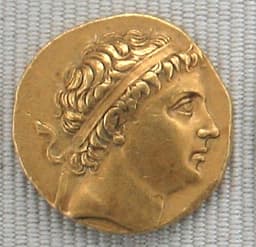
Diodotus I
Emperor · Ancient
48.6Total

Khasekhemwy
Emperor · Ancient
49.4Total
Basic Information
Born
-285
-2730
Died
-239
-2700
Era
Ancient
Ancient
Nationality
Greco-Bactrian Kingdom
Early Egypt
Occupation
Emperor
Emperor
Civilization
Eastern
Middle Eastern
Score Comparison
Military (10%)
30.0
10.0
Political (20%)
48.0
68.0
Influence (20%)
50.2
57.2
Legacy (20%)
44.2
47.5
Leadership (15%)
64.0
40.0
Strategy (15%)
51.7
60.0
TOTAL
48.6
49.4
Diodotus I — Complete Timeline
256 BC
Revolt Against the Seleucid EmpirePolitical Action
Diodotus I, the Seleucid satrap of Bactria, declared independence from the Seleucid Empire. This revolt established the Greco-Bactrian Kingdom, a Hellenistic state in Central Asia.
IndependenceSeleucid EmpireGreco-Bactrian Kingdom
Impact: regionalconstructive
Foundation of the Greco-Bactrian KingdomPolitical Action◆ Major
Diodotus I established himself as the first king of the Greco-Bactrian Kingdom. He consolidated control over Bactria and Sogdiana, creating a powerful Hellenistic state.
FoundationHellenistic StateCentral Asia
Impact: regionalconstructive
250 BC
Defense Against Seleucid ReconquestWar◆ Major
Diodotus I successfully defended his new kingdom against attempts by the Seleucid king Antiochus II to reconquer Bactria. This secured the independence of the Greco-Bactrian Kingdom.
WarSeleucid EmpireIndependence
Impact: regional
Khasekhemwy — Complete Timeline
2720 BC
Reunification of EgyptPolitical Action
Khasekhemwy reunited Upper and Lower Egypt after a period of division during the Second Dynasty. He is credited with ending the internal conflict that had split the country, possibly through military campaigns or political consolidation, and established a unified rule that paved the way for the Old Kingdom.
ReunificationSecond DynastyPolitical Consolidation
Impact: nationalconstructive
2715 BC
Construction of mudbrick fort at HierakonpolisOther
Khasekhemwy built a large mudbrick enclosure at Hierakonpolis, known as the 'Fort'. This structure, measuring about 67 by 57 meters, served as a ceremonial or defensive site. It is one of the earliest monumental mudbrick constructions in Egypt, reflecting the pharaoh's building program and control over resources.
ArchitectureHierakonpolisMudbrick
constructive
2700 BC
Burial in mastaba at AbydosOther
Khasekhemwy was buried in a large mudbrick mastaba tomb at Abydos (tomb V). The tomb contained stone vessels, seal impressions, and a stela. It is one of the largest and most elaborate tombs of the Second Dynasty, indicating his wealth and status.
BurialAbydosMastaba
This comparison has not been analyzed yet.
One-time AI generation (~1 minute). Scores and timeline are already available below.
Rankings
🥇
KhasekhemwyLeader
Mil: 10.0Pol: 68.0Inf: 57.2
49.4
🥈
Diodotus I
Mil: 30.0Pol: 48.0Inf: 50.2
48.6
+0.8 behind
How This Comparison Works
Algorithm
Each figure is scored on 6 dimensions (0—100 scale) based on structured historical data: Military (10%), Political (20%), Influence (20%), Legacy (20%), Leadership (15%), Strategy (15%). The weighted total produces the final ranking.
Data Sources
Scores are computed from structured sub-indicators in the database. Scale factors adjust for era (Ancient ×0.85, Modern ×1.0) and civilization size (Eastern ×1.05, Other ×0.80) to account for differences in population and military scale.
Maximum 3 Figures
Comparisons are limited to 2—3 figures to ensure readability and statistical meaningfulness.
Error Margins
±5 points per dimension — Sub-scores are derived from historical records with inherent uncertainty. Two figures within 5 points on a dimension should be considered roughly equivalent in that area.
Total Score Accuracy
±3 points overall — The weighted combination of 6 dimensions produces a total score with approximately ±3 points of uncertainty. Differences of less than 3 points are not statistically significant— the figures are effectively tied.
Known Limitations
- Historical records are incomplete and uneven across civilizations
- Figures from oral-tradition societies may be underrepresented
- Occupation labels can misclassify multi-role figures
- Scores measure capability and impact, not moral character
- Quantitative scoring is a comparison tool, not absolute truth
Capability Radar
Military (10%) — Battles & Warfare
Battles
30
30
Win Rate
40
40
Expansion
50
40
Political (20%) — Governance & Reform
Reform
35
60
Diplomacy
45
55
Economy
40
50
Influence (20%) — Cultural & Global Reach
Cultural
30
45
Global
30
40
Legacy (20%) — Historical Impact
Historical
40
50
Longevity
35
45
Leadership (15%) — Power & Stability
Tenure
40
55
Stability
35
60
Strategy (15%) — Tactics & Innovation
Strategy
45
40
Tactics
35
35
Reform
30
45
Similar Comparisons
Comments & Discussion
No comments yet. Be the first to share your thoughts!