Loading...
Decentius vs Marcus Aurelius
Marcus Aurelius leads by 23.6 pts · 2 figures compared
…
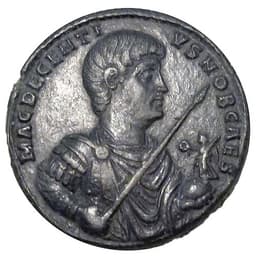
Decentius
Emperor · Ancient
44.9Total

Marcus Aurelius
Emperor · Ancient
68.5Total
Basic Information
Born
290
121
Died
353
180
Era
Ancient
Ancient
Nationality
Roman Empire
Roman Empire
Occupation
Emperor
Emperor
Civilization
Western
Western
Score Comparison
Military (10%)
45.0
70.0
Political (20%)
39.4
72.0
Influence (20%)
56.4
68.0
Legacy (20%)
39.2
65.0
Leadership (15%)
45.0
79.8
Strategy (15%)
38.3
55.0
TOTAL
44.9
68.5
Decentius — Complete Timeline
350 AD
Appointed Caesar by MagnentiusPolitical Action◆ Major
After Magnentius usurped the Western Roman throne, he appointed his brother Decentius as Caesar. Decentius was given command of Gaul and tasked with defending the Rhine frontier against Germanic tribes.
Imperial AppointmentUsurpationMagnentius
Impact: regional
352 AD
Failed to defend Gaul against AlemanniWar◆ Major
Decentius's forces failed to prevent Alemanni incursions into Gaul, leading to significant devastation. This military failure weakened Magnentius's position and undermined confidence in the usurper regime.
Military DefeatGermanic InvasionGaul
Impact: regionaldestructive
353 AD
Committed suicide after Magnentius's defeatOther◆ Major
After Magnentius was defeated by Constantius II at the Battle of Mons Seleucus, Decentius hanged himself. His suicide ended the usurper dynasty and restored the Western Roman Empire to Constantius II's control.
SuicideUsurpationConstantius II
Impact: regionaltragic
Marcus Aurelius — Complete Timeline
161 AD
Became Roman EmperorPolitical Action◆ Major
Marcus Aurelius succeeded Antoninus Pius as Roman Emperor in 161 CE, initially co-ruling with Lucius Verus. His accession marked the beginning of a reign that would be defined by constant warfare and the Antonine Plague, testing his Stoic principles.
SuccessionRoman EmpireCo-Emperor
Impact: global
165 AD
Endured the Antonine PlagueOther◆ Major
The Antonine Plague, likely smallpox, swept through the Roman Empire during Marcus Aurelius's reign, killing an estimated 5-10 million people. The epidemic weakened the military and economy, contributing to the empire's long-term decline and forcing the emperor to recruit slaves and gladiators.
PlaguePandemicRoman Empire
Impact: globaltragic
166 AD
Fought the Marcomannic WarsWar◆ Major
Marcus Aurelius led Roman forces in a series of campaigns along the Danube frontier against the Marcomanni, Quadi, and other Germanic tribes. The wars lasted from 166 to 180 CE, straining the empire's resources and requiring the emperor to spend years on the front lines.
Danube FrontierGermanic TribesWar
Impact: regional
170 AD
Wrote MeditationsCultural
During his military campaigns, Marcus Aurelius composed his personal philosophical writings, later known as Meditations. The work, written in Greek, consists of Stoic reflections on duty, mortality, and self-discipline, and has become a foundational text of Western philosophy.
PhilosophyStoicismLiterature
Impact: globalconstructive
177 AD
Appointed Commodus as SuccessorPolitical Action◆ Major
Marcus Aurelius appointed his son Commodus as co-emperor and successor, breaking the tradition of adopting capable successors. Commodus's subsequent tyrannical rule is often cited as a turning point in Rome's decline, marking the end of the Pax Romana.
SuccessionCommodusPax Romana
Impact: globaltragic
Expert Analysis
Origins
Decentius was born around the early 4th century CE, likely in Gaul, into a family of modest origins. His brother, Magnentius, was a Roman general of barbarian descent who seized power in 350 CE. Decentius's early life remains obscure; he was elevated to the position of Caesar in 351 CE by his brother, tasked with governing Gaul. His background lacked the philosophical or military training typical of Roman emperors, and his rise was entirely dependent on family loyalty.
Marcus Aurelius was born in 121 CE in Rome into a wealthy and politically connected family. His father died young, and he was raised by his grandfather, who ensured he received a top-tier education in rhetoric and philosophy. At age 17, he was adopted by Emperor Antoninus Pius as part of a dynastic plan. Marcus studied under prominent Stoic teachers, including Junius Rusticus, and his philosophical development shaped his later reign. Unlike Decentius, Marcus was groomed for leadership from childhood.
Rise to Power
Decentius's rise was swift and precarious. In 351 CE, after Magnentius defeated Emperor Constans and claimed the Western throne, Magnentius appointed Decentius as Caesar to secure Gaul. This was a direct challenge to Constantius II, the Eastern Roman Emperor. Decentius's authority was limited; he commanded forces in Gaul, but his primary role was to hold the region against Alemanni incursions while Magnentius fought Constantius. His rise was entirely dependent on his brother's usurpation, with no independent power base.
Marcus Aurelius rose through the established imperial system. He was adopted by Antoninus Pius in 138 CE and held a series of political and military positions, including consul in 140, 145, and 161 CE. Upon Antoninus's death in 161 CE, Marcus became emperor, initially co-ruling with Lucius Verus. His accession was smooth, supported by the Senate and military. Marcus's rise was the result of careful grooming and merit, contrasting sharply with Decentius's sudden elevation through usurpation.
Leadership & Governance
Decentius's leadership was ineffective and short-lived. As Caesar in Gaul, he failed to defend the province against Alemanni raids, allowing significant devastation. His governance lacked strategic vision; he relied on Magnentius's orders and could not secure loyalty from local troops. When Constantius II's forces advanced, Decentius's position collapsed. His leadership score of 45.0 reflects his inability to command respect or achieve military objectives.
Marcus Aurelius governed with a focus on justice and duty, guided by Stoic philosophy. He co-ruled effectively with Lucius Verus until Verus's death in 169 CE, then solely. He implemented legal reforms, including improving the rights of slaves and women, and streamlined the administration. During the Marcomannic Wars (166–180 CE), he personally led campaigns along the Danube, demonstrating resilience. His political score of 72.0 reflects his ability to maintain stability despite the Antonine Plague (165–180 CE), which killed 5–10 million people. Marcus's leadership was principled but pragmatic; he appointed his son Commodus as successor, a decision that later proved disastrous.
Triumph & Tragedy
Decentius's greatest success was his appointment as Caesar, which gave him temporary authority. However, his failures were overwhelming: he could not protect Gaul from Alemanni incursions, and his forces were ineffective. His tragic end came in 353 CE after Magnentius's defeat at the Battle of Mons Seleucus. Decentius hanged himself, ending the usurper dynasty. His total score of 44.9 reflects a reign marked by failure and suicide.
Marcus Aurelius's triumphs include his philosophical writings, *Meditations*, which survive as a classic of Stoic thought, and his successful defense of the empire's frontiers during the Marcomannic Wars. He also maintained civil order during a devastating plague. However, his greatest tragedy was appointing Commodus as successor, breaking the tradition of adoptive succession. Commodus's tyrannical rule (180–192 CE) led to civil war and instability. Marcus's military score of 70.0 and legacy score of 65.0 reflect his mixed achievements: strong leadership but flawed succession planning.
Character & Destiny
Decentius was a figure of limited ability, thrust into a role he could not fulfill. His suicide suggests a lack of resilience, and his character was overshadowed by his brother's ambition. Historical assessments dismiss him as a minor usurper whose destiny was tied to Magnentius's failure.
Marcus Aurelius is remembered as a philosopher-king, known for his introspective and disciplined character. His *Meditations* reveal a man constantly striving for self-improvement and justice. However, his decision to appoint Commodus indicates a blind spot regarding his son's incompetence. Marcus's character shaped his destiny: his Stoic principles helped him endure plague and war, but his familial loyalty led to a flawed succession.
Legacy
Decentius's legacy is negligible. He is a footnote in Roman history, remembered only as the brother of a usurper who failed and died by suicide. His influence score of 56.4 is inflated by his brief role in a major civil war, but he left no lasting institutions or ideas.
Marcus Aurelius's legacy is profound. *Meditations* continues to influence philosophy, leadership, and popular culture. His reign is seen as the end of the Pax Romana, and his efforts to stabilize the empire provided a model for later rulers. Despite the failure of his succession, his commitment to duty and justice earned him a reputation as one of Rome's greatest emperors. His total score of 68.5 reflects enduring impact.
Conclusion
Marcus Aurelius had far greater impact than Decentius. With a total score of 68.5 compared to Decentius's 44.9, the gap of 23.6 points underscores Marcus's superior leadership, political skill, and lasting legacy. Marcus successfully navigated crises of plague and war, while Decentius failed in his sole responsibility and died ignominiously. Marcus's philosophical works continue to inspire, whereas Decentius is forgotten except by specialists. The data supports a clear verdict: Marcus Aurelius stands as a model of enlightened rule, while Decentius represents the ephemeral nature of usurper power.
Rankings
🥇
Marcus AureliusLeader
Mil: 70.0Pol: 72.0Inf: 68.0
68.5
🥈
Decentius
Mil: 45.0Pol: 39.4Inf: 56.4
44.9
+23.6 behind
How This Comparison Works
Algorithm
Each figure is scored on 6 dimensions (0—100 scale) based on structured historical data: Military (10%), Political (20%), Influence (20%), Legacy (20%), Leadership (15%), Strategy (15%). The weighted total produces the final ranking.
Data Sources
Scores are computed from structured sub-indicators in the database. Scale factors adjust for era (Ancient ×0.85, Modern ×1.0) and civilization size (Eastern ×1.05, Other ×0.80) to account for differences in population and military scale.
Maximum 3 Figures
Comparisons are limited to 2—3 figures to ensure readability and statistical meaningfulness.
Error Margins
±5 points per dimension — Sub-scores are derived from historical records with inherent uncertainty. Two figures within 5 points on a dimension should be considered roughly equivalent in that area.
Total Score Accuracy
±3 points overall — The weighted combination of 6 dimensions produces a total score with approximately ±3 points of uncertainty. Differences of less than 3 points are not statistically significant— the figures are effectively tied.
Known Limitations
- Historical records are incomplete and uneven across civilizations
- Figures from oral-tradition societies may be underrepresented
- Occupation labels can misclassify multi-role figures
- Scores measure capability and impact, not moral character
- Quantitative scoring is a comparison tool, not absolute truth
Capability Radar
Military (10%) — Battles & Warfare
Battles
10
70
Win Rate
5
65
Expansion
0
40
Political (20%) — Governance & Reform
Reform
0
70
Diplomacy
5
75
Economy
0
60
Influence (20%) — Cultural & Global Reach
Cultural
0
85
Global
0
80
Legacy (20%) — Historical Impact
Historical
5
90
Longevity
0
95
Leadership (15%) — Power & Stability
Tenure
5
85
Stability
0
65
Strategy (15%) — Tactics & Innovation
Strategy
5
75
Tactics
10
60
Reform
0
55
Similar Comparisons
Comments & Discussion
No comments yet. Be the first to share your thoughts!