Loading...
Decebalus vs Sun Quan
Sun Quan leads by 6.1 pts · 2 figures compared
…

Decebalus
Emperor · Ancient
58.3Total
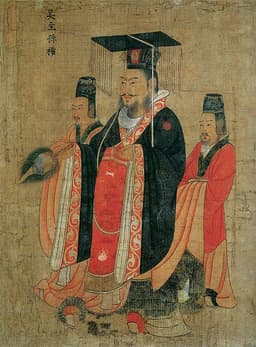
Sun Quan
Emperor · Ancient
64.4Total
Basic Information
Born
60
182
Died
106
252
Era
Ancient
Ancient
Nationality
Dacia
China
Occupation
Emperor
Emperor
Civilization
Western
Eastern
Score Comparison
Military (10%)
63.3
67.3
Political (20%)
68.0
65.0
Influence (20%)
53.3
59.0
Legacy (20%)
45.0
58.0
Leadership (15%)
74.0
80.0
Strategy (15%)
61.2
66.3
TOTAL
58.3
64.4
Decebalus — Complete Timeline
85 AD
First Dacian WarWar◆ Major
Decebalus led Dacian forces in a war against the Roman Empire under Emperor Domitian. The Dacians invaded Moesia, defeating the Roman governor and forcing Domitian to send reinforcements. The war ended in a negotiated peace.
WarRoman-Dacian ConflictDomitian
Impact: regionaldestructive
89 AD
Treaty with DomitianPolitical Action◆ Major
Decebalus signed a treaty with Emperor Domitian that recognized Dacia as a client kingdom. Rome agreed to pay annual subsidies and provide military engineers, while Decebalus promised to respect Roman borders.
TreatyRoman-Dacian RelationsClient Kingdom
Impact: regionalconstructive
101 AD
Second Dacian WarWar
Emperor Trajan launched a major invasion of Dacia, beginning the Second Dacian War. Decebalus resisted fiercely, using guerrilla tactics and fortifications, but was gradually pushed back by the superior Roman army.
WarRoman InvasionTrajan
Impact: regionaldestructive
Battle of TapaeWar◆ Major
Decebalus fought Trajan's forces at the Battle of Tapae, a bloody engagement that resulted in a Roman victory. The Dacians suffered heavy losses but managed to retreat in good order, prolonging the war.
BattleRoman-Dacian WarRoman Victory
Impact: regionaltragic
106 AD
Siege of SarmizegetusaWar
Roman forces besieged and captured Sarmizegetusa, the Dacian capital. The city was destroyed, and Decebalus's treasury was seized. The fall of the capital marked the end of Dacian resistance.
SiegeRoman ConquestDacian Capital
Impact: regionaltragic
Suicide to Avoid CapturePolitical Action◆ Major
Decebalus committed suicide by cutting his own throat to avoid capture by Roman pursuers. His head was taken to Rome and displayed on the Gemonian stairs. Dacia was annexed as a Roman province.
SuicideRoman ConquestEnd of Dacia
Impact: regionaltragic
Sun Quan — Complete Timeline
208 AD
Battle of Red CliffsWar
Sun Quan allied with Liu Bei to defeat Cao Cao's invasion at Red Cliffs. Zhou Yu commanded Sun Quan's fleet, using fire ships to destroy Cao Cao's larger navy. This victory preserved Sun Quan's independence and established the tripartite division of China.
Three KingdomsNaval battleAlliance
Impact: regional
213 AD
Battle of RuxuWar◆ Major
Cao Cao launched a naval invasion against Sun Quan's fortress at Ruxu. Sun Quan personally led a small reconnaissance force that was surrounded, but he broke out. The battle ended in a stalemate, with Cao Cao withdrawing, securing Sun Quan's control of the Yangtze.
Three KingdomsBattleDefense
Impact: regional
222 AD
Proclamation of Eastern WuPolitical Action◆ Major
Sun Quan declared himself Emperor of Wu, establishing the Eastern Wu dynasty. This formalized the Three Kingdoms period, with Wu controlling the Yangtze River basin. Sun Quan's reign lasted until 252, making him the longest-ruling of the three founding emperors.
Three KingdomsDynasty foundingImperial proclamation
Impact: regionalconstructive
Expert Analysis
Origins
Decebalus (c. 40–106 AD) was the last king of Dacia, a region roughly corresponding to modern Romania. Little is known of his early life, but he emerged as a leader during a period of Roman expansion under Domitian. He likely came from the Dacian nobility and was skilled in warfare and diplomacy. His reign began around 85 AD, when Dacia was a decentralized kingdom with a warrior culture.
Sun Quan (182–252 AD) was born in Fuchun (modern Zhejiang) to a military family. His father Sun Jian was a warlord who died in battle when Sun Quan was 10. His elder brother Sun Ce established a power base in the Jiangdong region. Sun Quan was educated in both civil and military arts, and he took control of the family domain after Sun Ce's assassination in 200 AD.
Rise to Power
Decebalus rose to prominence by uniting Dacian tribes and challenging Roman dominance. In 85 AD, he led an invasion of the Roman province of Moesia, killing the governor Oppius Sabinus. Emperor Domitian responded with a campaign that initially failed. In 89 AD, after a stalemate, Domitian signed a treaty recognizing Dacia as a client kingdom, with subsidies and military aid. This allowed Decebalus to strengthen his state. However, Trajan's ascension in 98 AD ended the accommodation. Trajan launched the First Dacian War (101–102) and defeated Decebalus, forcing him to accept Roman terms. Decebalus rebuilt and violated the treaty, leading to the Second Dacian War (105–106) and his ultimate defeat.
Sun Quan inherited control of Jiangdong at age 18 after Sun Ce's death. He skillfully navigated factional politics, retaining loyal generals like Zhou Yu and Zhang Zhao. In 208 AD, Cao Cao, the dominant northern warlord, invaded the south. Sun Quan allied with Liu Bei and decisively defeated Cao Cao at the Battle of Red Cliffs (208 AD), using fire ships to destroy his fleet. This victory secured his control of the Yangtze region. He later fought Cao Cao again at Ruxu (213, 217) and held his ground. In 222 AD, after defeating Liu Bei at the Battle of Yiling, he declared himself Emperor of Wu in 229 AD, formalizing the Three Kingdoms.
Leadership & Governance
Decebalus governed Dacia as a centralized monarchy, consolidating tribal alliances and building fortifications. He used Roman subsidies to modernize his army and construct defensive works, including the fortresses of the Orăștie Mountains. His leadership was charismatic but autocratic, relying on personal loyalty. He employed guerrilla tactics and scorched-earth strategies against Rome, but his governance lacked institutional depth, as Dacia remained a tribal kingdom without a strong bureaucracy.
Sun Quan established a stable bureaucratic state in Eastern Wu. He adopted the Chinese imperial model, with a civil service, tax system, and legal code. He promoted agriculture and trade, especially along the Yangtze River, which became the economic backbone of Wu. He also expanded naval capabilities, making Wu a maritime power. His leadership was more collaborative, delegating military command to capable generals like Zhou Yu, Lu Xun, and Lü Meng. However, he faced succession issues and purges in his later years.
Triumph & Tragedy
Decebalus's greatest triumph was forcing Rome to a favorable treaty in 89 AD, a rare achievement for a barbarian king. He also successfully resisted Trajan for two wars, inflicting heavy losses on the Romans. His tragedy was his ultimate defeat: after the fall of Sarmizegetusa in 106 AD, he committed suicide to avoid capture. Dacia was annexed as a Roman province, and its culture was largely erased. His score of 63.3 in military reflects his tactical skill but strategic failure against Rome.
Sun Quan's greatest triumph was the Battle of Red Cliffs (208), which preserved southern independence and enabled the Three Kingdoms. He also successfully expanded Wu's territory and reigned for 30 years as emperor. His tragedy includes the later decline of Wu due to internal strife and his own harsh policies, such as the execution of his heir Sun He. He scored 67.3 in military and 80.0 in leadership, reflecting his ability to maintain stability and command loyalty.
Character & Destiny
Decebalus was determined, proud, and uncompromising. He chose death over submission, a decision that shaped his legacy as a freedom fighter. His character led him to resist Rome despite overwhelming odds, but his inflexibility prevented a negotiated settlement. Sun Quan was pragmatic, cautious, and adaptable. He knew when to fight and when to ally, as shown by his alliance with Liu Bei. His character enabled him to survive in a volatile era, but his later paranoia damaged his regime.
Legacy
Decebalus became a symbol of Romanian nationalism, celebrated as a hero who resisted Roman imperialism. The Dacian wars were commemorated on Trajan's Column, and Decebalus's suicide is remembered as an act of defiance. However, his legacy is limited to the Dacian region and lacks global impact. He scores 45.0 in legacy.
Sun Quan's legacy is more substantial. He established the Eastern Wu dynasty, which lasted until 280 AD. His reign contributed to the development of the Jiangnan region, which became a cultural and economic center. The Three Kingdoms period remains a cornerstone of Chinese history and literature. He scores 58.0 in legacy, reflecting his role in shaping Chinese history.
Conclusion
Sun Quan had greater impact than Decebalus. With a total score of 64.4 versus 58.3, Sun Quan outperforms in military (67.3 vs 63.3), political (65.0 vs 68.0), influence (59.0 vs 53.3), legacy (58.0 vs 45.0), leadership (80.0 vs 74.0), and strategy (66.3 vs 61.2). While Decebalus was a capable leader who resisted Rome, his defeat and the absorption of Dacia into the Roman Empire limited his long-term influence. Sun Quan established a dynasty that lasted for decades, shaped the Three Kingdoms period, and contributed to the development of southern China. The data supports Sun Quan as the more consequential figure.
Rankings
🥇
Sun QuanLeader
Mil: 67.3Pol: 65.0Inf: 59.0
64.4
🥈
Decebalus
Mil: 63.3Pol: 68.0Inf: 53.3
58.3
+6.1 behind
How This Comparison Works
Algorithm
Each figure is scored on 6 dimensions (0—100 scale) based on structured historical data: Military (10%), Political (20%), Influence (20%), Legacy (20%), Leadership (15%), Strategy (15%). The weighted total produces the final ranking.
Data Sources
Scores are computed from structured sub-indicators in the database. Scale factors adjust for era (Ancient ×0.85, Modern ×1.0) and civilization size (Eastern ×1.05, Other ×0.80) to account for differences in population and military scale.
Maximum 3 Figures
Comparisons are limited to 2—3 figures to ensure readability and statistical meaningfulness.
Error Margins
±5 points per dimension — Sub-scores are derived from historical records with inherent uncertainty. Two figures within 5 points on a dimension should be considered roughly equivalent in that area.
Total Score Accuracy
±3 points overall — The weighted combination of 6 dimensions produces a total score with approximately ±3 points of uncertainty. Differences of less than 3 points are not statistically significant— the figures are effectively tied.
Known Limitations
- Historical records are incomplete and uneven across civilizations
- Figures from oral-tradition societies may be underrepresented
- Occupation labels can misclassify multi-role figures
- Scores measure capability and impact, not moral character
- Quantitative scoring is a comparison tool, not absolute truth
Capability Radar
Military (10%) — Battles & Warfare
Battles
70
70
Win Rate
65
65
Expansion
55
70
Political (20%) — Governance & Reform
Reform
50
65
Diplomacy
65
80
Economy
55
75
Influence (20%) — Cultural & Global Reach
Cultural
45
65
Global
35
60
Legacy (20%) — Historical Impact
Historical
50
75
Longevity
40
70
Leadership (15%) — Power & Stability
Tenure
60
85
Stability
50
70
Strategy (15%) — Tactics & Innovation
Strategy
70
80
Tactics
75
75
Reform
60
60
Similar Comparisons
Comments & Discussion
No comments yet. Be the first to share your thoughts!