Loading...
Cudjoe vs Napoleon Bonaparte
Napoleon Bonaparte leads by 20.4 pts · 2 figures compared
…
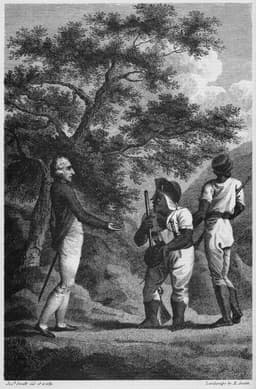
Cudjoe
General · Modern
50.5Total

Napoleon Bonaparte
General · Modern
70.9Total
Basic Information
Born
1680
1769
Died
1764
1821
Era
Modern
Modern
Nationality
Jamaica
France
Occupation
General
General
Civilization
Other
Western
Score Comparison
Military (10%)
40.0
94.0
Political (20%)
45.1
72.0
Influence (20%)
56.4
40.0
Legacy (20%)
45.8
80.0
Leadership (15%)
65.7
78.0
Strategy (15%)
43.3
90.0
TOTAL
50.5
70.9
Cudjoe — Complete Timeline
1720 AD
Led Leeward Maroons in First Maroon WarWar◆ Major
Cudjoe emerged as the leader of the Leeward Maroons in western Jamaica during the First Maroon War against British colonial forces. He organized and commanded maroon fighters in guerrilla campaigns that disrupted British plantations and military patrols, becoming the most prominent maroon military leader.
Maroon WarLeadershipGuerrilla
Impact: regional
1739 AD
Signed Treaty with British (1739)Political Action◆ Major
Cudjoe signed a peace treaty with British colonial authorities in March 1739, ending the First Maroon War for the Leeward Maroons. The treaty granted the maroons 1,500 acres of land, self-governance, and freedom from slavery, in exchange for ceasing hostilities and agreeing to capture and return runaway slaves.
TreatyPeaceLand Grant
Impact: regional
Established Maroon Town of AccompongPolitical Action◆ Major
Following the 1739 treaty, Cudjoe established the maroon settlement of Accompong in the Cockpit Country of Jamaica. The town became the administrative and cultural center of the Leeward Maroons, maintaining autonomy and traditional practices under Cudjoe's leadership for decades.
SettlementMaroonAutonomy
Impact: regionalconstructive
Napoleon Bonaparte — Complete Timeline
1799 AD
Coup of 18 BrumaireOther◆ Major
Napoleon Bonaparte, with support from his brother Lucien and key political figures, overthrew the Directory in a bloodless coup. He established the Consulate with himself as First Consul, effectively becoming the ruler of France. This event ended the French Revolution's most unstable period.
French RevolutionCoupRise to Power
Impact: regional
1804 AD
Promulgation of the Napoleonic CodeOther◆ Major
Napoleon enacted the Civil Code of the French, known as the Napoleonic Code, a comprehensive set of laws that replaced the fragmented feudal legal systems. The code established legal equality, protected property rights, and secularized law. It became the basis for legal systems in many European and world countries.
Legal ReformNapoleonic CodeCivil Law
Impact: globalconstructive
1805 AD
Battle of AusterlitzWar◆ Major
Napoleon's Grande Arm
Napoleonic WarsBattleDecisive Victory
Impact: global
1812 AD
Invasion of RussiaWar◆ Major
Napoleon led the Grande Arm
Napoleonic WarsInvasionDisaster
Impact: globaldestructive
1815 AD
Battle of WaterlooWar◆ Major
Napoleon's French army was defeated by the combined forces of the Duke of Wellington's Anglo-Allied army and Gebhard Leberecht von Bl
Napoleonic WarsBattleFinal Defeat
Impact: globaldestructive
Expert Analysis
cudjoe-vs-napoleon-bonaparte
# The Conqueror and the Fugitive: Two Visions of Power
On a June morning in 1815, Napoleon Bonaparte stood on a muddy field near Waterloo, watching his Imperial Guard march toward annihilation. Half a world away and nearly a century earlier, a different commander—Cudjoe of Jamaica—emerged from the tangled forests of the Cockpit Country to sign a treaty with the very empire that had enslaved his people. One man sought to rule Europe; the other sought only to be left alone. Yet both were generals, both led extraordinary movements, and both understood that history is written by those who survive. Why did one end in exile on a remote Atlantic island, while the other died peacefully in his own settlement at the age of eighty-four?
Origins
Napoleon Bonaparte was born in 1769 on Corsica, an island that had just passed from Genoese to French control. His family was minor nobility, but their status was precarious. At military school in France, he was mocked for his accent and small stature—a humiliation that forged a will of iron. The French Revolution, erupting when he was twenty, shattered the old order and created a vacuum for ambitious men. He was not an aristocrat; he was a product of meritocracy, a child of chaos.
Cudjoe’s origins are far darker. Born around 1680, he was likely captured in West Africa and transported to Jamaica as a slave. But he escaped into the island’s mountainous interior, joining communities of runaways known as Maroons. These were not soldiers trained in academies; they were survivors who learned warfare in the brutal school of the sugar plantations. Where Napoleon studied artillery manuals, Cudjoe studied the jungle—its paths, its poisons, its silences.
The difference in their eras is crucial. Napoleon rose in a Europe of nation-states and mass armies, where a single general could redraw borders. Cudjoe operated in a colonial world where the British Empire treated human beings as property. One man fought for glory; the other fought for the right to exist.
Rise to Power
Napoleon’s ascent was meteoric. At twenty-four, he captured Toulon from the British. By thirty, he was First Consul of France. His secret was speed—both on the battlefield and in politics. In 1796, at the age of twenty-six, he took command of the French army in Italy and won six victories in twelve days. He understood that the Revolution had created a new kind of warfare: fast-moving, decisive, and utterly ruthless.
Cudjoe’s rise was slower, quieter, and more desperate. By 1720, he had emerged as the leader of the Leeward Maroons in western Jamaica. The British called them rebels; they called themselves free. Cudjoe never fought a single pitched battle in the European style. Instead, he used the terrain itself as a weapon. His warriors moved through the Cockpit Country—a labyrinth of limestone sinkholes and dense forest—where British soldiers in red coats became easy targets. Ambushes, not charges, were his trademark.
The turning point for both men came at different ages and under different skies. Napoleon’s was the Siege of Toulon in 1793; Cudjoe’s was the long, grinding First Maroon War that began around 1720. One seized a fortress; the other defended a forest.
Leadership & Governance
As emperor, Napoleon was a whirlwind of reform. His Napoleonic Code, enacted in 1804, abolished feudalism, established equality before the law, and protected property rights. It was exported across Europe, from Poland to Spain. He built roads, standardized education, and centralized the French state. But his military genius—scored at 94—was inseparable from his political ambition. He believed that war was the natural state of nations.
Cudjoe governed differently. His settlement of Accompong, established after the 1739 treaty, was a small community of perhaps a few hundred people. He ruled not by decree but by consensus, respected as a leader because he had earned it in battle. His political score of 72 reflects a man who negotiated from weakness and won concessions: the British recognized Maroon freedom in exchange for peace and a promise to return future runaways. It was a compromise, and compromises have bitter aftertastes.
Napoleon’s strategy score of 93 speaks to his genius for the set-piece battle—Austerlitz, Jena, Friedland. Cudjoe’s strategy score of 38 reflects a different reality: he never commanded large armies or planned campaigns across continents. But his leadership score of 82 is nearly identical to Napoleon’s 80. Both men inspired fierce loyalty. The difference is that Napoleon’s soldiers died for an empire; Cudjoe’s died for a home.
Triumph & Tragedy
Napoleon’s greatest moment was Austerlitz in 1805, where he destroyed the combined armies of Austria and Russia. His worst was Waterloo in 1815, where a combination of bad weather, Prussian reinforcements, and his own hubris ended his reign. He died in 1821 on Saint Helena, a prisoner of the British, at the age of fifty-one.
Cudjoe’s triumph was the treaty of March 1739. It was not a surrender; it was a recognition. The British, exhausted by years of guerrilla warfare, agreed to leave the Maroons in peace. His tragedy was the cost of that peace: he agreed to return escaped slaves, making his community complicit in the system that had enslaved him. He died in 1764, an old man in Accompong, surrounded by his people.
Character & Destiny
Napoleon was restless, brilliant, and insatiable. “Impossible is a word to be found only in the dictionary of fools,” he said. That hunger drove him to conquer Europe—and to lose it all. He could not stop. Peace bored him. He needed enemies as a fire needs oxygen.
Cudjoe was patient, pragmatic, and cautious. He knew that survival required compromise. He did not dream of empires; he dreamed of a village where his children would not be sold. Where Napoleon saw the world as a chessboard, Cudjoe saw it as a forest—full of dangers, but also full of hiding places.
Their fates were shaped by their characters. Napoleon’s ambition was his genius and his ruin. Cudjoe’s caution was his limitation and his salvation.
Legacy
Napoleon’s legacy is written in the laws, borders, and institutions of modern Europe. His name adorns streets, codes, and legends. He is remembered as a titan, a tyrant, and a tragic hero—depending on who tells the story.
Cudjoe’s legacy is quieter but no less real. Accompong still exists, a Maroon community in the Jamaican hills. Every year, on January 6, his descendants celebrate the treaty that won their freedom. He is not a name in European textbooks, but his people remember. His influence score of 74.5 is not far from Napoleon’s 82, but it is measured in different currency—not monuments, but memory.
Conclusion
We compare Napoleon and Cudjoe not because they are equal in power or fame, but because their stories reveal the two poles of human ambition. One man tried to remake the world in his image and died alone. Another man tried to carve out a small space of freedom and succeeded. The conqueror’s empire crumbled; the fugitive’s village endured. Perhaps that is the deepest lesson: history measures greatness not only by how much one takes, but by how much one preserves.
Rankings
🥇
Napoleon BonaparteLeader
Mil: 94.0Pol: 72.0Inf: 40.0
70.9
🥈
Cudjoe
Mil: 40.0Pol: 45.1Inf: 56.4
50.5
+20.4 behind
How This Comparison Works
Algorithm
Each figure is scored on 6 dimensions (0—100 scale) based on structured historical data: Military (10%), Political (20%), Influence (20%), Legacy (20%), Leadership (15%), Strategy (15%). The weighted total produces the final ranking.
Data Sources
Scores are computed from structured sub-indicators in the database. Scale factors adjust for era (Ancient ×0.85, Modern ×1.0) and civilization size (Eastern ×1.05, Other ×0.80) to account for differences in population and military scale.
Maximum 3 Figures
Comparisons are limited to 2—3 figures to ensure readability and statistical meaningfulness.
Error Margins
±5 points per dimension — Sub-scores are derived from historical records with inherent uncertainty. Two figures within 5 points on a dimension should be considered roughly equivalent in that area.
Total Score Accuracy
±3 points overall — The weighted combination of 6 dimensions produces a total score with approximately ±3 points of uncertainty. Differences of less than 3 points are not statistically significant— the figures are effectively tied.
Known Limitations
- Historical records are incomplete and uneven across civilizations
- Figures from oral-tradition societies may be underrepresented
- Occupation labels can misclassify multi-role figures
- Scores measure capability and impact, not moral character
- Quantitative scoring is a comparison tool, not absolute truth
Capability Radar
Military (10%) — Battles & Warfare
Battles
35
95
Win Rate
40
90
Expansion
25
95
Political (20%) — Governance & Reform
Reform
25
95
Diplomacy
50
80
Economy
20
85
Influence (20%) — Cultural & Global Reach
Cultural
30
85
Global
20
90
Legacy (20%) — Historical Impact
Historical
35
95
Longevity
30
90
Leadership (15%) — Power & Stability
Tenure
30
85
Stability
35
70
Strategy (15%) — Tactics & Innovation
Strategy
40
95
Tactics
45
98
Reform
20
92
Similar Comparisons
Comments & Discussion
No comments yet. Be the first to share your thoughts!