Loading...
Cuauhtemoc vs Julius Caesar
Julius Caesar leads by 33.8 pts · 2 figures compared
…
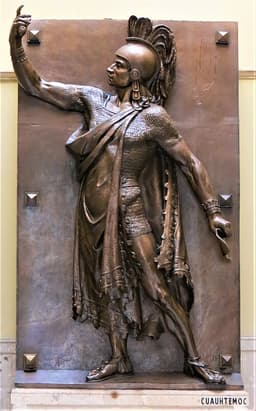
Cuauhtemoc
Emperor · Medieval
49.0Total

Julius Caesar
General · Ancient
82.8Total
Basic Information
Born
1497
-100
Died
1525
-44
Era
Medieval
Ancient
Nationality
Aztec Empire
Roman Republic
Occupation
Emperor
General
Civilization
Other
Western
Score Comparison
Military (10%)
46.7
88.0
Political (20%)
30.7
78.0
Influence (20%)
56.7
85.0
Legacy (20%)
58.0
82.0
Leadership (15%)
33.6
80.0
Strategy (15%)
60.0
85.0
TOTAL
49.0
82.8
Cuauhtemoc — Complete Timeline
1440 AD
Expanded the Aztec Empire through Military CampaignsWar◆ Major
Moctezuma I launched a series of military campaigns that extended Aztec control into the Gulf Coast, Oaxaca, and Guerrero regions. He conquered cities such as Cuetlaxtlan and Coixtlahuaca, incorporating them into the tribute system.
Aztec ExpansionMilitary ConquestTribute System
Impact: regional
1450 AD
Implemented the Flower Wars (Xochiyaoyotl)War◆ Major
Moctezuma I institutionalized the Flower Wars, ritualized conflicts with Tlaxcala and other city-states. These battles were designed to capture prisoners for religious sacrifice rather than territorial conquest, reinforcing Aztec religious practices.
Ritual WarfareHuman SacrificeAztec Religion
Impact: regionaldestructive
Constructed the Aqueduct of ChapultepecCultural
Moctezuma I commissioned the construction of a stone aqueduct from Chapultepec springs to Tenochtitlan, providing fresh water to the island city. This engineering project improved public health and supported the city's growing population.
InfrastructureWater SupplyUrban Development
constructive
Julius Caesar — Complete Timeline
58 BC
Gallic WarsWar◆ Major
Caesar, as proconsul of Gaul, launched a series of campaigns that conquered all of Gaul (modern France, Belgium, and parts of Switzerland). He fought numerous battles, including against the Helvetii, the Belgae, and the Gallic chieftain Vercingetorix. The wars brought immense wealth and a loyal army to Caesar.
Gallic WarsConquestRoman Expansion
Impact: regional
49 BC
Crossing the RubiconPolitical Action◆ Major
Caesar led Legio XIII across the Rubicon River into Italy, defying the Roman Senate's order to disband his army. This act triggered a civil war against Pompey and the Optimates, ultimately leading to Caesar's dictatorship and the end of the Roman Republic.
Roman Civil WarEnd of RepublicPower Struggle
Impact: global
48 BC
Battle of PharsalusWar◆ Major
Caesar's outnumbered army defeated the larger forces of Pompey the Great at Pharsalus in Greece. Caesar's tactical use of a reserve line to counter Pompey's cavalry charge proved decisive. Pompey fled to Egypt, where he was assassinated, leaving Caesar as the undisputed master of the Roman world.
Roman Civil WarBattleDecisive Victory
Impact: regional
44 BC
Appointment as Dictator for LifePolitical Action◆ Major
The Roman Senate appointed Caesar dictator perpetuo (dictator for life), granting him unprecedented personal power. This move concentrated military, legislative, and judicial authority in one person, effectively ending the Roman Republic's traditional system of checks and balances and alarming many senators.
DictatorshipEnd of RepublicPower Consolidation
Impact: regionaldestructive
Assassination on the Ides of MarchPolitical Action◆ Major
A group of Roman senators, led by Marcus Junius Brutus and Gaius Cassius Longinus, stabbed Caesar to death at a meeting of the Senate in the Theatre of Pompey. The assassination was intended to restore the Republic, but instead triggered another civil war that led to the rise of the Roman Empire.
AssassinationRoman PoliticsEnd of Republic
Impact: globaldestructive
Expert Analysis
cuauhtemoc-vs-julius-caesar
# The Edge of the World
In the spring of 1521, as Hernán Cortés tightened his siege around Tenochtitlan, the most magnificent city in the Americas, its emperor Cuauhtemoc faced a choice that would define his place in history. Two thousand years earlier and half a world away, another leader—Julius Caesar—had stood on the banks of the Rubicon, a small river in northern Italy, and made a decision that would reshape the Western world. Both men were young, both were warriors, both faced moments of supreme crisis. Yet one became the architect of an empire that would endure for centuries, while the other became the tragic symbol of a world that vanished. What separated them was not merely luck, but the deep currents of history, culture, and character that carried them to such different fates.
Origins
Caesar was born into the chaos of the late Roman Republic, a world of bitter patrician rivalries, senatorial intrigue, and expanding frontiers. His family, the Julii, claimed descent from the goddess Venus, but they were not among Rome’s wealthiest. From childhood, Caesar breathed the air of a civilization that believed in law, rhetoric, and the relentless pursuit of glory. He was educated by Greek tutors, trained in oratory, and steeped in the military traditions that had already built an empire around the Mediterranean.
Cuauhtemoc, by contrast, came from a world where gods demanded human blood and where the calendar governed every aspect of life. Born in 1497, he was a noble of the Aztec ruling class, raised in the shadow of the Great Temple of Tenochtitlan. His people had risen from nomadic obscurity to dominate central Mexico in less than two centuries, building a tribute empire on warfare, trade, and ritual sacrifice. The Aztecs believed their sun god required constant nourishment—and that nourishment came from the hearts of enemies. This was not a world of senatorial debate but of prophecy, omens, and the terrifying certainty that the cosmos depended on human suffering.
Rise to Power
Caesar’s path to power was a masterpiece of calculated risk. He climbed the Roman political ladder—quaestor, aedile, praetor—borrowing enormous sums to fund games and bribes, always aiming higher. His military career began in earnest with the conquest of Gaul (58–50 BCE), a campaign he documented in his own *Commentaries*, blending self-promotion with literary genius. By the time he crossed the Rubicon in 49 BCE, he had an army that worshipped him and a reputation that terrified his enemies. He was 50 years old, a veteran of decades of warfare and politics.
Cuauhtemoc became emperor in 1520, at about age 23, after his predecessor Moctezuma II died under Spanish custody. He inherited a catastrophe. Smallpox had already killed tens of thousands. Cortés had allied with the Aztecs’ traditional enemies—the Tlaxcalans, the Totonacs—and had burned his own ships to commit his men to conquest. Cuauhtemoc had no time to build alliances or consolidate power; he had only to defend a dying city. His rise was not a climb but a desperate last stand.
Leadership & Governance
Caesar governed with a blend of ruthlessness and magnanimity that has fascinated historians ever since. As dictator, he reformed the calendar, granted citizenship to provincials, launched public works, and pardoned many of his former enemies. His military genius lay in speed and logistics—he once wrote, “I came, I saw, I conquered,” and he meant it literally. He could win battles against overwhelming odds, as at Alesia, where he besieged a Gallic army while simultaneously fighting off a relief force. But his political wisdom was flawed: he underestimated the depth of republican sentiment among the Roman elite, and his accumulation of honors—dictator for life, consul for ten years, the title “imperator”—made him a target.
Cuauhtemoc’s leadership was that of a cornered king. He organized the defense of Tenochtitlan with remarkable skill, using the city’s canals and causeways to slow the Spanish advance. His warriors fought with obsidian-bladed swords and wooden shields against gunpowder, steel, and horses. He refused to surrender even as famine and disease ravaged his people. But he could not match Caesar’s strategic depth. The Aztec empire was a tribute system, not a bureaucratic state; it had no standing army, no siege technology, and no experience with the kind of total war that the Spanish waged. Cuauhtemoc’s courage was immense, but his tools were medieval—and his enemies had already entered the Renaissance.
Triumph & Tragedy
Caesar’s greatest triumph was also the seed of his tragedy. The conquest of Gaul made him rich and powerful, but it also made him feared. When he crossed the Rubicon, he plunged Rome into civil war. He defeated Pompey at Pharsalus, crushed the remnants of the senatorial forces, and returned to Rome as master of the world. But on the Ides of March, 44 BCE, a conspiracy of senators—many of them his own allies—stabbed him to death at the foot of Pompey’s statue. His last words, according to tradition, were “Et tu, Brute?”—a cry of betrayal that has echoed through history.
Cuauhtemoc’s tragedy was absolute. After months of siege, Tenochtitlan fell in August 1521. The emperor was captured while trying to escape across Lake Texcoco in a canoe. Brought before Cortés, he reportedly said, “I have done what I could to defend my city. Do with me what you will.” The Spanish tortured him, burning his feet, to reveal the location of Aztec gold. He endured in silence. In 1525, Cortés took him on an expedition to Honduras, fearing he might lead a rebellion. There, on dubious charges of conspiracy, Cuauhtemoc was hanged. He was 28 years old.
Character & Destiny
Caesar was a man who believed he could shape destiny. He was ambitious, calculating, and supremely confident—he once dismissed death as “the last thing to be feared.” His personality drove him to take risks that would have destroyed lesser men, but it also blinded him to the hatred he inspired. He thought he could win over his enemies with clemency; instead, he gave them time to plot.
Cuauhtemoc was a man who believed destiny had already been written. The Aztecs had long prophesied the return of a white-skinned god, and Moctezuma II had hesitated fatally, unsure whether Cortés was Quetzalcoatl or a man. Cuauhtemoc had no such doubts—he knew the Spanish were mortal enemies—but he was trapped by a worldview that saw history as cyclical and human effort as ultimately futile against the will of the gods. His courage was not the calculating boldness of Caesar but the stoic endurance of a man who knows he will lose.
Legacy
Caesar’s legacy is immeasurable. His name became synonymous with imperial power—*kaiser*, *tsar*. His reforms outlived him, and his adopted heir, Octavian, became Augustus, the first Roman emperor. The Roman Empire that Caesar helped create shaped Western law, language, and governance for two millennia. He is remembered as a genius, a tyrant, and a warning.
Cuauhtemoc’s legacy is more intimate but no less powerful. In Mexico, he is a national hero, a symbol of resistance against colonialism. His face appears on coins and statues; his name is given to streets and schools. But he is also a figure of profound sadness—a reminder of a civilization that was destroyed not because it was weak, but because it was vulnerable. The Aztecs had no immunity to European diseases, no steel, no horses, no gunpowder. Cuauhtemoc fought with what he had, and he lost.
Conclusion
What separates Caesar from Cuauhtemoc is not courage or intelligence—both had those in abundance. It is the accident of history. Caesar stood at the dawn of an empire that would dominate the known world, armed with the tools of a civilization that was expanding outward. Cuauhtemoc stood at the twilight of an empire that was about to be erased, facing an invader from a world he could not have imagined. One man built a bridge to the future; the other became a monument to a past that was already gone. Their stories remind us that history is not always a story of triumph—sometimes it is the story of those who stood, fought, and fell, while the world turned without them.
Rankings
🥇
Julius CaesarLeader
Mil: 88.0Pol: 78.0Inf: 85.0
82.8
🥈
Cuauhtemoc
Mil: 46.7Pol: 30.7Inf: 56.7
49.0
+33.8 behind
How This Comparison Works
Algorithm
Each figure is scored on 6 dimensions (0—100 scale) based on structured historical data: Military (10%), Political (20%), Influence (20%), Legacy (20%), Leadership (15%), Strategy (15%). The weighted total produces the final ranking.
Data Sources
Scores are computed from structured sub-indicators in the database. Scale factors adjust for era (Ancient ×0.85, Modern ×1.0) and civilization size (Eastern ×1.05, Other ×0.80) to account for differences in population and military scale.
Maximum 3 Figures
Comparisons are limited to 2—3 figures to ensure readability and statistical meaningfulness.
Error Margins
±5 points per dimension — Sub-scores are derived from historical records with inherent uncertainty. Two figures within 5 points on a dimension should be considered roughly equivalent in that area.
Total Score Accuracy
±3 points overall — The weighted combination of 6 dimensions produces a total score with approximately ±3 points of uncertainty. Differences of less than 3 points are not statistically significant— the figures are effectively tied.
Known Limitations
- Historical records are incomplete and uneven across civilizations
- Figures from oral-tradition societies may be underrepresented
- Occupation labels can misclassify multi-role figures
- Scores measure capability and impact, not moral character
- Quantitative scoring is a comparison tool, not absolute truth
Capability Radar
Military (10%) — Battles & Warfare
Battles
55
95
Win Rate
30
92
Expansion
10
97
Political (20%) — Governance & Reform
Reform
10
90
Diplomacy
15
85
Economy
10
82
Influence (20%) — Cultural & Global Reach
Cultural
60
88
Global
55
94
Legacy (20%) — Historical Impact
Historical
65
95
Longevity
60
96
Leadership (15%) — Power & Stability
Tenure
20
75
Stability
10
60
Strategy (15%) — Tactics & Innovation
Strategy
55
94
Tactics
60
96
Reform
10
88
Similar Comparisons
Comments & Discussion
No comments yet. Be the first to share your thoughts!