Loading...
Croesus vs Julius Caesar
Julius Caesar leads by 32.2 pts · 2 figures compared
…
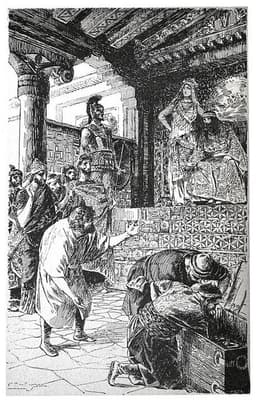
Croesus
Emperor · Ancient
50.6Total

Julius Caesar
General · Ancient
82.8Total
Basic Information
Born
-595
-100
Died
-546
-44
Era
Ancient
Ancient
Nationality
Lydia
Roman Republic
Occupation
Emperor
General
Civilization
Middle Eastern
Western
Score Comparison
Military (10%)
46.7
88.0
Political (20%)
68.0
78.0
Influence (20%)
54.1
85.0
Legacy (20%)
47.5
82.0
Leadership (15%)
40.0
80.0
Strategy (15%)
43.7
85.0
TOTAL
50.6
82.8
Croesus — Complete Timeline
550 BC
Dedication of Votive Offerings at DelphiCultural
Croesus sent numerous lavish gifts to the Oracle at Delphi, including gold and silver statues, bowls, and a golden lion. These offerings were among the most famous dedications in Greek history, symbolizing his legendary wealth and piety.
DelphiWealthReligion
Impact: regionalconstructive
547 BC
Defeat by Cyrus the Great at the Battle of ThymbraWar
Croesus led the Lydian army against the Persian forces of Cyrus the Great at Thymbra. The Lydian forces were defeated, leading to the siege and fall of Sardis. This battle ended the Kingdom of Lydia and incorporated it into the Persian Empire.
Lydian-Persian WarConquestFall of Lydia
Impact: regionaldestructive
Consultation of the Oracle at DelphiCultural◆ Major
Croesus consulted the Delphic oracle before attacking Persia, receiving the ambiguous prophecy that a great empire would fall. He interpreted this as Persia's defeat, but the fallen empire was his own. This event became a classic example of oracular ambiguity.
OracleProphecyLydian-Persian War
Impact: regionaltragic
546 BC
Capture and Near-Execution by CyrusPolitical Action◆ Major
After the fall of Sardis, Croesus was captured by Cyrus. According to Herodotus, Cyrus ordered Croesus to be burned alive, but the king's cries of 'Solon' caused Cyrus to reconsider and spare him. Croesus then became an advisor to Cyrus.
CaptivityCyrus the GreatHerodotus
Impact: regionaltragic
Julius Caesar — Complete Timeline
58 BC
Gallic WarsWar◆ Major
Caesar, as proconsul of Gaul, launched a series of campaigns that conquered all of Gaul (modern France, Belgium, and parts of Switzerland). He fought numerous battles, including against the Helvetii, the Belgae, and the Gallic chieftain Vercingetorix. The wars brought immense wealth and a loyal army to Caesar.
Gallic WarsConquestRoman Expansion
Impact: regional
49 BC
Crossing the RubiconPolitical Action◆ Major
Caesar led Legio XIII across the Rubicon River into Italy, defying the Roman Senate's order to disband his army. This act triggered a civil war against Pompey and the Optimates, ultimately leading to Caesar's dictatorship and the end of the Roman Republic.
Roman Civil WarEnd of RepublicPower Struggle
Impact: global
48 BC
Battle of PharsalusWar◆ Major
Caesar's outnumbered army defeated the larger forces of Pompey the Great at Pharsalus in Greece. Caesar's tactical use of a reserve line to counter Pompey's cavalry charge proved decisive. Pompey fled to Egypt, where he was assassinated, leaving Caesar as the undisputed master of the Roman world.
Roman Civil WarBattleDecisive Victory
Impact: regional
44 BC
Appointment as Dictator for LifePolitical Action◆ Major
The Roman Senate appointed Caesar dictator perpetuo (dictator for life), granting him unprecedented personal power. This move concentrated military, legislative, and judicial authority in one person, effectively ending the Roman Republic's traditional system of checks and balances and alarming many senators.
DictatorshipEnd of RepublicPower Consolidation
Impact: regionaldestructive
Assassination on the Ides of MarchPolitical Action◆ Major
A group of Roman senators, led by Marcus Junius Brutus and Gaius Cassius Longinus, stabbed Caesar to death at a meeting of the Senate in the Theatre of Pompey. The assassination was intended to restore the Republic, but instead triggered another civil war that led to the rise of the Roman Empire.
AssassinationRoman PoliticsEnd of Republic
Impact: globaldestructive
Expert Analysis
croesus-vs-julius-caesar
# The Weight of Gold and the Edge of a Sword
On a spring day in 546 BCE, the wealthiest man in the world knelt in the dust of his own burning capital, watching Persian soldiers pile wood for his execution pyre. Croesus of Lydia, whose name would become synonymous with unimaginable riches, was about to learn what his gold could not buy. Four centuries later, on the Ides of March in 44 BCE, another man—one who had conquered Gaul, crossed the Rubicon, and made himself master of Rome—fell beneath twenty-three dagger wounds at the foot of a statue of his greatest rival. Between these two moments lies the difference between a cautionary tale and a world-changing tragedy. Why did one king become a proverb for folly, while the other became a name that still echoes in every Western language?
Origins
Croesus was born around 595 BCE into a world of ancient certainties. Lydia, in what is now western Turkey, sat at the crossroads of Asia and Europe, its wealth built on the gold-rich river Pactolus and the invention of coinage itself. As king, Croesus inherited not just a throne but a system—the first in history to mint pure gold and silver coins, standardizing value across an empire. His power was measured in talents of gold, his diplomacy conducted through gifts that dazzled even the gods. When he sent offerings to Delphi, they included a golden lion weighing 600 pounds and a mixing bowl so massive it required a special foundation. He believed, as his world taught him, that wealth purchased favor, and favor secured destiny.
Julius Caesar was born in 100 BCE into a very different kind of certainty—the dying gasp of a republic. Rome had conquered the Mediterranean but could not govern itself. The senatorial aristocracy clung to power while generals amassed private armies. Caesar’s family was patrician but poor, his aunt married to Gaius Marius, the populist general who had defied the Senate. From childhood, Caesar understood that in Rome, gold was not enough. What mattered was the sword, the crowd, and the nerve to break every rule.
Rise to Power
Croesus came to power by inheritance. His path was clear: defend Lydia, expand its influence, and maintain the favor of the gods. When he looked east and saw the rising power of Persia under Cyrus the Great, he did what any prudent king would do—he consulted the oracles. The priests at Delphi delivered their famous ambiguity: if Croesus attacked Persia, a great empire would fall. He interpreted this as divine endorsement. He did not ask which empire.
Caesar’s rise was a masterpiece of calculated risk. Captured by pirates as a young man, he laughed at their ransom demand, promised to crucify them, and did exactly that after his release. He climbed the political ladder through debt, marriage alliances, and military command. His conquest of Gaul between 58 and 50 BCE was not just a war—it was a personal empire-building project, funded by plunder and staffed by soldiers loyal to him alone. When the Senate ordered him to disband his army, he crossed the Rubicon River into Italy, famously declaring *“Alea iacta est”*—the die is cast. He was not consulting oracles. He was making his own.
Leadership & Governance
Croesus governed as a traditional monarch. His wealth bought allies and temples, but his military strategy was static. At the Battle of Thymbra in 547 BCE, he faced Cyrus’s innovative use of camels to disrupt Lydian cavalry—a tactical adaptation Croesus could not match. His army was defeated, his capital Sardis fell, and his kingdom vanished. Herodotus tells us that as Croesus stood on the pyre, Cyrus asked him what he had learned. The Lydian king replied that no man is happy until he is dead—a wisdom acquired too late.
Caesar governed as a revolutionary. As dictator, he reformed the calendar, granted citizenship to provincials, initiated public works, and centralized power in ways that made the old republic obsolete. His military genius lay not just in winning battles—Alesia, Pharsalus, Zela—but in understanding that victory required political consolidation. He pardoned former enemies, promoted talent regardless of birth, and built a cult of personality that outlasted his death. Yet his fatal flaw was the same hubris that undid Croesus: he believed his position was secure. When warned about the Ides of March, he dismissed the soothsayer.
Triumph & Tragedy
Croesus’s greatest moment was also his worst. He had everything—gold, power, the favor of Delphi—and lost it all in a single battle. His tragedy is that he never understood the limits of his own system. Gold could buy oracles but not victory; it could build temples but not armies that could adapt. His capture and near-execution by Cyrus became the archetypal story of fallen pride. According to Herodotus, Cyrus spared Croesus after seeing the flames and hearing the king cry out Solon’s name—the Athenian lawgiver who had once told him that no life can be called happy until its end.
Caesar’s triumph was the conquest of Gaul, the defeat of Pompey, and the transformation of Rome. His tragedy was that he could not transform himself. He accepted dictatorship for life, wore the purple robe, and allowed statues of himself to be placed among the gods. On March 15, 44 BCE, a conspiracy of senators—many of them men he had pardoned—surrounded him in the Theatre of Pompey. He fell, according to Suetonius, covering his face with his toga as the daggers struck. He was 55 years old. He had changed the world, but he could not change the system that killed him.
Character & Destiny
Croesus was a man of his time—reverent, trusting, and ultimately naive. He believed that the universe was governed by divine reciprocity: give gold to the gods, receive victory from the gods. When that system failed, he had no backup plan. His character was defined by wealth, and wealth proved brittle.
Caesar was a man outside his time—cynical, calculating, and relentlessly ambitious. He understood that power was a human game, not a divine contract. He wrote his own commentaries, controlled his own image, and treated the republic as a stage. His character was defined by will, and will proved both his greatness and his undoing.
Legacy
Croesus survived in memory as a name—a synonym for riches, a warning against pride. His story, preserved by Herodotus, became a moral lesson for every generation that followed: gold does not guarantee greatness. His kingdom vanished, but his cautionary tale endures.
Caesar’s legacy is Rome itself. His name became a title—Kaiser, Tsar—worn by emperors for two millennia. His reforms outlived the republic he destroyed. His writings shaped Latin literature. His assassination did not restore the old order; it simply cleared the stage for Augustus. Caesar understood something Croesus never grasped: that the greatest power is not gold, but the story you leave behind.
Conclusion
Two ancient rulers, two different answers to the same question. Croesus believed that wealth was the foundation of power. Caesar believed that power was its own foundation. One trusted the gods and lost everything; one trusted himself and changed everything. In the end, both fell to the same human flaw—the belief that their world would last forever. But Caesar’s world, in a sense, did last. The Roman Empire, the Western tradition, the very idea of a secular state built on law and military might—these are his children. Croesus left only a proverb. The difference is not in what they had, but in what they understood.
Rankings
🥇
Julius CaesarLeader
Mil: 88.0Pol: 78.0Inf: 85.0
82.8
🥈
Croesus
Mil: 46.7Pol: 68.0Inf: 54.1
50.6
+32.2 behind
How This Comparison Works
Algorithm
Each figure is scored on 6 dimensions (0—100 scale) based on structured historical data: Military (10%), Political (20%), Influence (20%), Legacy (20%), Leadership (15%), Strategy (15%). The weighted total produces the final ranking.
Data Sources
Scores are computed from structured sub-indicators in the database. Scale factors adjust for era (Ancient ×0.85, Modern ×1.0) and civilization size (Eastern ×1.05, Other ×0.80) to account for differences in population and military scale.
Maximum 3 Figures
Comparisons are limited to 2—3 figures to ensure readability and statistical meaningfulness.
Error Margins
±5 points per dimension — Sub-scores are derived from historical records with inherent uncertainty. Two figures within 5 points on a dimension should be considered roughly equivalent in that area.
Total Score Accuracy
±3 points overall — The weighted combination of 6 dimensions produces a total score with approximately ±3 points of uncertainty. Differences of less than 3 points are not statistically significant— the figures are effectively tied.
Known Limitations
- Historical records are incomplete and uneven across civilizations
- Figures from oral-tradition societies may be underrepresented
- Occupation labels can misclassify multi-role figures
- Scores measure capability and impact, not moral character
- Quantitative scoring is a comparison tool, not absolute truth
Capability Radar
Military (10%) — Battles & Warfare
Battles
30
95
Win Rate
20
92
Expansion
35
97
Political (20%) — Governance & Reform
Reform
40
90
Diplomacy
50
85
Economy
85
82
Influence (20%) — Cultural & Global Reach
Cultural
45
88
Global
40
94
Legacy (20%) — Historical Impact
Historical
55
95
Longevity
50
96
Leadership (15%) — Power & Stability
Tenure
60
75
Stability
55
60
Strategy (15%) — Tactics & Innovation
Strategy
20
94
Tactics
25
96
Reform
10
88
Similar Comparisons
Comments & Discussion
No comments yet. Be the first to share your thoughts!