Loading...
Cornelis Tromp vs Erich von Manstein
Erich von Manstein leads by 4.4 pts · 2 figures compared
…

Cornelis Tromp
General · Modern
51.8Total
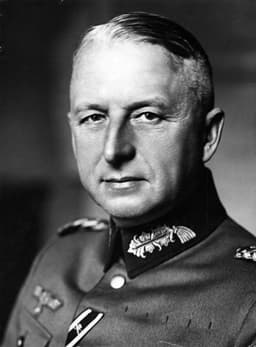
Erich von Manstein
General · Modern
56.2Total
Basic Information
Born
1629
1887
Died
1691
1973
Era
Modern
Modern
Nationality
Netherlands
Germany
Occupation
General
General
Civilization
Western
Western
Score Comparison
Military (10%)
65.0
72.0
Political (20%)
36.5
35.1
Influence (20%)
58.0
65.0
Legacy (20%)
48.3
55.0
Leadership (15%)
43.8
43.8
Strategy (15%)
66.3
72.0
TOTAL
51.8
56.2
Cornelis Tromp — Complete Timeline
1658 AD
Battle of the SoundWar◆ Major
Cornelis Tromp commanded a Dutch squadron in the Battle of the Sound, supporting the Dutch Republic's ally Denmark against Sweden. The Dutch victory broke the Swedish blockade of Copenhagen and secured Danish independence.
Dano-Swedish WarNaval BattleDutch Intervention
Impact: regional
1672 AD
Battle of SolebayWar
Tromp served as a vice-admiral under Michiel de Ruyter at the Battle of Solebay. He commanded the rear squadron and fought aggressively against the English fleet, contributing to the Dutch strategic success in preventing an invasion.
Third Anglo-Dutch WarNaval BattleDutch Defense
Impact: regional
1673 AD
Battle of the TexelWar◆ Major
Tromp commanded the van squadron of the Dutch fleet at the Battle of the Texel. His aggressive tactics helped secure a Dutch tactical victory over the Anglo-French fleet, preventing an invasion of the Netherlands.
Franco-Dutch WarNaval BattleDutch Victory
Impact: regional
1676 AD
Dismissed from the NavyPolitical Action
Tromp was dismissed from the Dutch navy after a conflict with the States General over his conduct and insubordination. He was later reinstated but the dismissal reflected his difficult personality and political rivalries.
Dutch NavyDisputeDismissal
Impact: nationaldestructive
1679 AD
Appointed Lieutenant-Admiral of the Admiralty of AmsterdamPolitical Action
Tromp was appointed Lieutenant-Admiral of the Admiralty of Amsterdam, one of the highest naval commands in the Dutch Republic. This appointment restored his career after his earlier dismissal.
Dutch NavyNaval CommandReinstatement
Impact: nationalconstructive
Erich von Manstein — Complete Timeline
1942 AD
Battle of SevastopolWar◆ Major
Manstein commanded the 11th Army in the assault on the Soviet fortress of Sevastopol in Crimea. After a prolonged siege, German forces captured the city in July 1942. For this victory, Manstein was promoted to field marshal.
World War IIEastern FrontSiege
Impact: regionaldestructive
1943 AD
Battle of KurskWar◆ Major
Manstein commanded Army Group South during the Battle of Kursk, the largest tank battle in history. His forces achieved tactical successes at Prokhorovka but failed to break through Soviet defenses. The German offensive was halted, marking a strategic defeat on the Eastern Front.
World War IIEastern FrontTank Battle
Impact: globaldestructive
1944 AD
Planning of the Ardennes OffensiveWar◆ Major
Manstein did not plan the Ardennes Offensive; that was Hitler's plan. Manstein was the primary planner of the 1940 Ardennes offensive through Belgium and France. His plan, known as the Manstein Plan, involved a surprise armored thrust through the Ardennes forest, leading to the rapid defeat of France.
World War IIBattle of FranceMilitary Strategy
Impact: global
Dismissal by HitlerPolitical Action◆ Major
After repeated disagreements with Hitler over military strategy, Manstein was dismissed from command of Army Group South in March 1944. He was replaced by Walter Model and never held another active command during the war.
World War IICommand ChangeHitler
Impact: national
1949 AD
Trial and ImprisonmentPolitical Action◆ Major
Manstein was tried by a British military court in Hamburg for war crimes, including the use of scorched earth tactics and mistreatment of prisoners. He was convicted on several counts and sentenced to 18 years imprisonment, but was released in 1953 due to health reasons.
War Crimes TrialPost-WarJustice
Impact: nationaltragic
Expert Analysis
Origins
Cornelis Tromp was born on September 9, 1629 in Rotterdam, Netherlands, into a naval family. His father, Maarten Tromp, was a celebrated Dutch admiral. Cornelis joined the navy at a young age, serving under his father and later under other commanders. He received practical training at sea, but his education was informal, shaped by the maritime culture of the Dutch Republic.
Erich von Manstein was born on November 24, 1887 in Berlin, Germany, into an aristocratic Prussian military family. His birth name was Erich von Lewinski; he was adopted by his uncle. He attended the Prussian Cadet Corps and the War Academy, receiving a formal military education. He served as a staff officer in World War I, gaining experience in operational planning.
Rise to Power
Cornelis Tromp rose through the ranks due to his family name and personal bravery. In 1653, he was promoted to captain, and by 1659 he was a vice-admiral. His major breakthrough came in the Battle of the Sound (1658) where he commanded a Dutch squadron supporting Denmark against Sweden. The Dutch victory secured his reputation. He later served under Michiel de Ruyter in the Second Anglo-Dutch War, but his insubordination led to conflicts. In 1673, he was dismissed from the navy after a dispute with the States General, but was reinstated in 1676 as Lieutenant-Admiral of the Admiralty of Amsterdam.
Erich von Manstein's rise was due to his strategic acumen. In World War II, he served as chief of staff to Gerd von Rundstedt during the invasion of Poland (1939). He then conceived the plan for the 1940 Ardennes offensive, which led to the fall of France. This earned him command of the 11th Army in 1941, and later command of Army Group Don (later South) in 1942. He was promoted to field marshal in 1942 after the capture of Sevastopol.
Leadership & Governance
Tromp's leadership style was aggressive and personal. He led from the front, often engaging in close combat. His governance approach was confrontational: he frequently clashed with political authorities, leading to his dismissal. He scored 43.8 in leadership, reflecting his inability to manage superiors and peers. For example, at the Battle of Solebay (1672), he fought fiercely but his insubordination created friction with de Ruyter.
Manstein's leadership was more systematic. He was a master of operational warfare, using maneuver and combined arms. He scored 43.8 in leadership as well, but this was due to his conflict with Hitler over strategy. Manstein often argued for tactical withdrawals, which Hitler opposed. His governance approach was to follow military logic, even when it meant disobeying orders indirectly. For instance, during the Battle of Kursk (1943), he advocated for a defensive stance after the initial offensive failed, but was overruled.
Triumph & Tragedy
Tromp's greatest success was the Battle of the Sound (1658), where his squadron's actions helped Denmark and weakened Sweden. His aggressive tactics at the Battle of the Texel (1673) also contributed to a Dutch victory. However, his greatest failure was his insubordination, which led to his dismissal and limited his career. He never achieved the highest command like de Ruyter.
Manstein's triumph was the 1940 Ardennes offensive, a brilliant plan that bypassed the Maginot Line and captured France in six weeks. His capture of Sevastopol in 1942 was a major siege victory. His tragedy was the Battle of Kursk, where his forces failed to achieve a decisive breakthrough despite tactical successes. He was also convicted of war crimes for scorched-earth tactics, tarnishing his legacy. He scored 72.0 in military and 72.0 in strategy, reflecting his operational genius but also his involvement in unethical actions.
Character & Destiny
Tromp was bold and impetuous. His character drove him to take risks, but also led to conflicts with authority. His destiny was to remain a subordinate commander, never achieving the political influence of his father. Historical assessments note his courage but temper.
Manstein was calculating and strategic. He believed in professional military autonomy, which clashed with Hitler's control. His character led him to implement plans that were effective but sometimes morally questionable. His destiny was to be dismissed and later imprisoned. He scored 35.1 in political, showing his inability to navigate Nazi politics.
Legacy
Tromp's legacy is as a capable but flawed admiral in the Dutch Golden Age. He influenced naval tactics but is overshadowed by de Ruyter. He is remembered in the Netherlands as a patriotic figure. His impact on naval warfare is limited.
Manstein's legacy is as one of the greatest operational commanders in history. His writings influenced post-war military theory, especially in NATO. However, his involvement in war crimes and the Nazi regime complicates his reputation. He scored 55.0 in legacy, reflecting both his military contributions and ethical failures.
Conclusion
Erich von Manstein had greater impact than Cornelis Tromp. His strategic innovations changed warfare, and his ideas continue to be studied. Tromp's impact was limited to his era and region. Manstein's total score of 56.2 vs. Tromp's 51.8 reflects this, though both had similar leadership scores (43.8 each). Manstein's military (72.0) and strategy (72.0) scores far exceed Tromp's 65.0 and 66.3. While Tromp was a competent admiral, Manstein's influence on military thought and his role in major campaigns give him a clear edge in historical significance.
Rankings
🥇
Erich von MansteinLeader
Mil: 72.0Pol: 35.1Inf: 65.0
56.2
🥈
Cornelis Tromp
Mil: 65.0Pol: 36.5Inf: 58.0
51.8
+4.4 behind
How This Comparison Works
Algorithm
Each figure is scored on 6 dimensions (0—100 scale) based on structured historical data: Military (10%), Political (20%), Influence (20%), Legacy (20%), Leadership (15%), Strategy (15%). The weighted total produces the final ranking.
Data Sources
Scores are computed from structured sub-indicators in the database. Scale factors adjust for era (Ancient ×0.85, Modern ×1.0) and civilization size (Eastern ×1.05, Other ×0.80) to account for differences in population and military scale.
Maximum 3 Figures
Comparisons are limited to 2—3 figures to ensure readability and statistical meaningfulness.
Error Margins
±5 points per dimension — Sub-scores are derived from historical records with inherent uncertainty. Two figures within 5 points on a dimension should be considered roughly equivalent in that area.
Total Score Accuracy
±3 points overall — The weighted combination of 6 dimensions produces a total score with approximately ±3 points of uncertainty. Differences of less than 3 points are not statistically significant— the figures are effectively tied.
Known Limitations
- Historical records are incomplete and uneven across civilizations
- Figures from oral-tradition societies may be underrepresented
- Occupation labels can misclassify multi-role figures
- Scores measure capability and impact, not moral character
- Quantitative scoring is a comparison tool, not absolute truth
Capability Radar
Military (10%) — Battles & Warfare
Battles
75
85
Win Rate
70
80
Expansion
40
75
Political (20%) — Governance & Reform
Reform
10
20
Diplomacy
40
25
Economy
15
15
Influence (20%) — Cultural & Global Reach
Cultural
40
55
Global
40
65
Legacy (20%) — Historical Impact
Historical
50
75
Longevity
40
60
Leadership (15%) — Power & Stability
Tenure
20
30
Stability
20
10
Strategy (15%) — Tactics & Innovation
Strategy
65
90
Tactics
80
95
Reform
30
70
Similar Comparisons
Comments & Discussion
No comments yet. Be the first to share your thoughts!