Loading...
This comparison has not been analyzed yet.
One-time AI generation (~1 minute). Scores and timeline are already available below.
Corazon Aquino vs Eduardo Frei Ruiz-Tagle
Corazon Aquino leads by 4.4 pts · 2 figures compared
…

Corazon Aquino
Politician · Modern
55.5Total
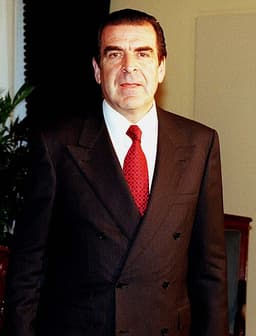
Eduardo Frei Ruiz-Tagle
Politician · Modern
51.1Total
Basic Information
Born
1933
1942
Died
—
—
Era
Modern
Modern
Nationality
Philippines
Chile
Occupation
Politician
Politician
Civilization
Eastern
Western
Score Comparison
Military (10%)
13.0
50.0
Political (20%)
72.0
45.0
Influence (20%)
68.0
55.7
Legacy (20%)
52.0
45.0
Leadership (15%)
66.0
66.0
Strategy (15%)
35.3
42.9
TOTAL
55.5
51.1
Corazon Aquino — Complete Timeline
1986 AD
People Power RevolutionPolitical Action
Corazon Aquino led the People Power Revolution, a series of nonviolent protests that ousted dictator Ferdinand Marcos. She was installed as the 11th President of the Philippines, the first female to hold the office.
RevolutionNonviolentDemocracy
Impact: nationalconstructive
Restored DemocracyPolitical Action◆ Major
Aquino abolished the 1973 Marcos constitution and restored democratic institutions. She appointed a commission to draft a new constitution, which was ratified in 1987, re-establishing a presidential system with checks and balances.
ConstitutionDemocracyReform
Impact: nationalconstructive
1987 AD
Faced Multiple Coup AttemptsPolitical Action◆ Major
Aquino's government survived several coup attempts by military factions loyal to Marcos. The most serious was in August 1987, when rebel soldiers attacked the presidential palace. The government suppressed the rebellion with U.S. support.
Coup AttemptMilitaryStability
Impact: national
1988 AD
Land Reform ProgramReform◆ Major
Aquino signed the Comprehensive Agrarian Reform Program (CARP), aiming to redistribute land to tenant farmers. Implementation was slow and faced opposition from landowners, limiting its impact.
Land ReformAgricultureSocial Justice
Impact: nationalconstructive
Eduardo Frei Ruiz-Tagle — Complete Timeline
1994 AD
Elected President of ChilePolitical Action◆ Major
Frei Ruiz-Tagle won the presidency as the candidate of the Concertaci
ElectionChileDemocracy
Impact: nationalconstructive
1996 AD
Signed free trade agreementsPolitical Action◆ Major
Frei's government signed free trade agreements with Canada, Mexico, and the European Union. These agreements boosted Chilean exports and integrated the country into the global economy.
TradeChileGlobalization
Impact: globalconstructive
1997 AD
Reformed the judicial systemReform◆ Major
Frei's government implemented a major judicial reform, replacing the inquisitorial system with an adversarial one. The reform aimed to increase transparency and efficiency in the courts.
Judicial ReformChileRule of Law
Impact: nationalconstructive
This comparison has not been analyzed yet.
One-time AI generation (~1 minute). Scores and timeline are already available below.
Rankings
🥇
Corazon AquinoLeader
Mil: 13.0Pol: 72.0Inf: 68.0
55.5
🥈
Eduardo Frei Ruiz-Tagle
Mil: 50.0Pol: 45.0Inf: 55.7
51.1
+4.4 behind
How This Comparison Works
Algorithm
Each figure is scored on 6 dimensions (0—100 scale) based on structured historical data: Military (10%), Political (20%), Influence (20%), Legacy (20%), Leadership (15%), Strategy (15%). The weighted total produces the final ranking.
Data Sources
Scores are computed from structured sub-indicators in the database. Scale factors adjust for era (Ancient ×0.85, Modern ×1.0) and civilization size (Eastern ×1.05, Other ×0.80) to account for differences in population and military scale.
Maximum 3 Figures
Comparisons are limited to 2—3 figures to ensure readability and statistical meaningfulness.
Error Margins
±5 points per dimension — Sub-scores are derived from historical records with inherent uncertainty. Two figures within 5 points on a dimension should be considered roughly equivalent in that area.
Total Score Accuracy
±3 points overall — The weighted combination of 6 dimensions produces a total score with approximately ±3 points of uncertainty. Differences of less than 3 points are not statistically significant— the figures are effectively tied.
Known Limitations
- Historical records are incomplete and uneven across civilizations
- Figures from oral-tradition societies may be underrepresented
- Occupation labels can misclassify multi-role figures
- Scores measure capability and impact, not moral character
- Quantitative scoring is a comparison tool, not absolute truth
Capability Radar
Military (10%) — Battles & Warfare
Battles
15
30
Win Rate
16
30
Expansion
21
35
Political (20%) — Governance & Reform
Reform
65
55
Diplomacy
70
60
Economy
40
65
Influence (20%) — Cultural & Global Reach
Cultural
70
30
Global
65
35
Legacy (20%) — Historical Impact
Historical
75
40
Longevity
60
30
Leadership (15%) — Power & Stability
Tenure
60
60
Stability
55
55
Strategy (15%) — Tactics & Innovation
Strategy
23
36
Tactics
25
43
Reform
30
45
Similar Comparisons
Comments & Discussion
No comments yet. Be the first to share your thoughts!