Loading...
Constantius I vs Deiotarus of Galatia
Constantius I leads by 14.6 pts · 2 figures compared
…
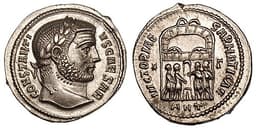
Constantius I
Emperor · Ancient
57.8Total

Deiotarus of Galatia
Emperor · Ancient
43.2Total
Basic Information
Born
250
-90
Died
306
-40
Era
Ancient
Ancient
Nationality
Roman Empire
Galatia
Occupation
Emperor
Emperor
Civilization
Western
Western
Score Comparison
Military (10%)
50.0
25.0
Political (20%)
68.0
40.8
Influence (20%)
54.9
46.3
Legacy (20%)
50.0
36.7
Leadership (15%)
74.0
62.2
Strategy (15%)
52.5
45.0
TOTAL
57.8
43.2
Constantius I — Complete Timeline
296 AD
Recovery of Britain from Carausius and AllectusWar◆ Major
Constantius I led an invasion to reclaim Britain from the usurper Allectus, who had succeeded Carausius. His forces landed near London and defeated Allectus, restoring Britain to the Roman Empire and ending the breakaway Britannic Empire.
BritainReconquestUsurper
Impact: regionalconstructive
298 AD
Campaign against the AlemanniWar◆ Major
Constantius I defeated the Alemanni at the Battle of Lingones (modern Langres) and later at Vindonissa. These victories secured the Rhine frontier and earned him the title Germanicus Maximus, strengthening his reputation as a capable military commander.
CampaignAlemanniRhine Frontier
Impact: regional
305 AD
Elevation to AugustusPolitical Action◆ Major
Upon the abdication of Diocletian and Maximian, Constantius I became the senior Augustus of the Western Roman Empire as part of the Tetrarchy. He ruled jointly with Galerius in the East, but his reign was short-lived as he died the following year.
TetrarchySuccessionAugustus
Impact: global
306 AD
Death at Eboracum (York)Other◆ Major
Constantius I died at Eboracum (modern York) while on campaign against the Picts in northern Britain. His son Constantine was proclaimed Augustus by the troops, setting the stage for Constantine's eventual rise to sole emperor.
DeathSuccessionConstantine
Impact: global
Toleration of Christians (Edict of Milan precursor)Political Action
Constantius I, unlike his co-emperor Galerius, was tolerant of Christians and did not enforce the Diocletianic persecution in his territories. This policy of religious tolerance foreshadowed the Edict of Milan issued by his son Constantine.
ToleranceChristianityReligion
Impact: regionalconstructive
Deiotarus of Galatia — Complete Timeline
45 BC
Defense Before Cicero in the Roman SenatePolitical Action◆ Major
Deiotarus of Galatia was accused of plotting to assassinate Julius Caesar. The orator Cicero defended him in a speech before the Roman Senate, arguing his loyalty. Deiotarus was acquitted, retaining his kingdom.
TrialCiceroGalatia
Impact: regionalconstructive
Expert Analysis
Origins
Constantius I, born around 250 AD in Illyria (modern Balkans), was of humble origins, possibly the son of a military officer. He rose through the Roman army, serving under Emperor Aurelian and later under Diocletian. His career was marked by steady advancement, eventually becoming a caesar in the Tetrarchy in 293 AD. Deiotarus of Galatia, born around 120 BC, was a Galatian noble, likely of Celtic descent. Galatia was a region in central Anatolia settled by Celtic tribes. Deiotarus became a tetrarch, ruling over one of the four Galatian tribes, and later united them under his kingship. His early life was shaped by the Hellenistic and Roman influences in Asia Minor.
Rise to Power
Constantius I's rise was tied to the Tetrarchic system established by Diocletian. In 293 AD, he was appointed caesar (junior emperor) to Maximian, tasked with governing Gaul and Britain. His major achievement was the recovery of Britain from the usurper Allectus in 296 AD. He defeated Allectus near London, restoring Roman control. In 305 AD, upon the abdication of Diocletian and Maximian, Constantius became the senior Augustus of the West. Deiotarus rose to power as a tetrarch among the Galatians, but his influence grew through alliances with Rome. He supported the Roman general Pompey against Mithridates VI of Pontus, and later sided with the Roman Senate against Julius Caesar. After Caesar's victory, Deiotarus was accused of plotting against Caesar, leading to his defense by Cicero in 45 BC. Despite the accusation, he retained his kingdom due to Cicero's oratory and his own diplomatic skill.
Leadership & Governance
Constantius I's leadership was pragmatic and effective. As caesar and later Augustus, he focused on securing the Rhine frontier, defeating the Alemanni at the Battles of Lingones (298 AD) and Vindonissa (302 AD). He also reformed the administration of Gaul and Britain, promoting stability. His governance was marked by religious tolerance: unlike his co-emperor Galerius, he did not enforce the Diocletianic persecution of Christians, which later influenced his son Constantine's policies. Deiotarus ruled as a client king under Roman suzerainty. He maintained order in Galatia, raised troops for Roman campaigns, and navigated the complex politics of the late Republic. His leadership score of 62.2 reflects his ability to maintain power despite accusations and shifting allegiances.
Triumph & Tragedy
Constantius I's greatest triumph was the reconquest of Britain from Allectus in 296 AD, which secured the western provinces. His victory over the Alemanni also stabilized the Rhine. His tolerance of Christians was a significant political move, earning him goodwill. However, his reign was short as senior Augustus (only one year), and he died at Eboracum (York) in 306 AD while campaigning against the Picts. His death triggered a succession crisis, as his son Constantine was proclaimed Augustus by the troops, leading to civil wars. Deiotarus's triumph was his successful defense before the Roman Senate, securing his kingdom. He also expanded his territory through diplomacy. However, his failure to fully align with Caesar's faction led to his accusation and diminished influence. He died around 40 BC, his kingdom later absorbed into the Roman province of Galatia.
Character & Destiny
Constantius I was known for his competence and moderation. He was a capable general and administrator, but his early death prevented him from shaping the empire directly. His character, especially his religious tolerance, set the stage for Constantine's later Edict of Milan. Deiotarus was a shrewd diplomat, able to navigate Roman politics. His defense by Cicero shows his ability to secure powerful patrons. However, his reliance on Roman favor limited his independence. Both figures were shaped by the larger forces of the Roman Empire, but Constantius I's destiny was to be a transitional figure, while Deiotarus was a local king who ultimately could not resist Roman expansion.
Legacy
Constantius I's legacy is overshadowed by his son Constantine the Great, but his military campaigns and tolerance of Christians were crucial. He is remembered as a stabilizing force in the Tetrarchy. His death at York led to Constantine's proclamation, a pivotal moment in history. Deiotarus's legacy is more localized: he is remembered as a Galatian king who maintained his kingdom under Roman domination, and his defense by Cicero is a famous example of Roman oratory. However, his kingdom did not endure, and he scored 36.7 in legacy, reflecting his limited long-term impact.
Conclusion
Constantius I had a greater impact than Deiotarus. With a total score of 57.8 compared to Deiotarus's 43.2, Constantius I's military and political actions directly influenced the Roman Empire's stability and the rise of Christianity. His military score of 50.0, though modest, reflects his victories, while Deiotarus's 25.0 shows his lack of major campaigns. Constantius I's leadership score of 74.0 indicates his effective governance, whereas Deiotarus's 62.2 shows his skill in diplomacy. Ultimately, Constantius I's role as father of Constantine and his policies shaped Western civilization, while Deiotarus remained a minor client king. Constantius I is the more significant figure.
Rankings
🥇
Constantius ILeader
Mil: 50.0Pol: 68.0Inf: 54.9
57.8
🥈
Deiotarus of Galatia
Mil: 25.0Pol: 40.8Inf: 46.3
43.2
+14.6 behind
How This Comparison Works
Algorithm
Each figure is scored on 6 dimensions (0—100 scale) based on structured historical data: Military (10%), Political (20%), Influence (20%), Legacy (20%), Leadership (15%), Strategy (15%). The weighted total produces the final ranking.
Data Sources
Scores are computed from structured sub-indicators in the database. Scale factors adjust for era (Ancient ×0.85, Modern ×1.0) and civilization size (Eastern ×1.05, Other ×0.80) to account for differences in population and military scale.
Maximum 3 Figures
Comparisons are limited to 2—3 figures to ensure readability and statistical meaningfulness.
Error Margins
±5 points per dimension — Sub-scores are derived from historical records with inherent uncertainty. Two figures within 5 points on a dimension should be considered roughly equivalent in that area.
Total Score Accuracy
±3 points overall — The weighted combination of 6 dimensions produces a total score with approximately ±3 points of uncertainty. Differences of less than 3 points are not statistically significant— the figures are effectively tied.
Known Limitations
- Historical records are incomplete and uneven across civilizations
- Figures from oral-tradition societies may be underrepresented
- Occupation labels can misclassify multi-role figures
- Scores measure capability and impact, not moral character
- Quantitative scoring is a comparison tool, not absolute truth
Capability Radar
Military (10%) — Battles & Warfare
Battles
45
35
Win Rate
50
40
Expansion
35
30
Political (20%) — Governance & Reform
Reform
45
25
Diplomacy
55
55
Economy
50
30
Influence (20%) — Cultural & Global Reach
Cultural
30
20
Global
40
15
Legacy (20%) — Historical Impact
Historical
55
25
Longevity
60
15
Leadership (15%) — Power & Stability
Tenure
50
45
Stability
55
35
Strategy (15%) — Tactics & Innovation
Strategy
60
35
Tactics
55
30
Reform
40
20
Similar Comparisons
Comments & Discussion
No comments yet. Be the first to share your thoughts!