Loading...
Constantine XI Palaiologos vs Julius Caesar
Julius Caesar leads by 39.6 pts · 2 figures compared
…
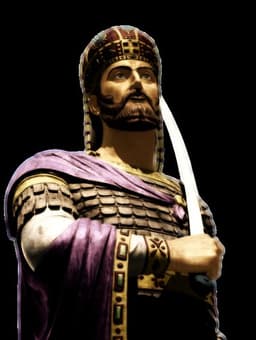
Constantine XI Palaiologos
Emperor · Medieval
43.2Total

Julius Caesar
General · Ancient
82.8Total
Basic Information
Born
1405
-100
Died
1453
-44
Era
Medieval
Ancient
Nationality
Byzantine Empire
Roman Republic
Occupation
Emperor
General
Civilization
Western
Western
Score Comparison
Military (10%)
21.2
88.0
Political (20%)
27.9
78.0
Influence (20%)
59.0
85.0
Legacy (20%)
50.0
82.0
Leadership (15%)
39.0
80.0
Strategy (15%)
38.3
85.0
TOTAL
43.2
82.8
Constantine XI Palaiologos — Complete Timeline
1452 AD
Attempt to secure Western aid for Constantinople's defensePolitical Action
Constantine XI sought military assistance from Western Europe, including the Papacy and Venice, but received only limited support. The failure to secure substantial aid weakened the city's defenses.
DiplomacyOttoman WarsByzantine Empire
Impact: regional
1453 AD
Death at the Fall of ConstantinopleWar
Constantine XI Palaiologos died defending the walls of Constantinople during the final Ottoman assault led by Sultan Mehmed II. His death marked the end of the Byzantine Empire and the Roman imperial tradition.
Fall of ConstantinopleOttoman ConquestEnd of Empire
Impact: globaltragic
Refusal to surrender Constantinople to Mehmed IIPolitical Action◆ Major
Constantine XI rejected Sultan Mehmed II's offer of safe passage and rule over the Morea in exchange for surrendering Constantinople. He chose to defend the city to the death.
SiegeOttoman WarsByzantine Empire
Impact: regional
Julius Caesar — Complete Timeline
58 BC
Gallic WarsWar◆ Major
Caesar, as proconsul of Gaul, launched a series of campaigns that conquered all of Gaul (modern France, Belgium, and parts of Switzerland). He fought numerous battles, including against the Helvetii, the Belgae, and the Gallic chieftain Vercingetorix. The wars brought immense wealth and a loyal army to Caesar.
Gallic WarsConquestRoman Expansion
Impact: regional
49 BC
Crossing the RubiconPolitical Action◆ Major
Caesar led Legio XIII across the Rubicon River into Italy, defying the Roman Senate's order to disband his army. This act triggered a civil war against Pompey and the Optimates, ultimately leading to Caesar's dictatorship and the end of the Roman Republic.
Roman Civil WarEnd of RepublicPower Struggle
Impact: global
48 BC
Battle of PharsalusWar◆ Major
Caesar's outnumbered army defeated the larger forces of Pompey the Great at Pharsalus in Greece. Caesar's tactical use of a reserve line to counter Pompey's cavalry charge proved decisive. Pompey fled to Egypt, where he was assassinated, leaving Caesar as the undisputed master of the Roman world.
Roman Civil WarBattleDecisive Victory
Impact: regional
44 BC
Appointment as Dictator for LifePolitical Action◆ Major
The Roman Senate appointed Caesar dictator perpetuo (dictator for life), granting him unprecedented personal power. This move concentrated military, legislative, and judicial authority in one person, effectively ending the Roman Republic's traditional system of checks and balances and alarming many senators.
DictatorshipEnd of RepublicPower Consolidation
Impact: regionaldestructive
Assassination on the Ides of MarchPolitical Action◆ Major
A group of Roman senators, led by Marcus Junius Brutus and Gaius Cassius Longinus, stabbed Caesar to death at a meeting of the Senate in the Theatre of Pompey. The assassination was intended to restore the Republic, but instead triggered another civil war that led to the rise of the Roman Empire.
AssassinationRoman PoliticsEnd of Republic
Impact: globaldestructive
Expert Analysis
Origins
Constantine XI Palaiologos was born on February 8, 1405, in Constantinople, the eighth child of Emperor Manuel II Palaiologos and Helena Dragaš. As a member of the Palaiologos dynasty, he grew up in a shrinking empire beset by Ottoman expansion. He served as despot of the Morea from 1428, gaining military experience in campaigns against the Ottomans and the Latin Principality of Achaea. His early education emphasized Orthodox theology and Roman administrative traditions.
Julius Caesar was born on July 12, 100 BCE, in Rome into the patrician Julian family, which claimed descent from the goddess Venus. His father, Gaius Julius Caesar the Elder, died when Caesar was 16, leaving him under the protection of his mother, Aurelia. Caesar received a Hellenistic education, studying rhetoric, philosophy, and military tactics. He became a priest of Jupiter (flamen Dialis) and later served in the military, winning the Civic Crown for bravery at the Siege of Mytilene in 81 BCE.
Rise to Power
Constantine XI became emperor on January 6, 1449, after the death of his brother John VIII Palaiologos. His coronation was performed by the local metropolitan rather than the Patriarch, reflecting the desperate state of the empire. Constantine immediately faced the Ottoman threat, as Sultan Mehmed II prepared to besiege Constantinople. He attempted to secure Western aid by agreeing to the Union of Churches at the Council of Florence (1439), but this alienated many Orthodox subjects. Constantine's rise was essentially inherited, not earned through conquest.
Julius Caesar rose through military and political ambition. He served as quaestor in 69 BCE, aedile in 65 BCE, and praetor in 62 BCE. He formed the First Triumvirate with Pompey and Crassus in 60 BCE, securing the consulship in 59 BCE. His proconsulship of Gaul (58-50 BCE) provided the platform for his rise: he conquered Gaul, amassed wealth, and built a loyal army. The Rubicon crossing on January 10, 49 BCE, triggered civil war, culminating in his dictatorship. Caesar's rise was driven by personal initiative and strategic alliances.
Leadership & Governance
Constantine XI governed a dying empire with limited resources. He focused on fortifying Constantinople and seeking Western military aid, but his leadership was reactive. He rejected Mehmed II's offer to surrender the city in exchange for rule over the Morea, choosing to die defending the walls. His governance was constrained by Byzantine bureaucracy and religious divisions; his support for the Union of Churches undermined his legitimacy among Orthodox citizens. Constantine scored 36.1 in leadership, reflecting his inability to inspire effective resistance.
Julius Caesar was a transformative leader who centralized power and implemented reforms. As dictator, he restructured Roman government, expanded the Senate, introduced the Julian calendar, and initiated public works. He granted citizenship to provincials and reformed debt laws. His leadership style combined clemency (clementia) toward former enemies with decisive military command. Caesar scored 82.0 in leadership, demonstrating his ability to command loyalty and enact change. However, his accumulation of power alienated the Senate, leading to his assassination.
Triumph & Tragedy
Constantine XI's greatest triumph was his defiance in the face of overwhelming odds. He organized the defense of Constantinople, inspiring citizens and soldiers to resist the Ottoman army of 80,000 with only 7,000 defenders. His refusal to surrender preserved his honor as the last Roman emperor. His greatest tragedy was the fall of Constantinople on May 29, 1453, after a 53-day siege. He died in the fighting, his body never identified. The city's fall marked the end of the Roman Empire and the Byzantine state.
Julius Caesar's greatest triumph was the conquest of Gaul (58-50 BCE), which extended Roman territory to the Rhine and Atlantic. His victory at the Battle of Alesia (52 BCE) against Vercingetorix showcased his military genius. He also defeated Pompey at Pharsalus (48 BCE) and consolidated power. His tragedy was his assassination on the Ides of March (March 15, 44 BCE) by senators who feared his monarchy. Caesar's death plunged Rome into civil war, ultimately ending the Republic. He scored 88.0 in military and 78.0 in political, reflecting his dual success and failure.
Character & Destiny
Constantine XI was known for his piety, courage, and resignation. He accepted his fate as the defender of Christendom, refusing to abandon his city. His character was shaped by Orthodox faith and Roman tradition, but he lacked the strategic vision to save his empire. Historians describe him as a tragic figure whose destiny was tied to Constantinople's fall. His scores in strategy (65.7) and military (30.0) indicate limited tactical skill but symbolic importance.
Julius Caesar was ambitious, calculating, and charismatic. He took risks (crossing the Rubicon) and showed clemency to defeated enemies. His character combined military brilliance with political acumen, but his arrogance and disregard for republican norms led to his downfall. Caesar's destiny was to transform Rome, but he failed to secure his own safety. His military score of 88.0 and strategy of 88.0 reflect his genius, while his political score of 78.0 shows his ultimate miscalculation.
Legacy
Constantine XI's legacy is as the last Roman emperor, a symbol of resistance and martyrdom. His death marked the end of an era, but his defiance inspired later Greek and Orthodox nationalism. The city of Constantinople became Istanbul, and the Byzantine Empire gave way to Ottoman rule. His influence score of 73.6 reflects his symbolic importance, but his actual impact on world history is limited. The fall of Constantinople accelerated the Renaissance as Greek scholars fled west, but Constantine's personal role was minimal.
Julius Caesar's legacy is immense. He transformed the Roman Republic into an empire, setting the stage for Augustus. His conquests expanded Roman civilization, and his reforms influenced Western law, language, and governance. The title "Caesar" became synonymous with emperor. His assassination led to the end of the Republic, but his adopted heir Octavian (Augustus) realized his vision. Caesar's influence score of 85.0 and legacy of 82.0 confirm his enduring impact. He is studied as a military genius and political master.
Conclusion
Julius Caesar had a far greater impact than Constantine XI Palaiologos. Caesar's military conquests, political reforms, and role in the transition from Republic to Empire shaped Western civilization for centuries. His total score of 83.3 dwarfs Constantine's 55.1, with Caesar leading in every category except legacy (82.0 vs 67.5) and influence (85.0 vs 73.6). Constantine's significance is primarily symbolic as the last Roman emperor, but his actual achievements were limited to a failed defense. Caesar's legacy is concrete and transformative. While Constantine's defiance at Constantinople is poignant, Caesar's actions created the Roman Empire that Constantine defended. Caesar's impact is greater.
Rankings
🥇
Julius CaesarLeader
Mil: 88.0Pol: 78.0Inf: 85.0
82.8
🥈
Constantine XI Palaiologos
Mil: 21.2Pol: 27.9Inf: 59.0
43.2
+39.6 behind
How This Comparison Works
Algorithm
Each figure is scored on 6 dimensions (0—100 scale) based on structured historical data: Military (10%), Political (20%), Influence (20%), Legacy (20%), Leadership (15%), Strategy (15%). The weighted total produces the final ranking.
Data Sources
Scores are computed from structured sub-indicators in the database. Scale factors adjust for era (Ancient ×0.85, Modern ×1.0) and civilization size (Eastern ×1.05, Other ×0.80) to account for differences in population and military scale.
Maximum 3 Figures
Comparisons are limited to 2—3 figures to ensure readability and statistical meaningfulness.
Error Margins
±5 points per dimension — Sub-scores are derived from historical records with inherent uncertainty. Two figures within 5 points on a dimension should be considered roughly equivalent in that area.
Total Score Accuracy
±3 points overall — The weighted combination of 6 dimensions produces a total score with approximately ±3 points of uncertainty. Differences of less than 3 points are not statistically significant— the figures are effectively tied.
Known Limitations
- Historical records are incomplete and uneven across civilizations
- Figures from oral-tradition societies may be underrepresented
- Occupation labels can misclassify multi-role figures
- Scores measure capability and impact, not moral character
- Quantitative scoring is a comparison tool, not absolute truth
Capability Radar
Military (10%) — Battles & Warfare
Battles
15
95
Win Rate
10
92
Expansion
5
97
Political (20%) — Governance & Reform
Reform
10
90
Diplomacy
25
85
Economy
10
82
Influence (20%) — Cultural & Global Reach
Cultural
40
88
Global
45
94
Legacy (20%) — Historical Impact
Historical
55
95
Longevity
50
96
Leadership (15%) — Power & Stability
Tenure
20
75
Stability
5
60
Strategy (15%) — Tactics & Innovation
Strategy
25
94
Tactics
30
96
Reform
10
88
Similar Comparisons
Comments & Discussion
No comments yet. Be the first to share your thoughts!