Loading...
Conrad of Montferrat vs Gjergj Kastrioti Skanderbeg
Gjergj Kastrioti Skanderbeg leads by 14.4 pts · 2 figures compared
…
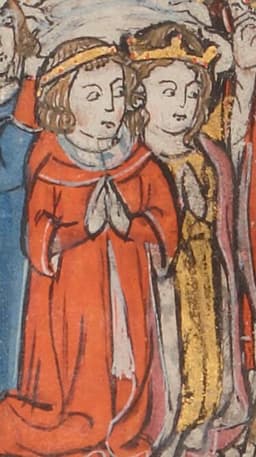
Conrad of Montferrat
General · Medieval
49.6Total

Gjergj Kastrioti Skanderbeg
General · Medieval
64.0Total
Basic Information
Born
1146
1405
Died
1192
1468
Era
Medieval
Medieval
Nationality
Jerusalem
Albania
Occupation
General
General
Civilization
Western
Western
Score Comparison
Military (10%)
60.0
74.7
Political (20%)
35.1
61.3
Influence (20%)
48.6
58.3
Legacy (20%)
41.7
58.0
Leadership (15%)
61.1
72.0
Strategy (15%)
66.3
75.0
TOTAL
49.6
64.0
Conrad of Montferrat — Complete Timeline
1187 AD
Defense of TyreWar
Conrad of Montferrat arrived at Tyre just before Saladin's forces besieged it. He organized the city's defenses and successfully repelled Saladin's attacks, preventing the fall of the last major Crusader port in the region.
Crusader StatesSiegeSaladin
Impact: regional
1189 AD
Siege of AcreWar◆ Major
Conrad participated in the Siege of Acre, where he played a key role in the Crusader efforts. He was a rival to Guy of Lusignan for leadership of the Crusader states.
CrusadeSiege
Impact: regional
1192 AD
Election as King of JerusalemPolitical Action◆ Major
Conrad was elected King of Jerusalem by the Crusader nobility in April 1192, after the death of Queen Sibylla. His election was supported by Richard the Lionheart and Philip Augustus.
Crusader StatesSuccession
Impact: regional
Assassination of Conrad of MontferratPolitical Action◆ Major
Conrad was assassinated by two Hashshashin (Assassins) in Tyre just days after his election. His death was a major blow to the Crusader states and led to the rise of Henry II of Champagne.
Crusader StatesAssassination
Impact: regionaltragic
Gjergj Kastrioti Skanderbeg — Complete Timeline
1444 AD
Battle of TorviollWar◆ Major
Skanderbeg led Albanian forces to victory against the Ottoman army under Ali Pasha at Torvioll. This battle marked the beginning of his 25-year resistance against the Ottoman Empire and established his reputation as a military commander.
Ottoman WarsAlbanian ResistanceBattle
Impact: regional
Formation of the League of LezhëPolitical Action◆ Major
Skanderbeg united Albanian and other regional nobles at Lezh
AllianceAlbanian UnityOttoman Wars
Impact: regionalconstructive
1450 AD
Siege of Krujë (First)War
Skanderbeg successfully defended the fortress of Kruj
SiegeOttoman WarsAlbanian Resistance
Impact: regional
1468 AD
Death of SkanderbegOther◆ Major
Skanderbeg died of natural causes in Lezh
DeathAlbanian HistoryNational Hero
Impact: regionaltragic
Expert Analysis
Origins
Conrad of Montferrat (c. 1145–1192) was born into the powerful Marquess family of Montferrat in northern Italy. His father, William V, was a Crusader veteran, and his brothers included a King of Jerusalem. Conrad received a knightly education and participated in Byzantine politics before traveling to the Holy Land in 1187. In contrast, Gjergj Kastrioti Skanderbeg (1405–1468) was born into a noble Albanian family in Krujë. As a child, he was taken hostage by the Ottoman Empire and trained as a military commander in the Ottoman army, serving as a sipahi. His early life under Ottoman tutelage gave him intimate knowledge of their military tactics.
Rise to Power
Conrad of Montferrat arrived at Tyre in July 1187, just days after Saladin's victory at Hattin and the fall of Jerusalem. He immediately took command of the city's defenses, rallying the citizens and organizing a successful resistance. His defense of Tyre from August 1187 to January 1188 made him a hero. He later became a key figure in the Third Crusade, rivaling Guy of Lusignan for the crown of Jerusalem. Skanderbeg's rise came after he defected from the Ottoman army in 1443 during the Battle of Niš, seizing the opportunity to reclaim his family's lands. He returned to Krujë, forged a seal reading "Albanorum rex" (King of the Albanians), and formed the League of Lezhë in 1444, uniting Albanian chieftains against the Ottomans.
Leadership & Governance
Conrad's leadership was autocratic and focused on military survival. He ruled Tyre with an iron hand, securing supplies and fortifications. His governance was pragmatic, but he alienated many by his ambition, particularly in his conflict with Guy of Lusignan. He was elected King of Jerusalem in 1192 but was assassinated before his coronation. Skanderbeg, by contrast, built a decentralized coalition. The League of Lezhë was a voluntary union of nobles, with Skanderbeg as supreme commander. He implemented a code of laws and maintained discipline through shared goals. His governance was more inclusive, but he faced constant challenges from rival nobles and Ottoman pressure. Skanderbeg scored 72.0 in leadership, while Conrad scored 61.1.
Triumph & Tragedy
Conrad's greatest triumph was the defense of Tyre, which saved a key Crusader port. He also played a significant role in the Siege of Acre (1189–1191), though his rivalry with Guy of Lusignan weakened Crusader unity. His tragedy was his assassination by the Assassins in 1192, likely ordered by Richard the Lionheart or Saladin, which ended his brief kingship. Skanderbeg's triumphs include the First Siege of Krujë (1450), where he defeated Sultan Murad II, and the Battle of Torvioll (1444), his first major victory. He successfully resisted Ottoman forces for 25 years. His tragedy was that his death in 1468 led to the collapse of Albanian resistance; within a decade, the Ottomans conquered Albania. Skanderbeg's military score of 74.7 exceeds Conrad's 60.0.
Character & Destiny
Conrad was described by contemporaries as courageous but arrogant and politically manipulative. His decision to challenge Guy of Lusignan for the crown created divisions among Crusaders. His assassination at the peak of his power reflects the volatile politics of the Crusader states. Skanderbeg was known for his discipline, strategic acumen, and ability to inspire loyalty. He was a master of guerrilla warfare, using mountainous terrain to his advantage. His character unified a fractured nation, but his reliance on personal leadership meant the resistance died with him. Historical assessments view Skanderbeg as a symbol of national identity, while Conrad is seen as a capable but divisive figure.
Legacy
Conrad's legacy is tied to the Third Crusade and the defense of Tyre. He delayed Saladin's conquest of the Crusader states but failed to secure lasting stability. His assassination highlighted the fragility of Crusader leadership. Skanderbeg's legacy is immense in Albanian history; he is revered as the national hero who preserved Albanian identity. His tactics influenced later resistance movements. However, his long-term impact was limited, as Albania fell to the Ottomans soon after his death. In terms of influence, Skanderbeg scored 58.3, Conrad 48.6. Legacy scores: Skanderbeg 58.0, Conrad 41.7.
Conclusion
Skanderbeg had greater impact on his nation and military history. His 25-year resistance against the Ottoman Empire, with a leadership score of 72.0 and military score of 74.7, far exceeds Conrad's achievements. Conrad's defense of Tyre was significant but temporary, and his political maneuvering undermined Crusader unity. Skanderbeg's ability to unite Albanian tribes and sustain a guerrilla war for a generation is a more lasting achievement. Total scores: Skanderbeg 64.0 vs. Conrad 49.6, a gap of 14.4 points. The data supports Skanderbeg as the superior historical figure.
Rankings
🥇
Gjergj Kastrioti SkanderbegLeader
Mil: 74.7Pol: 61.3Inf: 58.3
64.0
🥈
Conrad of Montferrat
Mil: 60.0Pol: 35.1Inf: 48.6
49.6
+14.4 behind
How This Comparison Works
Algorithm
Each figure is scored on 6 dimensions (0—100 scale) based on structured historical data: Military (10%), Political (20%), Influence (20%), Legacy (20%), Leadership (15%), Strategy (15%). The weighted total produces the final ranking.
Data Sources
Scores are computed from structured sub-indicators in the database. Scale factors adjust for era (Ancient ×0.85, Modern ×1.0) and civilization size (Eastern ×1.05, Other ×0.80) to account for differences in population and military scale.
Maximum 3 Figures
Comparisons are limited to 2—3 figures to ensure readability and statistical meaningfulness.
Error Margins
±5 points per dimension — Sub-scores are derived from historical records with inherent uncertainty. Two figures within 5 points on a dimension should be considered roughly equivalent in that area.
Total Score Accuracy
±3 points overall — The weighted combination of 6 dimensions produces a total score with approximately ±3 points of uncertainty. Differences of less than 3 points are not statistically significant— the figures are effectively tied.
Known Limitations
- Historical records are incomplete and uneven across civilizations
- Figures from oral-tradition societies may be underrepresented
- Occupation labels can misclassify multi-role figures
- Scores measure capability and impact, not moral character
- Quantitative scoring is a comparison tool, not absolute truth
Capability Radar
Military (10%) — Battles & Warfare
Battles
55
75
Win Rate
60
85
Expansion
25
30
Political (20%) — Governance & Reform
Reform
20
50
Diplomacy
55
70
Economy
30
40
Influence (20%) — Cultural & Global Reach
Cultural
30
80
Global
30
60
Legacy (20%) — Historical Impact
Historical
45
75
Longevity
35
70
Leadership (15%) — Power & Stability
Tenure
45
65
Stability
40
55
Strategy (15%) — Tactics & Innovation
Strategy
60
75
Tactics
65
80
Reform
20
60
Similar Comparisons
Comments & Discussion
No comments yet. Be the first to share your thoughts!