Loading...
Cleomenes III vs Julius Caesar
Julius Caesar leads by 30.4 pts · 2 figures compared
…
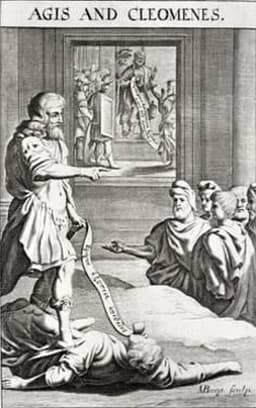
Cleomenes III
Emperor · Ancient
52.4Total

Julius Caesar
General · Ancient
82.8Total
Basic Information
Born
-260
-100
Died
-219
-44
Era
Ancient
Ancient
Nationality
Sparta
Roman Republic
Occupation
Emperor
General
Civilization
Western
Western
Score Comparison
Military (10%)
52.5
88.0
Political (20%)
45.0
78.0
Influence (20%)
52.5
85.0
Legacy (20%)
45.0
82.0
Leadership (15%)
68.0
80.0
Strategy (15%)
58.0
85.0
TOTAL
52.4
82.8
Cleomenes III — Complete Timeline
229 BC
Cleomenean WarWar◆ Major
Cleomenes III initiated a war against the Achaean League to restore Spartan hegemony in the Peloponnese. He won several battles, including the Battle of Mount Lycaeum and the Battle of Ladoceia, capturing many cities and expanding Spartan territory.
Cleomenean WarAchaean LeagueExpansion
Impact: regional
227 BC
Social Reforms in SpartaReform
Cleomenes III implemented radical reforms to revive Sparta's military strength. He abolished the ephorate, redistributed land, cancelled debts, and expanded the citizen body by enfranchising perioeci and helots. These reforms aimed to restore the Lycurgan system.
Spartan ReformLand RedistributionSocial Change
Impact: nationalprogressive
222 BC
Battle of SellasiaWar
Cleomenes III was decisively defeated by the combined forces of the Achaean League and Macedon under Antigonus III Doson at Sellasia. He fled to Egypt, and Sparta was forced to join the Hellenic League, ending his reforms and Spartan independence.
Cleomenean WarBattleDefeat
Impact: regionaltragic
219 BC
Death in ExilePolitical Action◆ Major
Cleomenes III was exiled in Egypt under the protection of Ptolemy III. After Ptolemy's death, he was placed under house arrest by Ptolemy IV. He attempted to lead a revolt in Alexandria, failed, and committed suicide.
ExileEgyptSuicide
Impact: nationaltragic
Julius Caesar — Complete Timeline
58 BC
Gallic WarsWar◆ Major
Caesar, as proconsul of Gaul, launched a series of campaigns that conquered all of Gaul (modern France, Belgium, and parts of Switzerland). He fought numerous battles, including against the Helvetii, the Belgae, and the Gallic chieftain Vercingetorix. The wars brought immense wealth and a loyal army to Caesar.
Gallic WarsConquestRoman Expansion
Impact: regional
49 BC
Crossing the RubiconPolitical Action◆ Major
Caesar led Legio XIII across the Rubicon River into Italy, defying the Roman Senate's order to disband his army. This act triggered a civil war against Pompey and the Optimates, ultimately leading to Caesar's dictatorship and the end of the Roman Republic.
Roman Civil WarEnd of RepublicPower Struggle
Impact: global
48 BC
Battle of PharsalusWar◆ Major
Caesar's outnumbered army defeated the larger forces of Pompey the Great at Pharsalus in Greece. Caesar's tactical use of a reserve line to counter Pompey's cavalry charge proved decisive. Pompey fled to Egypt, where he was assassinated, leaving Caesar as the undisputed master of the Roman world.
Roman Civil WarBattleDecisive Victory
Impact: regional
44 BC
Appointment as Dictator for LifePolitical Action◆ Major
The Roman Senate appointed Caesar dictator perpetuo (dictator for life), granting him unprecedented personal power. This move concentrated military, legislative, and judicial authority in one person, effectively ending the Roman Republic's traditional system of checks and balances and alarming many senators.
DictatorshipEnd of RepublicPower Consolidation
Impact: regionaldestructive
Assassination on the Ides of MarchPolitical Action◆ Major
A group of Roman senators, led by Marcus Junius Brutus and Gaius Cassius Longinus, stabbed Caesar to death at a meeting of the Senate in the Theatre of Pompey. The assassination was intended to restore the Republic, but instead triggered another civil war that led to the rise of the Roman Empire.
AssassinationRoman PoliticsEnd of Republic
Impact: globaldestructive
Expert Analysis
cleomenes-iii-vs-julius-caesar
# The Two Paths of Reform: Caesar and Cleomenes
On a January morning in 49 BCE, Julius Caesar stood at the banks of the Rubicon River, a small stream that marked the boundary of his legal command. To cross with an army was treason; to stay was political irrelevance. He hesitated only a moment before uttering the famous words, “The die is cast,” and led his legions into history. Nearly two centuries earlier, another reformer faced his own Rubicon—not a river, but the entrenched oligarchy of Sparta. Cleomenes III, a young king with dreams of resurrecting his city’s ancient glory, had already crossed his line, abolishing the ephorate and redistributing land. Both men sought to save their republics from decay. One succeeded in transforming the world; the other perished in exile, his revolution crushed. Why did their fates diverge so dramatically?
Origins
Julius Caesar was born into the patrician Julian clan, a family with ancient lineage but modest political influence in the late Republic. His childhood unfolded amid the violent struggles between populists and the senatorial aristocracy—the Social War, the civil wars of Marius and Sulla. By the time he came of age, the Republic’s institutions were already cracking under the weight of empire. Caesar learned early that politics was a game of survival, not honor. He was clever, ambitious, and ruthless when necessary, but he also possessed a rare charisma that drew soldiers and commoners alike.
Cleomenes III inherited a Sparta that was a shadow of its legendary past. The city that once defeated Athens and stood as the military paragon of Greece had become a stagnant oligarchy, its citizen body shrunk to a few hundred wealthy families, its army reduced to a mercenary force. Born around 260 BCE, Cleomenes grew up watching his father, King Leonidas II, resist the egalitarian reforms of King Agis IV—reforms that ended with Agis executed by the very oligarchs he sought to empower. The lesson was seared into young Cleomenes: reform was dangerous, but without it, Sparta would die.
Rise to Power
Caesar’s path was a masterclass in calculated advancement. He served as a military tribune, then quaestor in Spain, where he reportedly wept before a statue of Alexander the Great, lamenting that at the same age, Alexander had conquered the world while Caesar had done nothing. He built alliances with the wealthy Crassus and the popular Pompey, forming the First Triumvirate in 60 BCE. His consulship in 59 BCE was marked by aggressive land reforms that won him the loyalty of veterans and the poor, but made him mortal enemies in the Senate. When his term ended, he secured command of Gaul—a province that would become his launching pad.
Cleomenes ascended to kingship in 235 BCE at age twenty-five, co-ruling with his father. Unlike Caesar, his rise was hereditary, but his power was hemmed in by the ephors—five annually elected officials who controlled Spartan policy. His first years were cautious, watching the Achaean League expand its influence across the Peloponnese. In 229 BCE, he struck, initiating the Cleomenean War. He won a string of victories, capturing Mantinea and Tegea, and by 227 BCE, he felt strong enough to launch his coup.
Leadership & Governance
Caesar governed through a blend of military genius and political pragmatism. As a general, he was innovative, using siegecraft, rapid marches, and psychological warfare to subdue Gaul in eight years—a feat that doubled Rome’s territory. His Commentaries remain a model of strategic writing, blending self-promotion with genuine tactical insight. Politically, he was a reformer who understood power more than principle. He reformed the calendar, granted citizenship to provincials, initiated public works, and curbed corruption—but he also centralized authority, packed the Senate with his supporters, and accepted the title of dictator perpetuo. His leadership was brilliant, but it came with a fatal blindness to the resentment it bred.
Cleomenes III was a reformer of a different order—an idealist trying to reverse time. In 227 BCE, he abolished the ephorate, canceled debts, and redistributed land to 4,000 new citizens, including helots and foreigners. He restored the ancient Spartan agoge training system and tried to revive the citizen army of equals. Militarily, however, he was outmatched. His strategy relied on pitched battles against superior numbers, and his reforms, while socially radical, could not produce enough soldiers to match the combined might of the Achaean League and Macedon. Where Caesar built a professional army loyal to him personally, Cleomenes tried to resurrect a citizen militia bound to a fading ideal.
Triumph & Tragedy
Caesar’s greatest triumph was the conquest of Gaul, culminating in the siege of Alesia in 52 BCE, where he defeated Vercingetorix and crushed a pan-Gallic revolt. His greatest tragedy came on the Ides of March, 44 BCE, when sixty senators stabbed him to death in the Pompeian Theatre. He had achieved supreme power, but failed to understand that the Republic’s elite would rather kill him than accept monarchy.
Cleomenes’s triumph was the Cleomenean War, where he humbled the Achaean League and briefly made Sparta a dominant power again. His tragedy unfolded at the Battle of Sellasia in 222 BCE, where the combined forces of Macedon and the League crushed his army. He fled to Egypt, where he lived under the protection of Ptolemy III. When Ptolemy died, his successor placed Cleomenes under house arrest. In 219 BCE, he attempted a desperate uprising in Alexandria, failed, and took his own life.
Character & Destiny
Caesar possessed an extraordinary blend of audacity and calculation. He could pardon enemies one day and destroy them the next, always with an eye on the larger game. His famous clemency was not kindness but strategy—a way to weaken opposition without creating martyrs. Yet his hubris was his undoing. He dismissed the omens, ignored warnings, and walked into the Senate unarmed. He believed his genius could control the forces he had unleashed.
Cleomenes was a tragic figure—a king who loved Sparta so deeply that he tried to force it into a shape it could no longer hold. His reforms were visionary but impractical: he could not manufacture the economic base or population needed to sustain his military model. He was brave, principled, and ultimately naive about power. Where Caesar manipulated the system, Cleomenes tried to smash it and rebuild from memory.
Legacy
Caesar’s legacy is immeasurable. His name became synonymous with imperial rule—Kaiser, Tsar, Caesar. He destroyed the Republic but created the Empire that would shape Western civilization for a millennium. His reforms, his calendar, his writings, and his myth all endure.
Cleomenes III is forgotten by all but historians. His reforms died with him, and Sparta never recovered. Yet his story resonates as a cautionary tale—a reminder that great ideals cannot survive without the means to defend them. He tried to save his city by making it equal, but the world had moved on, and equality could not compete with empire.
Conclusion
Standing at the Rubicon, Caesar understood something Cleomenes did not: that the past cannot be resurrected, only destroyed or transformed. The Spartan king tried to turn back the clock; the Roman general broke it and built a new one. One died in exile, the other at the height of power. Yet both were reformers undone by the very forces they sought to master—Caesar by the oligarchy he humiliated, Cleomenes by the history he could not escape. In the end, their fates remind us that the line between triumph and tragedy is often drawn not by our vision, but by the world’s willingness to be changed.
Rankings
🥇
Julius CaesarLeader
Mil: 88.0Pol: 78.0Inf: 85.0
82.8
🥈
Cleomenes III
Mil: 52.5Pol: 45.0Inf: 52.5
52.4
+30.4 behind
How This Comparison Works
Algorithm
Each figure is scored on 6 dimensions (0—100 scale) based on structured historical data: Military (10%), Political (20%), Influence (20%), Legacy (20%), Leadership (15%), Strategy (15%). The weighted total produces the final ranking.
Data Sources
Scores are computed from structured sub-indicators in the database. Scale factors adjust for era (Ancient ×0.85, Modern ×1.0) and civilization size (Eastern ×1.05, Other ×0.80) to account for differences in population and military scale.
Maximum 3 Figures
Comparisons are limited to 2—3 figures to ensure readability and statistical meaningfulness.
Error Margins
±5 points per dimension — Sub-scores are derived from historical records with inherent uncertainty. Two figures within 5 points on a dimension should be considered roughly equivalent in that area.
Total Score Accuracy
±3 points overall — The weighted combination of 6 dimensions produces a total score with approximately ±3 points of uncertainty. Differences of less than 3 points are not statistically significant— the figures are effectively tied.
Known Limitations
- Historical records are incomplete and uneven across civilizations
- Figures from oral-tradition societies may be underrepresented
- Occupation labels can misclassify multi-role figures
- Scores measure capability and impact, not moral character
- Quantitative scoring is a comparison tool, not absolute truth
Capability Radar
Military (10%) — Battles & Warfare
Battles
55
95
Win Rate
60
92
Expansion
40
97
Political (20%) — Governance & Reform
Reform
75
90
Diplomacy
50
85
Economy
55
82
Influence (20%) — Cultural & Global Reach
Cultural
45
88
Global
30
94
Legacy (20%) — Historical Impact
Historical
50
95
Longevity
40
96
Leadership (15%) — Power & Stability
Tenure
45
75
Stability
30
60
Strategy (15%) — Tactics & Innovation
Strategy
60
94
Tactics
65
96
Reform
70
88
Similar Comparisons
Comments & Discussion
No comments yet. Be the first to share your thoughts!