Loading...
This comparison has not been analyzed yet.
One-time AI generation (~1 minute). Scores and timeline are already available below.
Claude Auchinleck vs Mike Hoare
Claude Auchinleck leads by 15.1 pts · 2 figures compared
…
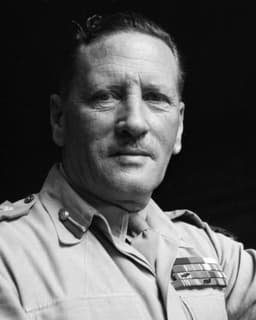
Claude Auchinleck
General · Modern
55.2Total

Mike Hoare
General · Modern
40.1Total
Basic Information
Born
1884
1919
Died
1981
2020
Era
Modern
Modern
Nationality
United Kingdom
South Africa
Occupation
General
General
Civilization
Western
Other
Score Comparison
Military (10%)
72.5
40.0
Political (20%)
39.4
26.4
Influence (20%)
61.0
51.0
Legacy (20%)
50.0
39.2
Leadership (15%)
54.2
35.4
Strategy (15%)
61.2
43.3
TOTAL
55.2
40.1
Claude Auchinleck — Complete Timeline
1941 AD
Appointed Commander-in-Chief of India CommandOther◆ Major
Auchinleck was appointed Commander-in-Chief of the Indian Army in January 1941. He oversaw the expansion and training of Indian forces for service in the Middle East, East Africa, and Southeast Asia, building a multi-ethnic army that grew to over two million men.
World War IIIndia
Impact: national
Appointed Commander-in-Chief of Middle East CommandOther◆ Major
Auchinleck replaced Archibald Wavell as Commander-in-Chief of Middle East Command in July 1941. He assumed command of British forces in North Africa, Iraq, and Persia during a critical period when German forces under Rommel were threatening Egypt and the Suez Canal.
World War IINorth Africa
Impact: national
Launched Operation CrusaderOther◆ Major
Auchinleck launched Operation Crusader on November 18, 1941, an offensive to relieve the besieged garrison at Tobruk. After heavy tank battles at Sidi Rezegh, British forces relieved Tobruk on December 10, forcing Rommel to retreat to El Agheila and lifting the 242-day siege.
World War IINorth AfricaVictory
Impact: nationalconstructive
1942 AD
Defeated at the First Battle of El AlameinOther◆ Major
Auchinleck personally took command of the Eighth Army in June 1942 after the fall of Tobruk. He halted Rommel's advance at the First Battle of El Alamein in July 1942, preventing the Axis from reaching Alexandria and the Suez Canal, but failed to destroy the German forces.
World War IINorth AfricaStalemate
Impact: national
Relieved of Command and Replaced by MontgomeryOther◆ Major
Auchinleck was relieved of command in August 1942 by Prime Minister Churchill, who lost confidence in his leadership. He was replaced by General Harold Alexander as Commander-in-Chief and Bernard Montgomery as commander of the Eighth Army, a decision that remains controversial among historians.
World War IINorth AfricaDismissal
Impact: nationaldestructive
1943 AD
Appointed Commander-in-Chief of India Command (Second Term)Other◆ Major
Auchinleck returned as Commander-in-Chief of the Indian Army in June 1943, a position he held until 1947. He oversaw the Burma Campaign, the defense against the Japanese invasion of India, and the post-war demobilization and partition of the Indian Army between India and Pakistan.
World War IIIndiaPartition
Impact: national
Mike Hoare — Complete Timeline
1964 AD
Recruited to lead mercenary unit '5 Commando' in the CongoWar◆ Major
Hoare was hired by the Congolese government to command 5 Commando, a unit of white mercenaries. His mission was to suppress the Simba rebellion, which he did with brutal efficiency, earning the nickname 'Mad Mike'.
5 CommandoSimba Rebellion
Impact: regional
Led Operation Dragon Rouge to rescue hostages in StanleyvilleWar◆ Major
Hoare's 5 Commando participated in Operation Dragon Rouge, a joint Belgian-US mission to rescue hostages held by Simba rebels in Stanleyville. The operation successfully freed hundreds of hostages but resulted in many rebel casualties.
Operation Dragon RougeHostage Rescue
Impact: regional
1981 AD
Attempted a coup in the SeychellesPolitical Action◆ Major
Hoare led a group of mercenaries in an attempt to overthrow the government of the Seychelles. The coup failed when the mercenaries were discovered at the airport, leading to a shootout and their eventual capture or escape.
Seychelles CoupMercenary
Impact: nationaldestructive
1982 AD
Tried and imprisoned for hijackingPolitical Action◆ Major
After the failed Seychelles coup, Hoare and his men hijacked an Air India plane to escape. He was arrested in South Africa, tried for hijacking, and sentenced to prison, though he was released after a few years.
HijackingTrial
Impact: globaltragic
This comparison has not been analyzed yet.
One-time AI generation (~1 minute). Scores and timeline are already available below.
Rankings
🥇
Claude AuchinleckLeader
Mil: 72.5Pol: 39.4Inf: 61.0
55.2
🥈
Mike Hoare
Mil: 40.0Pol: 26.4Inf: 51.0
40.1
+15.1 behind
How This Comparison Works
Algorithm
Each figure is scored on 6 dimensions (0—100 scale) based on structured historical data: Military (10%), Political (20%), Influence (20%), Legacy (20%), Leadership (15%), Strategy (15%). The weighted total produces the final ranking.
Data Sources
Scores are computed from structured sub-indicators in the database. Scale factors adjust for era (Ancient ×0.85, Modern ×1.0) and civilization size (Eastern ×1.05, Other ×0.80) to account for differences in population and military scale.
Maximum 3 Figures
Comparisons are limited to 2—3 figures to ensure readability and statistical meaningfulness.
Error Margins
±5 points per dimension — Sub-scores are derived from historical records with inherent uncertainty. Two figures within 5 points on a dimension should be considered roughly equivalent in that area.
Total Score Accuracy
±3 points overall — The weighted combination of 6 dimensions produces a total score with approximately ±3 points of uncertainty. Differences of less than 3 points are not statistically significant— the figures are effectively tied.
Known Limitations
- Historical records are incomplete and uneven across civilizations
- Figures from oral-tradition societies may be underrepresented
- Occupation labels can misclassify multi-role figures
- Scores measure capability and impact, not moral character
- Quantitative scoring is a comparison tool, not absolute truth
Capability Radar
Military (10%) — Battles & Warfare
Battles
65
45
Win Rate
55
40
Expansion
50
15
Political (20%) — Governance & Reform
Reform
20
5
Diplomacy
40
20
Economy
15
5
Influence (20%) — Cultural & Global Reach
Cultural
30
15
Global
45
20
Legacy (20%) — Historical Impact
Historical
55
20
Longevity
40
15
Leadership (15%) — Power & Stability
Tenure
30
10
Stability
25
5
Strategy (15%) — Tactics & Innovation
Strategy
75
40
Tactics
70
55
Reform
60
10
Similar Comparisons
Comments & Discussion
No comments yet. Be the first to share your thoughts!