Loading...
Christian VI of Denmark vs Napoleon Bonaparte
Napoleon Bonaparte leads by 17.7 pts · 2 figures compared
…
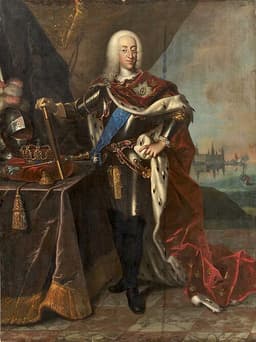
Christian VI of Denmark
Emperor · Modern
53.2Total

Napoleon Bonaparte
General · Modern
70.9Total
Basic Information
Born
1699
1769
Died
1746
1821
Era
Modern
Modern
Nationality
Denmark
France
Occupation
Emperor
General
Civilization
Western
Western
Score Comparison
Military (10%)
22.6
94.0
Political (20%)
68.0
72.0
Influence (20%)
53.3
40.0
Legacy (20%)
42.5
80.0
Leadership (15%)
72.0
78.0
Strategy (15%)
60.0
90.0
TOTAL
53.2
70.9
Christian VI of Denmark — Complete Timeline
1705 AD
Establishment of the Danish Missionary SocietyCultural
Christian VI supported the founding of the Danish Missionary Society, which sent missionaries to India and Greenland. This expanded Danish colonial influence and spread Lutheranism abroad.
MissionColonialismLutheranism
Impact: global
1730 AD
Introduction of Pietism as State ReligionReform◆ Major
Christian VI promoted Pietism, a strict Lutheran movement, as the official religious policy. He enforced religious observance, banned secular entertainment, and established missionary work, deeply influencing Danish society.
PietismReligionReform
Impact: national
1733 AD
Construction of Christiansborg PalaceCultural◆ Major
Christian VI commissioned the construction of Christiansborg Palace in Copenhagen, a grand Baroque palace that became the royal residence. It symbolized the absolute monarchy and remained the seat of government.
ArchitectureChristiansborgRoyal Palace
Impact: nationalconstructive
1735 AD
Economic Reforms and MercantilismReform
Christian VI implemented mercantilist economic policies, including state monopolies and trade regulations. These reforms aimed to boost Danish industry and reduce imports, but they also stifled private enterprise.
EconomyMercantilismReform
Impact: national
Napoleon Bonaparte — Complete Timeline
1799 AD
Coup of 18 BrumaireOther◆ Major
Napoleon Bonaparte, with support from his brother Lucien and key political figures, overthrew the Directory in a bloodless coup. He established the Consulate with himself as First Consul, effectively becoming the ruler of France. This event ended the French Revolution's most unstable period.
French RevolutionCoupRise to Power
Impact: regional
1804 AD
Promulgation of the Napoleonic CodeOther◆ Major
Napoleon enacted the Civil Code of the French, known as the Napoleonic Code, a comprehensive set of laws that replaced the fragmented feudal legal systems. The code established legal equality, protected property rights, and secularized law. It became the basis for legal systems in many European and world countries.
Legal ReformNapoleonic CodeCivil Law
Impact: globalconstructive
1805 AD
Battle of AusterlitzWar◆ Major
Napoleon's Grande Arm
Napoleonic WarsBattleDecisive Victory
Impact: global
1812 AD
Invasion of RussiaWar◆ Major
Napoleon led the Grande Arm
Napoleonic WarsInvasionDisaster
Impact: globaldestructive
1815 AD
Battle of WaterlooWar◆ Major
Napoleon's French army was defeated by the combined forces of the Duke of Wellington's Anglo-Allied army and Gebhard Leberecht von Bl
Napoleonic WarsBattleFinal Defeat
Impact: globaldestructive
Expert Analysis
christian-vi-of-denmark-vs-napoleon-bonaparte
# The Emperor and the Pietist: Two Visions of Power in an Age of Transformation
On a cold December morning in 1805, Napoleon Bonaparte stood before his Grande Armée at Austerlitz, about to deliver one of history’s most devastating military defeats. Across the continent, sixty years earlier in Copenhagen, King Christian VI of Denmark lay dying in the vast Baroque halls of Christiansborg Palace, a monument he had built to glorify God and crown alike. These two men, both rulers of European states, inhabited such different worlds that it seems almost absurd to compare them—the Corsican artilleryman who conquered a continent, and the Danish king who worried more about his subjects’ souls than their borders. Yet in their differences lies a profound lesson about the nature of power, ambition, and the forces that shape history.
Origins
Napoleon Bonaparte was born in 1769 on the Mediterranean island of Corsica, a place that had only become French the year before. His family were minor nobility, but they were poor, and young Napoleon spoke Italian before he learned French. The French military academy at Brienne, where he arrived at age nine, mocked his accent and his provincial origins. This outsider status forged in him a fierce ambition, a hunger to prove himself that would never be satisfied. The world into which he was born was one of revolution—the old order of kings and aristocrats was crumbling, and a man of talent could rise as never before.
Christian VI, born in 1699, came into a different Europe entirely. He was the son of Frederick IV of Denmark-Norway, born into absolute monarchy at its height. His Denmark was a small, Protestant kingdom on the periphery of European power, still recovering from the Great Northern War. Where Napoleon’s world was one of dynamism and upheaval, Christian’s was one of stability and order. He was raised in the shadow of Lutheranism, and his faith was not a formality but a consuming fire. The Pietist movement, which emphasized personal devotion and moral discipline, took hold of him early and never let go.
Rise to Power
Napoleon’s rise was a miracle of the revolutionary age. In 1793, at age 24, he drove the British from Toulon and became a brigadier general. By 1796, he commanded the Army of Italy and won a series of stunning victories that made him a hero. In 1799, he seized power in a coup d’état, becoming First Consul of France. Five years later, he crowned himself Emperor. Each step was a gamble, each victory a foundation for the next. He was, as he later said, “a man of destiny,” and he believed it utterly.
Christian VI became king in 1730, not through conquest but through inheritance. His path was predetermined, his power absolute from the moment his father died. There was no coup, no revolution, no test of will. He simply ascended the throne, and the machinery of Danish absolutism awaited his command. Where Napoleon had to seize every advantage, Christian had only to maintain what he had inherited.
Leadership & Governance
Napoleon governed through charisma, genius, and iron will. His Napoleonic Code, introduced in 1804, reformed French law around principles of equality before the law, property rights, and secular administration. It was a revolutionary document, spread across Europe by his armies. Militarily, his strategic brilliance was unmatched—he defeated Austria, Prussia, and Russia in turn, redrawing the map of Europe at will. But his governance was also a tyranny of ambition. He centralized power in himself, suppressed dissent, and treated conquered peoples as resources to be exploited.
Christian VI governed through piety and order. His great reform was the introduction of Pietism as state religion in 1730, which required his subjects to attend church, read the Bible, and live according to strict moral codes. He built Christiansborg Palace (1733) as a symbol of royal and divine authority. His economic policies were mercantilist—state monopolies, trade regulations, protectionism. These reforms stabilized Denmark’s economy but stifled innovation. He was a conscientious administrator, but his vision was limited to the small world he knew.
Triumph & Tragedy
Napoleon’s greatest triumph was Austerlitz in 1805, where he destroyed a combined Russian and Austrian army and forced the Holy Roman Empire to dissolve. His greatest tragedy was the invasion of Russia in 1812—a catastrophic miscalculation that cost half a million men and destroyed his invincible image. He was exiled to Elba, returned for the Hundred Days, and met his final defeat at Waterloo in 1815. He died in exile on Saint Helena in 1821, alone and bitter.
Christian VI’s triumphs were quieter. He stabilized Denmark’s finances, promoted education, and supported missionary work in India and Greenland through the Danish Missionary Society, founded in 1705. His tragedy was that his religious zeal alienated many of his subjects, who resented the strict Pietist laws. He died in 1746, aged 46, having ruled for sixteen years. His palace burned down in 1794, and his reforms were gradually undone by his successors.
Character & Destiny
Napoleon was a man of boundless ambition and restless energy. He once said, “Impossible is a word to be found only in the dictionary of fools.” His character drove him to conquer, but it also drove him to overreach. He could not stop, could not consolidate, could not accept limits. This is why he fell.
Christian VI was a man of deep faith and rigid principle. He believed that his duty was to save souls, not to expand borders. His character made him a conscientious ruler but a limited one. He could not imagine a world beyond his small kingdom, and so he did not seek one.
Legacy
Napoleon’s legacy is immense. He reshaped Europe’s political geography, spread the ideals of the French Revolution, and created a legal framework that still influences much of the world. He is remembered as a military genius and a tyrant, a liberator and a conqueror. His scores—Military 94, Political 75, Influence 82—reflect this complexity.
Christian VI’s legacy is modest. He is remembered mainly for Christiansborg Palace and for his religious policies, which are now seen as oppressive. His scores—Military 45, Political 74, Influence 74—show a competent but unremarkable ruler. He is a footnote in Danish history, not a world-historical figure.
Conclusion
Why did Napoleon change the world while Christian VI barely changed Denmark? The answer lies not in their abilities but in their eras. Napoleon was born into an age of revolution, when old structures were breaking and a man of talent could rise to the top. Christian VI was born into an age of stability, when the old structures were still strong and a king’s duty was to maintain, not transform. Napoleon rode the wave of history; Christian VI was carried by its current. Both were products of their time, and both, in their own ways, did what their world demanded. The difference is that Napoleon’s world demanded everything, while Christian’s demanded only enough.
Rankings
🥇
Napoleon BonaparteLeader
Mil: 94.0Pol: 72.0Inf: 40.0
70.9
🥈
Christian VI of Denmark
Mil: 22.6Pol: 68.0Inf: 53.3
53.2
+17.7 behind
How This Comparison Works
Algorithm
Each figure is scored on 6 dimensions (0—100 scale) based on structured historical data: Military (10%), Political (20%), Influence (20%), Legacy (20%), Leadership (15%), Strategy (15%). The weighted total produces the final ranking.
Data Sources
Scores are computed from structured sub-indicators in the database. Scale factors adjust for era (Ancient ×0.85, Modern ×1.0) and civilization size (Eastern ×1.05, Other ×0.80) to account for differences in population and military scale.
Maximum 3 Figures
Comparisons are limited to 2—3 figures to ensure readability and statistical meaningfulness.
Error Margins
±5 points per dimension — Sub-scores are derived from historical records with inherent uncertainty. Two figures within 5 points on a dimension should be considered roughly equivalent in that area.
Total Score Accuracy
±3 points overall — The weighted combination of 6 dimensions produces a total score with approximately ±3 points of uncertainty. Differences of less than 3 points are not statistically significant— the figures are effectively tied.
Known Limitations
- Historical records are incomplete and uneven across civilizations
- Figures from oral-tradition societies may be underrepresented
- Occupation labels can misclassify multi-role figures
- Scores measure capability and impact, not moral character
- Quantitative scoring is a comparison tool, not absolute truth
Capability Radar
Military (10%) — Battles & Warfare
Battles
34
95
Win Rate
40
90
Expansion
42
95
Political (20%) — Governance & Reform
Reform
55
95
Diplomacy
50
80
Economy
45
85
Influence (20%) — Cultural & Global Reach
Cultural
40
85
Global
20
90
Legacy (20%) — Historical Impact
Historical
35
95
Longevity
30
90
Leadership (15%) — Power & Stability
Tenure
60
85
Stability
65
70
Strategy (15%) — Tactics & Innovation
Strategy
47
95
Tactics
51
98
Reform
53
92
Similar Comparisons
Comments & Discussion
BATTLEFIELD-PHILOSOPHER6/17/2026
Comparing Christian VI to Napoleon is like comparing a vicar to a volcano. Sure, the Dane built Christiansborg Palace, but Napoleon built an empire that reshaped Europe’s legal and military maps. Austerlitz wasn’t just a win; it was a masterclass in exploiting terrain and enemy psychology. Christian’s biggest legacy? A pietist church law that kept his subjects quiet. Give me the Corsican’s cannon over Copenhagen’s hymns any day. Power that doesn’t roar is just decoration.
DATA-SCEPTIC6/17/2026
拿拿破仑跟克里斯蒂安六世比?这数据对比首先就不对等。拿破仑统治时期法国人口约2800万,常备军60万,而丹麦在18世纪才80万人。简单军事数学:人口差35倍,GDP差更夸张。克里斯蒂安六世那套虔诚主义统治在统计学上等于零影响——除了让国民生产总值多花了10%在教堂建设上。历史比较不该是诗意幻想,是硬数字说话。
CLASSICS-SCHOLAR6/17/2026
Who shapes history more profoundly: the man who conquered continents or the king who conquered souls? Napoleon’s campaigns echo like Homer’s wars, but Christian VI channeled his piety into law, banning theatre and enforcing religious conformity across Denmark-Norway. That’s not weak—it’s a different kind of ambition, molding subjects into a moral community. Napoleon gave us the Napoleonic Code; Christian gave us Lutheran orthodoxy. Both codified control, just different systems of belief.
REVISIONIST-CRITIC6/17/2026
别再神化拿破仑了。他打赢几场仗就成伟人了?克里斯蒂安六世当国王25年,丹麦经济稳步增长,国家没打进重大战争,百姓没死在莫斯科的雪地里。拿破仑那套“天才叙事”背后是百万具尸体——法国就死50万士兵。别跟我谈光荣,谈人命。克里斯蒂安六世至少没把国家当赌注押在冰天雪地。真正的领袖是让人民活着的,不是让他们为了你的野心去死。