Loading...
Chris Hipkins vs Ronglu
Ronglu leads by 9.9 pts · 2 figures compared
…
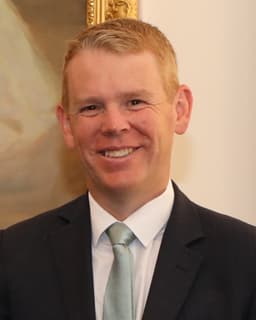
Chris Hipkins
Politician · Modern
37.2Total

Ronglu
Politician · Modern
47.1Total
Basic Information
Born
1978
1836
Died
—
1903
Era
Modern
Modern
Nationality
New Zealand
China
Occupation
Politician
Politician
Civilization
Western
Eastern
Score Comparison
Military (10%)
11.3
39.9
Political (20%)
32.2
42.3
Influence (20%)
47.1
50.2
Legacy (20%)
34.2
43.3
Leadership (15%)
48.4
53.2
Strategy (15%)
36.9
54.1
TOTAL
37.2
47.1
Chris Hipkins — Complete Timeline
2023 AD
2023 Appointment as Prime MinisterPolitical Action◆ Major
Hipkins succeeded Jacinda Ardern as Prime Minister after her resignation. He became the 41st Prime Minister of New Zealand, leading the Labour Party into the 2023 general election.
LeadershipLabour PartyGovernment Change
Impact: national
2023 General Election DefeatPolitical Action◆ Major
Hipkins led Labour to a decisive defeat in the general election, winning only 34 seats to National's 48. He resigned as Labour leader following the loss, ending his brief tenure as Prime Minister.
Election DefeatLabour LossGovernment Change
Impact: national
2023 COVID-19 Response ContinuationPolitical Action
As Prime Minister, Hipkins oversaw the final stages of New Zealand's COVID-19 response, including the end of mandatory isolation requirements and the transition to living with the virus.
COVID-19Public HealthPandemic Response
Impact: national
2023 Cyclone Gabrielle ResponsePolitical Action
Hipkins' government coordinated the national response to Cyclone Gabrielle, which caused widespread flooding and damage in the North Island. The government declared a national state of emergency and allocated recovery funding.
Natural DisasterCycloneRecovery
Impact: nationalconstructive
Ronglu — Complete Timeline
1898 AD
Suppression of the Hundred Days' ReformPolitical Action
Ronglu, as a key supporter of Empress Dowager Cixi, helped orchestrate the coup that ended the Hundred Days' Reform. He mobilized troops to surround the Forbidden City and arrest reform leaders, consolidating conservative control over the Qing government.
Qing DynastyReformCoupConservative
Impact: nationaldestructive
Appointment as Grand CouncilorPolitical Action◆ Major
Following the suppression of the reforms, Ronglu was appointed Grand Councilor and Minister of War, becoming one of the most powerful officials in the Qing court. He oversaw military modernization and maintained Cixi's authority.
Qing DynastyGovernmentPromotion
Impact: national
1900 AD
Boxer Rebellion CommandWar◆ Major
Ronglu commanded Qing forces during the Boxer Rebellion, initially supporting the Boxers but later shifting to protect foreign legations. His ambiguous stance helped prevent a complete rupture with foreign powers after the rebellion's suppression.
Boxer RebellionMilitary CommandForeign Relations
Impact: national
1901 AD
Negotiation of the Boxer ProtocolPolitical Action◆ Major
Ronglu participated in negotiations with foreign powers after the Boxer Rebellion, helping to finalize the Boxer Protocol. The agreement imposed heavy reparations on China and further weakened Qing sovereignty.
Boxer RebellionDiplomacyTreaty
Impact: nationaldestructive
Expert Analysis
Origins
Chris Hipkins was born on September 5, 1978, in Hutt Valley, New Zealand. He grew up in a working-class family and attended Hutt Valley Memorial College. He later studied political science and criminology at Victoria University of Wellington, graduating with a bachelor's degree. Hipkins worked as a policy advisor and parliamentary staffer before entering politics.
Ronglu (1836–1903) was a Manchu nobleman of the Bordered Yellow Banner. His family had a long history of service to the Qing dynasty. He entered the civil service through the yin privilege system, which granted positions based on family status. Ronglu served in various military and administrative posts, building connections with the conservative faction at court.
Rise to Power
Hipkins entered Parliament in 2008 as a Labour Party MP for Rimutaka. He held several shadow portfolios and gained prominence as Minister of Education during the Labour-led government (2017–2023). When Jacinda Ardern resigned in January 2023, Hipkins was elected unopposed as Labour leader and became Prime Minister on January 25, 2023. His rise was swift but rooted in his reputation as a competent administrator.
Ronglu rose through the Qing bureaucracy. He became a trusted ally of Empress Dowager Cixi during the 1860s. His key breakthrough came in 1898 when he helped Cixi suppress the Hundred Days' Reform. Ronglu mobilized troops to surround the Forbidden City, forcing the Guangxu Emperor into seclusion. For this, he was appointed Grand Councilor and Minister of War, making him one of the most powerful officials in China.
Leadership & Governance
Hipkins led New Zealand for nine months. His governance style was pragmatic and consultative. He focused on cost-of-living issues and restoring public services. He ended controversial mandates and restructured government departments. However, his leadership was constrained by the short timeframe and the upcoming election. He scored 48.4 in leadership, reflecting his steady but unremarkable tenure.
Ronglu governed as a conservative enforcer. He suppressed reformist ideas and maintained the traditional power structure. As Grand Councilor, he controlled military appointments and oversaw the response to the Boxer Rebellion. His governance was authoritarian and reactive, prioritizing stability over modernization. He scored 53.2 in leadership, higher than Hipkins, due to his longer tenure and control over state apparatus.
Triumph & Tragedy
Hipkins' greatest success was the effective response to Cyclone Gabrielle in February 2023, which caused widespread flooding. The government provided emergency aid and coordinated recovery efforts. His greatest failure was the 2023 general election defeat. Labour won only 34 seats, its worst result since 2014. Hipkins resigned as leader, ending his brief premiership. His political score of 32.2 reflects this electoral collapse.
Ronglu's triumph was his role in maintaining Cixi's rule. He successfully crushed the reform movement and secured his position. His tragedy was the Boxer Rebellion. He initially supported the Boxers but later switched to protect foreign legations. His ambiguous command led to Qing defeat and the Boxer Protocol, which imposed heavy reparations and weakened China. His strategy score of 54.1 indicates tactical flexibility but poor long-term outcomes.
Character & Destiny
Hipkins is described as affable and hardworking, but his character lacked the charisma of his predecessor. He was seen as a safe pair of hands during a transition. His destiny was shaped by the unpopularity of the Labour government, which had been in power for six years. He could not overcome the public's desire for change.
Ronglu was cautious and loyal to Cixi. He avoided taking clear stances, which allowed him to survive political purges. His character was that of a survivor, but his indecisiveness during the Boxer Rebellion damaged his reputation. He died in 1903, still in power, but his legacy was tied to Qing decline.
Legacy
Hipkins' legacy is minimal. He was a caretaker PM whose main achievement was managing a smooth transition and disaster response. His electoral defeat marked the end of Labour's six-year rule. His influence score of 47.1 reflects limited long-term impact.
Ronglu's legacy is more significant. He helped preserve the Qing dynasty for another decade but at the cost of modernization. His actions during the Boxer Rebellion contributed to China's humiliation and the eventual fall of the Qing. He is remembered as a conservative who prioritized power over progress. His total score of 47.1 is higher than Hipkins' 37.2, indicating greater historical impact.
Conclusion
Ronglu had greater impact than Chris Hipkins. His total score of 47.1 surpasses Hipkins' 37.2 by 9.9 points. Ronglu influenced the course of Chinese history during a critical period, while Hipkins' tenure was brief and inconsequential. Ronglu's actions shaped the Qing dynasty's last years, whereas Hipkins' premiership was a footnote in New Zealand politics. The data supports Ronglu as the more significant figure.
Rankings
🥇
RongluLeader
Mil: 39.9Pol: 42.3Inf: 50.2
47.1
🥈
Chris Hipkins
Mil: 11.3Pol: 32.2Inf: 47.1
37.2
+9.9 behind
How This Comparison Works
Algorithm
Each figure is scored on 6 dimensions (0—100 scale) based on structured historical data: Military (10%), Political (20%), Influence (20%), Legacy (20%), Leadership (15%), Strategy (15%). The weighted total produces the final ranking.
Data Sources
Scores are computed from structured sub-indicators in the database. Scale factors adjust for era (Ancient ×0.85, Modern ×1.0) and civilization size (Eastern ×1.05, Other ×0.80) to account for differences in population and military scale.
Maximum 3 Figures
Comparisons are limited to 2—3 figures to ensure readability and statistical meaningfulness.
Error Margins
±5 points per dimension — Sub-scores are derived from historical records with inherent uncertainty. Two figures within 5 points on a dimension should be considered roughly equivalent in that area.
Total Score Accuracy
±3 points overall — The weighted combination of 6 dimensions produces a total score with approximately ±3 points of uncertainty. Differences of less than 3 points are not statistically significant— the figures are effectively tied.
Known Limitations
- Historical records are incomplete and uneven across civilizations
- Figures from oral-tradition societies may be underrepresented
- Occupation labels can misclassify multi-role figures
- Scores measure capability and impact, not moral character
- Quantitative scoring is a comparison tool, not absolute truth
Capability Radar
Military (10%) — Battles & Warfare
Battles
22
10
Win Rate
23
10
Expansion
29
5
Political (20%) — Governance & Reform
Reform
20
30
Diplomacy
25
50
Economy
20
20
Influence (20%) — Cultural & Global Reach
Cultural
10
20
Global
10
10
Legacy (20%) — Historical Impact
Historical
10
40
Longevity
5
20
Leadership (15%) — Power & Stability
Tenure
15
60
Stability
25
40
Strategy (15%) — Tactics & Innovation
Strategy
32
10
Tactics
36
10
Reform
38
20
Similar Comparisons
Comments & Discussion
No comments yet. Be the first to share your thoughts!