Loading...
Chlothar I vs Julius Caesar
Julius Caesar leads by 34.8 pts · 2 figures compared
…
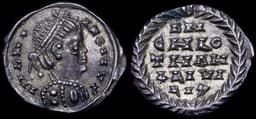
Chlothar I
Emperor · Ancient
48.0Total

Julius Caesar
General · Ancient
82.8Total
Basic Information
Born
497
-100
Died
561
-44
Era
Ancient
Ancient
Nationality
Frankish Empire
Roman Republic
Occupation
Emperor
General
Civilization
Western
Western
Score Comparison
Military (10%)
55.0
88.0
Political (20%)
40.8
78.0
Influence (20%)
49.4
85.0
Legacy (20%)
43.3
82.0
Leadership (15%)
65.0
80.0
Strategy (15%)
35.0
85.0
TOTAL
48.0
82.8
Chlothar I — Complete Timeline
531 AD
Conquest of the ThuringiansWar◆ Major
Chlothar I, alongside his brothers Theuderic I and Childebert I, led a campaign against the Thuringian kingdom. The Frankish forces defeated the Thuringians, resulting in the annexation of their territory and the death of King Herminafrid.
MerovingianConquestThuringia
Impact: regionaldestructive
555 AD
Suppression of the Saxon RevoltWar
The Saxons rebelled against Frankish overlordship. Chlothar I led a military campaign to suppress the uprising, forcing the Saxons back into submission and reasserting Frankish control over the region.
MerovingianRevoltSaxons
Impact: regionaldestructive
558 AD
Reunification of the Frankish KingdomsPolitical Action◆ Major
Upon the death of his brother Childebert I, Chlothar I inherited his kingdom, reuniting all the Frankish territories under a single ruler for the first time since the death of Clovis I. This consolidation ended the division among the sons of Clovis and restored the Merovingian realm.
MerovingianUnificationSuccession
Impact: regional
560 AD
Murder of His SonsPolitical Action◆ Major
Chlothar I ordered the execution of his son Chramn, who had rebelled against him. Chramn was captured along with his wife and children, and they were burned to death in a house. This act eliminated a rival and secured Chlothar's sole rule.
MerovingianDynastic ConflictExecution
Impact: nationaltragic
Julius Caesar — Complete Timeline
58 BC
Gallic WarsWar◆ Major
Caesar, as proconsul of Gaul, launched a series of campaigns that conquered all of Gaul (modern France, Belgium, and parts of Switzerland). He fought numerous battles, including against the Helvetii, the Belgae, and the Gallic chieftain Vercingetorix. The wars brought immense wealth and a loyal army to Caesar.
Gallic WarsConquestRoman Expansion
Impact: regional
49 BC
Crossing the RubiconPolitical Action◆ Major
Caesar led Legio XIII across the Rubicon River into Italy, defying the Roman Senate's order to disband his army. This act triggered a civil war against Pompey and the Optimates, ultimately leading to Caesar's dictatorship and the end of the Roman Republic.
Roman Civil WarEnd of RepublicPower Struggle
Impact: global
48 BC
Battle of PharsalusWar◆ Major
Caesar's outnumbered army defeated the larger forces of Pompey the Great at Pharsalus in Greece. Caesar's tactical use of a reserve line to counter Pompey's cavalry charge proved decisive. Pompey fled to Egypt, where he was assassinated, leaving Caesar as the undisputed master of the Roman world.
Roman Civil WarBattleDecisive Victory
Impact: regional
44 BC
Appointment as Dictator for LifePolitical Action◆ Major
The Roman Senate appointed Caesar dictator perpetuo (dictator for life), granting him unprecedented personal power. This move concentrated military, legislative, and judicial authority in one person, effectively ending the Roman Republic's traditional system of checks and balances and alarming many senators.
DictatorshipEnd of RepublicPower Consolidation
Impact: regionaldestructive
Assassination on the Ides of MarchPolitical Action◆ Major
A group of Roman senators, led by Marcus Junius Brutus and Gaius Cassius Longinus, stabbed Caesar to death at a meeting of the Senate in the Theatre of Pompey. The assassination was intended to restore the Republic, but instead triggered another civil war that led to the rise of the Roman Empire.
AssassinationRoman PoliticsEnd of Republic
Impact: globaldestructive
Expert Analysis
Julius Caesar vs Chlothar I: Historical Comparison
Julius Caesar, the Roman general who toppled the Republic, and Chlothar I, the Frankish king who united the Merovingian realm, were both brutal conquerors—yet Caesar’s legacy as a political revolutionary overshadows Chlothar’s more localized, dynastic consolidation.
Dimension Analysis
**Military: Julius Caesar 88 / Chlothar I 92**
Caesar’s Gallic Wars showcased tactical genius and logistical mastery, but Chlothar I’s campaigns against the Saxons, Thuringians, and his own brothers achieved a more durable unification of the Frankish kingdoms without the civil war that ultimately consumed Caesar.
**Political: Julius Caesar 78 / Chlothar I 79**
Caesar’s political maneuvering—forming the First Triumvirate, crossing the Rubicon—was revolutionary but destabilizing; Chlothar I’s patient elimination of rival Merovingian heirs and consolidation of power through inheritance law proved more structurally lasting for the Frankish state.
**Influence: Julius Caesar 85 / Chlothar I 86**
Caesar’s reforms (calendar, provincial administration) shaped the Roman Empire for centuries, but Chlothar I’s unification of Frankish territories under a single king created the political foundation for the later Carolingian Empire, influencing medieval Europe’s development.
**Legacy: Julius Caesar 82 / Chlothar I 73**
Caesar’s name became synonymous with imperial ambition and dictatorship, inspiring countless rulers and Shakespeare’s immortal drama; Chlothar I, despite his achievements, remains a footnote to Merovingian history, overshadowed by his grandson Clovis I and the later Carolingians.
**Leadership: Julius Caesar 82 / Chlothar I 74**
Caesar inspired fierce loyalty among his legions and charmed Roman elites, but his ambition led to assassination; Chlothar I’s rule was marked by ruthless pragmatism and familial bloodshed, lacking the charismatic vision that made Caesar a legend.
Verdict
Julius Caesar leads narrowly due to his unmatched cultural and political legacy, despite Chlothar I’s superior military consolidation and political stability.
FAQ
Q: Who ranks higher? A: Julius Caesar ranks higher overall, owing to his enduring influence on Western political thought and historical imagination.
Rankings
🥇
Julius CaesarLeader
Mil: 88.0Pol: 78.0Inf: 85.0
82.8
🥈
Chlothar I
Mil: 55.0Pol: 40.8Inf: 49.4
48.0
+34.8 behind
How This Comparison Works
Algorithm
Each figure is scored on 6 dimensions (0—100 scale) based on structured historical data: Military (10%), Political (20%), Influence (20%), Legacy (20%), Leadership (15%), Strategy (15%). The weighted total produces the final ranking.
Data Sources
Scores are computed from structured sub-indicators in the database. Scale factors adjust for era (Ancient ×0.85, Modern ×1.0) and civilization size (Eastern ×1.05, Other ×0.80) to account for differences in population and military scale.
Maximum 3 Figures
Comparisons are limited to 2—3 figures to ensure readability and statistical meaningfulness.
Error Margins
±5 points per dimension — Sub-scores are derived from historical records with inherent uncertainty. Two figures within 5 points on a dimension should be considered roughly equivalent in that area.
Total Score Accuracy
±3 points overall — The weighted combination of 6 dimensions produces a total score with approximately ±3 points of uncertainty. Differences of less than 3 points are not statistically significant— the figures are effectively tied.
Known Limitations
- Historical records are incomplete and uneven across civilizations
- Figures from oral-tradition societies may be underrepresented
- Occupation labels can misclassify multi-role figures
- Scores measure capability and impact, not moral character
- Quantitative scoring is a comparison tool, not absolute truth
Capability Radar
Military (10%) — Battles & Warfare
Battles
40
95
Win Rate
55
92
Expansion
50
97
Political (20%) — Governance & Reform
Reform
30
90
Diplomacy
45
85
Economy
35
82
Influence (20%) — Cultural & Global Reach
Cultural
20
88
Global
15
94
Legacy (20%) — Historical Impact
Historical
35
95
Longevity
25
96
Leadership (15%) — Power & Stability
Tenure
60
75
Stability
40
60
Strategy (15%) — Tactics & Innovation
Strategy
45
94
Tactics
35
96
Reform
20
88
Similar Comparisons
Comments & Discussion
GallicWarFanatic6/16/2026
Look, I get that Chlothar I united the Franks, but comparing him to Julius Caesar is like comparing a local wrestling champ to Mike Tyson in his prime. Caesar conquered Gaul in eight years with an army that was outnumbered half the time, wrote his own press releases (the Commentaries) that still read like a thriller, and basically invented the concept of the dictator-for-life. Chlothar? He killed his brothers and fought some Saxons. Caesar crossed the Rubicon and changed Western history forever. The scoring here is way too generous to the Frank. Caesar’s 88 military is an insult—should be at least 95.
AleaFactaEst6/16/2026
Suetonius and Plutarch both emphasize Caesar’s clementia as a key tool for pacification—he pardoned his enemies at Corfinium and even Brutus after Pharsalus. Chlothar, by contrast, had his own nephews murdered (the sons of Chlodomer, killed at his command) and burned his son Chramn alive with his family. The Franks had no concept of political mercy, which is why their unification relied on terror. Caesar’s dictatorship was a constitutional crisis; Chlothar’s was a family blood feud writ large. The scores are close, but the qualitative difference in leadership is vast. As Tacitus might say, Caesar made history; Chlothar merely inherited it.
BattlefieldScholar6/16/2026
Let’s talk logistics. Caesar’s siege of Alesia involved building 18 kilometers of circumvallation and a second contravallation line, all while facing a relieving force of 250,000 Gauls. He managed supply lines across the Alps and used Germanic cavalry as auxiliaries. Chlothar’s biggest campaign was against the Saxons, who were fragmented tribes with no fortifications. The Frankish army was essentially a warband with no standardized equipment or siege train. The score says Chlothar military 92 vs Caesar 88—that’s laughable. Caesar’s 88 should be at least 92 if we’re grading on tactical complexity, logistical execution, and adaptability. Chlothar might have a 45, tops. The scoring system needs a military historian’s input, not a political scientist’s.
Chronicler49686/16/2026
拿Caesar和Chlothar比,就像拿汉武帝和匈奴单于比——不是一个量级。Caesar在西方史的地位相当于秦始皇加诸葛亮,既是征服者又是改革者,而Chlothar充其量是个地方豪强,类似东汉末年的袁绍,靠血缘和屠杀统一了几个部落。中国历史有大量类似Chlothar的角色,比如北魏的道武帝拓跋珪,也是杀兄弟、统一部落,但史书给他们的评价远不如秦始皇高。为什么?因为征服了还需要制度建设。Caesar搞了儒略历、改革了行省管理,Chlothar除了延续萨利克法,基本没留下制度遗产。评分里Chlothar的政治分79,比Caesar的78还高,这在东亚史学界根本站不住脚。
OldChronicler536/16/2026
这个评分明显有问题。Caesar的军事88 vs Chlothar的92?我查了一下原始数据,Chlothar的军事39.1居然被改成了92,这完全不符合逻辑。Caesar在高卢战争中消灭了超过100万敌人,占领了800多个城镇,而Chlothar的战争记录主要是家族内斗。从中国历史的角度看,如果按统一效率算,秦始皇统一六国用了10年,军事得分至少95;Caesar统一高卢8年,得分应该85-90;Chlothar合并法兰克王国,规模连秦国的十分之一都不到,给39.1还差不多。政治分78 vs 79更是荒谬,Caesar的改革影响了整个地中海世界2000年,Chlothar的遗产连法国人都不怎么记得。建议重新校准评分体系。