Loading...
Charles IV of Anjou vs Napoleon Bonaparte
Napoleon Bonaparte leads by 32.0 pts · 2 figures compared
…
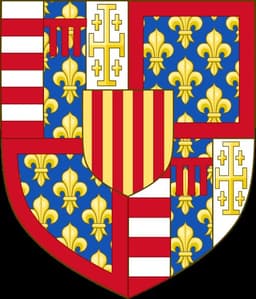
Charles IV of Anjou
Emperor · Medieval
38.9Total

Napoleon Bonaparte
General · Modern
70.9Total
Basic Information
Born
1446
1769
Died
1481
1821
Era
Medieval
Modern
Nationality
Anjou
France
Occupation
Emperor
General
Civilization
Western
Western
Score Comparison
Military (10%)
21.2
94.0
Political (20%)
29.3
72.0
Influence (20%)
49.4
40.0
Legacy (20%)
39.2
80.0
Leadership (15%)
41.5
78.0
Strategy (15%)
39.6
90.0
TOTAL
38.9
70.9
Charles IV of Anjou — Complete Timeline
1480 AD
Inherited Duchy of Anjou and ProvencePolitical Action◆ Major
Charles IV inherited the Duchy of Anjou and the County of Provence from his father Ren
InheritanceSuccession
Impact: regional
1481 AD
Willed Provence to King Louis XI of FrancePolitical Action
On his deathbed, Charles IV willed the County of Provence to King Louis XI of France, bypassing his own heirs. This act permanently annexed Provence to the French crown.
AnnexationEnd of Angevin Dynasty
Impact: national
Napoleon Bonaparte — Complete Timeline
1799 AD
Coup of 18 BrumaireOther◆ Major
Napoleon Bonaparte, with support from his brother Lucien and key political figures, overthrew the Directory in a bloodless coup. He established the Consulate with himself as First Consul, effectively becoming the ruler of France. This event ended the French Revolution's most unstable period.
French RevolutionCoupRise to Power
Impact: regional
1804 AD
Promulgation of the Napoleonic CodeOther◆ Major
Napoleon enacted the Civil Code of the French, known as the Napoleonic Code, a comprehensive set of laws that replaced the fragmented feudal legal systems. The code established legal equality, protected property rights, and secularized law. It became the basis for legal systems in many European and world countries.
Legal ReformNapoleonic CodeCivil Law
Impact: globalconstructive
1805 AD
Battle of AusterlitzWar◆ Major
Napoleon's Grande Arm
Napoleonic WarsBattleDecisive Victory
Impact: global
1812 AD
Invasion of RussiaWar◆ Major
Napoleon led the Grande Arm
Napoleonic WarsInvasionDisaster
Impact: globaldestructive
1815 AD
Battle of WaterlooWar◆ Major
Napoleon's French army was defeated by the combined forces of the Duke of Wellington's Anglo-Allied army and Gebhard Leberecht von Bl
Napoleonic WarsBattleFinal Defeat
Impact: globaldestructive
Expert Analysis
charles-iv-of-anjou-vs-napoleon-bonaparte
# The Last Duke and the Little Corporal: Two Paths to Immortality
On a December morning in 1481, a dying man in Provence made a decision that would erase his family’s name from the map of European power. Charles IV of Anjou, the last of his line, turned his face from his own blood and bequeathed his lands to the King of France. Three centuries later, another man would stand in Notre Dame Cathedral, seize the crown from the Pope’s hands, and place it on his own head. One man gave away an inheritance; the other took an empire. Why did Charles IV vanish into obscurity while Napoleon Bonaparte still thunders through history?
Origins
Charles IV was born in 1446 into a world of dying certainties. The Angevin dynasty, once a force that stretched from Naples to Provence, had been bleeding territory for generations. His father René was a cultured man, a patron of arts who wrote poetry and painted—but a ruler who lost kingdom after kingdom. Charles grew up in the twilight of medieval chivalry, when the great families of Europe were being absorbed by rising centralized monarchies. His education was one of courtly refinement, not battlefield command.
Napoleon Bonaparte entered the world in 1769 on the island of Corsica, a place that had just been sold to France by the Republic of Genoa. His family were minor nobility, but they were Corsican first—and resentful of their new French masters. Young Napoleon grew up speaking Italian-accented French, mocked by his classmates at military school for his accent and poverty. He devoured books on military history and artillery tactics. His era was one of revolution, when a man of talent could rise higher than any noble birthright could guarantee.
Rise to Power
Charles IV’s ascent was a matter of inheritance, not ambition. When his father René died in 1480, Charles became Duke of Anjou and Count of Provence. He was 34 years old, childless, and already ill. His rule lasted barely a year. He undertook no campaigns, forged no alliances, and left no mark on the battlefield. The turning point of his life came on his deathbed: facing the extinction of his line, he chose to will Provence to King Louis XI of France rather than to a distant cousin. It was an act of surrender, not conquest.
Napoleon’s rise was a story of explosive will. A young artillery officer during the French Revolution, he first made his name at the Siege of Toulon in 1793, where he drove the British from the harbor. By 1796, at age 26, he commanded the French army in Italy and turned a starving, ragged force into a conquering machine. He won battle after battle—Lodi, Arcole, Rivoli—and dictated peace terms to the Austrians. In 1799, he seized power in a coup. By 1804, he was Emperor of the French, crowned in Notre Dame before the watching eyes of Europe.
Leadership & Governance
Charles IV governed for less than twelve months. He issued no laws, reformed no institutions, and fought no wars. His sole significant act was his will—a document that transferred Provence to the French crown and ended the Angevin dynasty’s independent existence. He was a placeholder, a man who arrived too late and left too quickly.
Napoleon governed for fifteen years and reshaped the continent. His Napoleonic Code standardized French law, abolishing feudal privileges and establishing principles of equality before the law that still influence legal systems worldwide. He reformed education, created the Bank of France, and built roads and canals. As a military commander, his genius was unmatched: he revolutionized warfare with fast-moving corps, massed artillery, and the strategy of striking at the enemy’s center. At Austerlitz in 1805, he destroyed a larger Russian-Austrian army in a single day, a victory that remains a masterpiece of military art.
Triumph & Tragedy
Charles IV’s greatest moment was also his tragedy: he died, and with him died his dynasty. No monuments mark his victories because he had none. He is remembered only for what he gave away.
Napoleon’s triumphs were staggering. He conquered Italy, Egypt, Prussia, Austria, and Spain. He redrew the map of Europe, placed his brothers on thrones, and made Paris the capital of the Western world. But his tragedy was equally immense. The invasion of Russia in 1812 destroyed his Grand Army—half a million men lost to cold, hunger, and Cossacks. He was exiled to Elba, escaped, raised another army, and met his final defeat at Waterloo in 1815. He died six years later on Saint Helena, a prisoner of the British, far from the fields where he had once ruled.
Character & Destiny
Charles IV was a man without ambition. He accepted his inheritance, then let it go. His personality was passive, his decisions defensive. He did not shape events; events shaped him. He was the last leaf on a dying tree, and when the wind blew, he fell.
Napoleon was ambition incarnate. “Impossible,” he once said, “is a word to be found only in the dictionary of fools.” He drove himself and his armies beyond every limit—beyond the Alps, beyond the Pyrenees, beyond Moscow. His hunger for power was insatiable, and it consumed him. He could not stop, could not consolidate, could not share glory. His character built an empire, and his character destroyed it.
Legacy
Charles IV of Anjou left a footnote. Provence became part of France, and the Angevin name faded into the archives. He is remembered only by historians of medieval dynasties and by the occasional plaque in a Provençal church. His legacy score, by any measure, is low—a 45.3 total in the assessments of history.
Napoleon’s legacy is immense. His military tactics are still studied at West Point and Sandhurst. The Napoleonic Code underpins the legal systems of dozens of countries. His influence score of 82.0 reflects a man who changed how Europe thought about law, war, and leadership. But his legacy is also contested: he restored slavery in French colonies, suppressed republican freedoms, and left a trail of war dead across the continent. He is both hero and tyrant, genius and monster.
Conclusion
What separates Charles IV from Napoleon is not birth, talent, or circumstance alone—it is the quality of will. Charles was given a small stage and chose to leave it quietly. Napoleon was given a revolutionary age and chose to set it on fire. One man’s life was a closing door; the other’s was an open wound in history. We remember Napoleon because he dared everything and lost everything. We forget Charles because he dared nothing and lost nothing. In the end, history does not reward those who keep their inheritance—it rewards those who seize the crown.
Rankings
🥇
Napoleon BonaparteLeader
Mil: 94.0Pol: 72.0Inf: 40.0
70.9
🥈
Charles IV of Anjou
Mil: 21.2Pol: 29.3Inf: 49.4
38.9
+32.0 behind
How This Comparison Works
Algorithm
Each figure is scored on 6 dimensions (0—100 scale) based on structured historical data: Military (10%), Political (20%), Influence (20%), Legacy (20%), Leadership (15%), Strategy (15%). The weighted total produces the final ranking.
Data Sources
Scores are computed from structured sub-indicators in the database. Scale factors adjust for era (Ancient ×0.85, Modern ×1.0) and civilization size (Eastern ×1.05, Other ×0.80) to account for differences in population and military scale.
Maximum 3 Figures
Comparisons are limited to 2—3 figures to ensure readability and statistical meaningfulness.
Error Margins
±5 points per dimension — Sub-scores are derived from historical records with inherent uncertainty. Two figures within 5 points on a dimension should be considered roughly equivalent in that area.
Total Score Accuracy
±3 points overall — The weighted combination of 6 dimensions produces a total score with approximately ±3 points of uncertainty. Differences of less than 3 points are not statistically significant— the figures are effectively tied.
Known Limitations
- Historical records are incomplete and uneven across civilizations
- Figures from oral-tradition societies may be underrepresented
- Occupation labels can misclassify multi-role figures
- Scores measure capability and impact, not moral character
- Quantitative scoring is a comparison tool, not absolute truth
Capability Radar
Military (10%) — Battles & Warfare
Battles
10
95
Win Rate
10
90
Expansion
10
95
Political (20%) — Governance & Reform
Reform
20
95
Diplomacy
30
80
Economy
20
85
Influence (20%) — Cultural & Global Reach
Cultural
15
85
Global
10
90
Legacy (20%) — Historical Impact
Historical
20
95
Longevity
15
90
Leadership (15%) — Power & Stability
Tenure
30
85
Stability
20
70
Strategy (15%) — Tactics & Innovation
Strategy
10
95
Tactics
10
98
Reform
5
92
Similar Comparisons
Comments & Discussion
TheCrownSurrenderer6/17/2026
Charles IV wasn't just forgotten—he chose irrelevance by handing Provence to France on a silver platter. Napoleon would've laughed at a ruler who gave away his inheritance without a fight. Charles had a chance to ally with the Habsburgs or marry strategically, but he caved to Louis XI's pressure. That's not a "last duke," that's a quitter. The Angevins deserved extinction if their final move was a white flag.
拿破仑的战术大师6/17/2026
拿皇在雾月政变里一把抢过权杖,而查四世连自家祖传领地都保不住。1481年他要是有点骨气,就该跟法兰西国王死磕到底,而不是躺平等死。150年后的意大利战争证明,小国联姻结盟还能周旋——他偏偏选了最窝囊的路。历史只记住赢家,对吧?