Loading...
Charles de Gaulle vs Mustafa Kemal Ataturk
Mustafa Kemal Ataturk leads by 11.8 pts · 2 figures compared
…
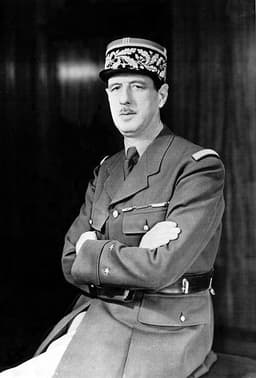
Charles de Gaulle
Politician · Modern
68.2Total
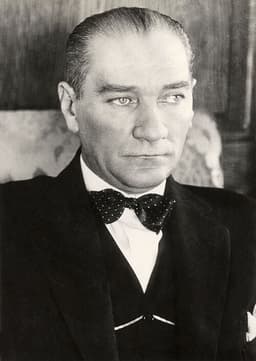
Mustafa Kemal Ataturk
Politician · Modern
80.0Total
Basic Information
Born
1890
1881
Died
1970
1938
Era
Modern
Modern
Nationality
France
Turkey
Occupation
Politician
Politician
Civilization
Western
Middle Eastern
Score Comparison
Military (10%)
55.0
75.0
Political (20%)
75.0
85.0
Influence (20%)
65.0
75.0
Legacy (20%)
68.0
90.0
Leadership (15%)
78.0
80.0
Strategy (15%)
65.0
65.0
TOTAL
68.2
80.0
Charles de Gaulle — Complete Timeline
1940 AD
Appeal of 18 June 1940Political Action
From London, de Gaulle broadcast a radio appeal urging French resistance against Nazi occupation. He called on French soldiers and citizens to continue the fight, founding the Free French Forces and becoming the symbol of French defiance.
World War IIResistanceLeadership
Impact: nationalconstructive
1958 AD
Founding of the Fifth RepublicPolitical Action
De Gaulle returned to power during the Algerian crisis and oversaw the drafting of a new constitution. The Fifth Republic established a strong executive presidency, replacing the unstable parliamentary system of the Fourth Republic.
ConstitutionGovernment ReformPolitical System
Impact: nationalconstructive
1962 AD
End of the Algerian WarPolitical Action◆ Major
De Gaulle negotiated the
DecolonizationPeace TreatyAlgeria
Impact: regionalconstructive
1968 AD
May 1968 CrisisPolitical Action◆ Major
Mass student protests and general strikes paralyzed France, challenging de Gaulle's government. De Gaulle briefly fled to Germany, then returned to dissolve the National Assembly and call elections, which his party won, but his authority was weakened.
ProtestPolitical CrisisSocial Unrest
Impact: nationaldestructive
1969 AD
Resignation as PresidentPolitical Action
De Gaulle resigned after losing a referendum on regional reform and Senate restructuring. The defeat marked the end of his political career, as he withdrew from public life and died the following year.
ResignationPolitical DefeatReferendum
Impact: nationaltragic
Mustafa Kemal Ataturk — Complete Timeline
1915 AD
Battle of GallipoliWar
As a colonel, Mustafa Kemal commanded Ottoman forces at Gallipoli, successfully repelling Allied landings. His leadership at critical points like Chunuk Bair made him a national hero and laid the foundation for his political career.
World War IOttoman EmpireMilitary Victory
Impact: regional
1919 AD
Turkish War of IndependenceWar
Kemal organized and led the Turkish National Movement against the Allied occupation of Anatolia and the Treaty of S
Independence WarNational MovementAnkara
Impact: nationalconstructive
1922 AD
Abolition of the SultanatePolitical Action◆ Major
The Grand National Assembly of Turkey, under Kemal's leadership, abolished the Ottoman Sultanate, ending 600 years of imperial rule. This severed the link with the old regime and paved the way for the proclamation of the Republic.
SultanateRepublicPolitical Reform
Impact: nationalprogressive
1923 AD
Proclamation of the Republic of TurkeyPolitical Action
Kemal declared Turkey a republic, becoming its first president. He moved the capital to Ankara and initiated a series of radical reforms to modernize and secularize the state, including the adoption of a new legal code and the Latin alphabet.
RepublicModernizationSecularism
Impact: globalprogressive
1925 AD
Adoption of the Hat LawReform◆ Major
Kemal introduced the Hat Law, banning the fez and encouraging Western-style hats. This was part of his broader cultural revolution to secularize and Westernize Turkish society, symbolizing the break with Ottoman traditions.
Cultural ReformSecularismWesternization
Impact: nationalprogressive
1934 AD
Granting of Women's SuffrageReform◆ Major
Kemal's government granted women the right to vote and stand for election in national elections, ahead of many European countries. This reform was part of his commitment to gender equality and modernization of Turkish society.
Women's RightsSuffrageModernization
Impact: nationalprogressive
Expert Analysis
Charles de Gaulle vs Mustafa Kemal Ataturk
# The Two Liberators: De Gaulle and Atatürk, Architects of Nations
In the spring of 1969, an aging Charles de Gaulle sat in his study at Colombey-les-Deux-Églises, having just resigned the presidency of France after a humiliating referendum defeat. Half a century earlier and two thousand miles away, Mustafa Kemal Atatürk had stood on a hillside in Anatolia, watching the last Ottoman soldiers retreat from Allied forces, knowing that the empire he served was dying. One man ended his career in quiet retirement, the other in the mausoleum of a nation he had willed into existence. Both had saved their countries from collapse. Why did their paths diverge so dramatically?
Origins
De Gaulle was born into a devoutly Catholic, patriotic family in Lille in 1890, the son of a philosophy professor who instilled in him a romantic vision of France's greatness. He entered Saint-Cyr military academy and was wounded three times in World War I, spending thirty-two months as a prisoner of war. His France was ancient, Catholic, hierarchical—a civilization that had existed for a millennium.
Atatürk, born Mustafa Kemal in 1881 in Salonika, grew up in the dying convulsions of the Ottoman Empire, a multi-ethnic, multi-religious state that Europeans called "the Sick Man of Europe." His father was a minor customs official; his mother a devout Muslim who wanted him to study the Quran. He chose a military career instead, and like de Gaulle, attended a war academy. But where de Gaulle's France was secure in its identity, Atatürk's Ottoman world was crumbling. That difference—between saving an ancient nation and inventing a new one—would define everything.
Rise to Power
De Gaulle's moment came on June 18, 1940, when he broadcast from London, calling on the French people to resist Nazi occupation. He was a brigadier general, virtually unknown, speaking from a foreign capital. His legitimacy was entirely self-proclaimed. For four years, he led the Free French Forces from exile, a voice in the wilderness.
Atatürk's rise was the opposite. At Gallipoli in 1915, he was already a colonel commanding troops on the ground, his leadership recognized by both his men and his enemies. When he organized the Turkish National Movement in 1919, he did so from within Anatolia itself, not from a foreign radio studio. He fought the Greek army, the French, the Italians, and the British—and won. By 1923, when he proclaimed the Republic of Turkey, he had military victory to back his political ambition.
Leadership & Governance
De Gaulle governed through his mystique. He believed that France could not be France without greatness, and he embodied that greatness through his aloofness, his theatrical press conferences, and his carefully crafted speeches. His Fifth Republic constitution gave the president extraordinary powers—a "republican monarch," his critics said. He ended the Algerian War in 1962, defying the army that had brought him back to power, and he pursued an independent foreign policy that withdrew France from NATO's military command.
Atatürk governed through revolution. He did not restore Turkey's greatness; he redefined it. He abolished the sultanate in 1922, the caliphate in 1924, and then systematically dismantled every institution of the old order. The fez was banned, the Latin alphabet replaced Arabic script, Islamic law gave way to Swiss civil code, and women gained the right to vote in 1934—before France, Italy, or Switzerland. Where de Gaulle preserved and purified, Atatürk destroyed and rebuilt.
Triumph & Tragedy
De Gaulle's triumph was the liberation of France in 1944, when he walked down the Champs-Élysées to the roar of a grateful nation. His tragedy came in May 1968, when student protests and a general strike paralyzed France. The man who had embodied national unity found himself isolated, briefly fleeing to Germany to consult with French generals. He won a snap election that summer, but his authority was broken. He resigned the following year.
Atatürk's triumph was the Turkish War of Independence itself—the creation of a nation from the ashes of an empire. His tragedy was more subtle. He died in 1938 at age fifty-seven, of cirrhosis of the liver, having spent his last years as an absolute ruler who tolerated no opposition. His reforms were imposed from above, not debated from below. The democracy he envisioned never fully took root.
Character & Destiny
Both men were stubborn, visionary, and convinced of their own historical role. De Gaulle once wrote, "France cannot be France without greatness." Atatürk declared, "I have no religion, and at times I wish all religions at the bottom of the sea." De Gaulle's vision was backward-looking—to restore France's ancient glory. Atatürk's was forward-looking—to create a modern, Western nation from an Islamic empire.
De Gaulle's Catholic, hierarchical France gave him a sense of continuity. He could afford to be conservative because the nation was secure in its identity. Atatürk's Ottoman Turkey had no such luxury. The empire had collapsed; everything had to be built anew. That is why Atatürk was a revolutionary and de Gaulle a restorer.
Legacy
De Gaulle's legacy is the Fifth Republic, which still governs France today, and a certain idea of French independence and grandeur that survives in French foreign policy. He is remembered as a savior, but also as a difficult, aloof figure—a man who loved France but was not always comfortable with the French.
Atatürk's legacy is Turkey itself. His face is on every banknote, his statue in every town square, his name on every public building. His reforms remain the foundation of the Turkish Republic. But he also left a difficult inheritance: a state that was secular by decree, not by conviction; a democracy that was always subordinate to the military; and a national identity that defined itself against its Ottoman and Islamic past.
Conclusion
Standing at the end of their lives, both men might have recognized a shared truth: that nations are fragile things, requiring constant effort to preserve. De Gaulle saved an ancient nation from humiliation; Atatürk created a new one from ruin. One restored, the other invented. Both succeeded, but their success carried the seeds of their limitations. De Gaulle's France remains proud, independent, and occasionally aloof. Atatürk's Turkey is modern, secular, and perpetually unsettled. The difference between them is the difference between preserving a cathedral and building one from the ground up. Both are acts of faith. But the builders never rest.
Rankings
🥇
Mustafa Kemal AtaturkLeader
Mil: 75.0Pol: 85.0Inf: 75.0
80.0
🥈
Charles de Gaulle
Mil: 55.0Pol: 75.0Inf: 65.0
68.2
+11.8 behind
How This Comparison Works
Algorithm
Each figure is scored on 6 dimensions (0—100 scale) based on structured historical data: Military (10%), Political (20%), Influence (20%), Legacy (20%), Leadership (15%), Strategy (15%). The weighted total produces the final ranking.
Data Sources
Scores are computed from structured sub-indicators in the database. Scale factors adjust for era (Ancient ×0.85, Modern ×1.0) and civilization size (Eastern ×1.05, Other ×0.80) to account for differences in population and military scale.
Maximum 3 Figures
Comparisons are limited to 2—3 figures to ensure readability and statistical meaningfulness.
Error Margins
±5 points per dimension — Sub-scores are derived from historical records with inherent uncertainty. Two figures within 5 points on a dimension should be considered roughly equivalent in that area.
Total Score Accuracy
±3 points overall — The weighted combination of 6 dimensions produces a total score with approximately ±3 points of uncertainty. Differences of less than 3 points are not statistically significant— the figures are effectively tied.
Known Limitations
- Historical records are incomplete and uneven across civilizations
- Figures from oral-tradition societies may be underrepresented
- Occupation labels can misclassify multi-role figures
- Scores measure capability and impact, not moral character
- Quantitative scoring is a comparison tool, not absolute truth
Capability Radar
Military (10%) — Battles & Warfare
Battles
60
85
Win Rate
55
90
Expansion
20
60
Political (20%) — Governance & Reform
Reform
95
98
Diplomacy
90
85
Economy
70
75
Influence (20%) — Cultural & Global Reach
Cultural
70
90
Global
80
80
Legacy (20%) — Historical Impact
Historical
85
95
Longevity
75
85
Leadership (15%) — Power & Stability
Tenure
85
85
Stability
75
70
Strategy (15%) — Tactics & Innovation
Strategy
85
85
Tactics
70
88
Reform
80
80
Similar Comparisons
Comments & Discussion
No comments yet. Be the first to share your thoughts!