Loading...
Catherine de Medici vs Rene Coty
Catherine de Medici leads by 17.8 pts · 2 figures compared
…
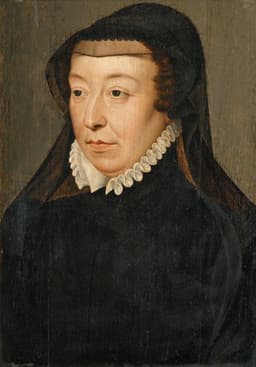
Catherine de Medici
Politician · Modern
60.0Total

Rene Coty
Politician · Modern
42.2Total
Basic Information
Born
1519
1882
Died
1589
1962
Era
Modern
Modern
Nationality
France
France
Occupation
Politician
Politician
Civilization
Western
Western
Score Comparison
Military (10%)
43.3
49.2
Political (20%)
72.0
36.5
Influence (20%)
68.0
46.3
Legacy (20%)
55.0
37.5
Leadership (15%)
66.0
43.8
Strategy (15%)
42.3
43.0
TOTAL
60.0
42.2
Catherine de Medici — Complete Timeline
1560 AD
Appointed Regent for Charles IXPolitical Action◆ Major
After the death of her son Francis II, Catherine de Medici became regent for her ten-year-old son Charles IX. She assumed control of the French government during the early Wars of Religion, seeking to maintain royal authority and religious peace.
RegencyWars of ReligionPower
Impact: national
1562 AD
Edict of Saint-GermainPolitical Action◆ Major
Catherine issued the Edict of Saint-Germain, granting limited toleration to Huguenots and allowing them to worship outside towns. This edict aimed to reduce religious tensions but was rejected by Catholic hardliners, contributing to the outbreak of the First War of Religion.
EdictReligious TolerationWars of Religion
Impact: nationalconstructive
1572 AD
St. Bartholomew's Day MassacreOther
Catherine de Medici was implicated in the assassination of Huguenot leader Gaspard de Coligny, which triggered a wave of mob violence in Paris that killed thousands of Huguenots. The massacre spread to other cities and deepened the religious conflict in France.
MassacreReligious ViolenceHuguenots
Impact: nationaldestructive
1576 AD
Peace of MonsieurPolitical Action◆ Major
Catherine negotiated the Peace of Monsieur, which granted extensive concessions to Huguenots, including freedom of worship and fortified towns. The peace was opposed by the Catholic League and led to the formation of the Catholic League, escalating tensions.
Peace TreatyReligious TolerationCatholic League
Impact: national
Rene Coty — Complete Timeline
1954 AD
Elected President of FrancePolitical Action◆ Major
René Coty was elected the second and last President of the Fourth French Republic, serving from 1954 to 1959. His presidency was marked by the Algerian War and political instability.
PresidencyFourth Republic
Impact: national
1958 AD
Appointed Charles de Gaulle as Prime MinisterPolitical Action
In May 1958, during the Algiers putsch and a severe political crisis, President Coty called upon Charles de Gaulle to form a government. This led to the end of the Fourth Republic and the establishment of the Fifth Republic.
Algerian WarFifth Republic
Impact: national
1959 AD
Stepped Down as PresidentPolitical Action◆ Major
Coty stepped down as president in January 1959 upon the inauguration of Charles de Gaulle as the first president of the Fifth Republic. He retired from political life.
End of Fourth Republic
Impact: national
Expert Analysis
Origins
Catherine de Medici was born in 1519 in Florence, Italy, to the powerful Medici family. Orphaned as an infant, she was raised by relatives and later married at age 14 to Henry, second son of King Francis I of France. Her early life was marked by political instability and her struggle to produce an heir, finally giving birth to ten children. Her Italian upbringing exposed her to Renaissance politics and the art of diplomacy.
René Coty was born in 1882 in Le Havre, France, into a middle-class family. He studied law and became a lawyer and politician, serving as a deputy and senator. His early career was shaped by the Third Republic's parliamentary system. He was a moderate conservative, known for his integrity but lacking the charisma of his contemporaries.
Rise to Power
Catherine de Medici rose to prominence after her husband Henry II died in 1559, leaving her as queen mother. Her eldest son Francis II became king but died in 1560, making her regent for her ten-year-old son Charles IX. She skillfully navigated the factions of Catholic Guise and Protestant Bourbon, initially seeking compromise to preserve royal authority. Her regency was marked by the Edict of Saint-Germain in 1562, granting limited toleration to Huguenots.
René Coty rose through the French Senate, becoming president of the Fourth Republic in 1954 after a series of short-lived governments. His election was a compromise among center-right parties. He was not a dominant figure but a consensus candidate, taking office during the Algerian War. His presidency was defined by the collapse of the Fourth Republic.
Leadership & Governance
Catherine de Medici governed through manipulation and balance-of-power politics. She issued edicts to appease Huguenots while simultaneously plotting against them. Her leadership was reactive, trying to maintain the monarchy's authority amid religious conflict. She scored 72.0 in political acumen, reflecting her ability to stay in power, but her military score of 43.3 shows her reliance on others for force.
René Coty's leadership was largely ceremonial; the Fourth Republic's constitution gave limited power to the president. He scored 43.8 in leadership, reflecting his passive role. He attempted to mediate crises but ultimately deferred to Charles de Gaulle. His governance was constrained by a weak executive system.
Triumph & Tragedy
Catherine's greatest triumph was preserving the Valois dynasty during her sons' reigns. She negotiated the Peace of Monsieur in 1576, granting extensive concessions to Huguenots. However, her greatest tragedy was the St. Bartholomew's Day Massacre in 1572, when she was implicated in the assassination of Huguenot leader Gaspard de Coligny, leading to thousands of deaths. This event tarnished her legacy and escalated the wars.
René Coty's triumph was his role in the peaceful transition to the Fifth Republic. By appointing Charles de Gaulle as prime minister in 1958, he averted a potential civil war. His tragedy was his inability to solve the Algerian crisis himself, leading to the end of the Fourth Republic. He stepped down in 1959, his influence fading.
Character & Destiny
Catherine de Medici was pragmatic, secretive, and ruthless. She prioritized the monarchy's survival over ideology. Her Italian upbringing influenced her Machiavellian tactics. Her character led to both compromises and atrocities, ultimately failing to unite France. She scored 66.0 in leadership, reflecting her decisiveness but also her moral ambiguity.
René Coty was modest, honest, and cautious. He lacked the ambition to shape events. His destiny was to be a caretaker president during a crisis. His character led him to step aside for de Gaulle, recognizing his own limitations. He scored 36.5 in political influence, showing his limited impact.
Legacy
Catherine de Medici's legacy is mixed. She is remembered for the St. Bartholomew's Day Massacre and her role in the Wars of Religion. However, she also sponsored arts and architecture, bringing Italian culture to France. Her political maneuvering set precedents for royal authority. Her legacy score is 55.0, reflecting her enduring infamy.
René Coty's legacy is overshadowed by de Gaulle. He is remembered as the last president of the Fourth Republic, a figure who facilitated the transition to a stronger executive. His legacy score is 37.5, indicating minimal long-term impact. He is not a major figure in French history.
Conclusion
Catherine de Medici had a far greater impact on France than René Coty. Her political score of 72.0 versus Coty's 36.5 reflects her active role in shaping events. While Coty's presidency was a footnote, Catherine's actions influenced the course of French history, even if disastrously. Her total score of 60.0 dwarfs Coty's 42.2. Therefore, Catherine de Medici is the more significant historical figure.
Rankings
🥇
Catherine de MediciLeader
Mil: 43.3Pol: 72.0Inf: 68.0
60.0
🥈
Rene Coty
Mil: 49.2Pol: 36.5Inf: 46.3
42.2
+17.8 behind
How This Comparison Works
Algorithm
Each figure is scored on 6 dimensions (0—100 scale) based on structured historical data: Military (10%), Political (20%), Influence (20%), Legacy (20%), Leadership (15%), Strategy (15%). The weighted total produces the final ranking.
Data Sources
Scores are computed from structured sub-indicators in the database. Scale factors adjust for era (Ancient ×0.85, Modern ×1.0) and civilization size (Eastern ×1.05, Other ×0.80) to account for differences in population and military scale.
Maximum 3 Figures
Comparisons are limited to 2—3 figures to ensure readability and statistical meaningfulness.
Error Margins
±5 points per dimension — Sub-scores are derived from historical records with inherent uncertainty. Two figures within 5 points on a dimension should be considered roughly equivalent in that area.
Total Score Accuracy
±3 points overall — The weighted combination of 6 dimensions produces a total score with approximately ±3 points of uncertainty. Differences of less than 3 points are not statistically significant— the figures are effectively tied.
Known Limitations
- Historical records are incomplete and uneven across civilizations
- Figures from oral-tradition societies may be underrepresented
- Occupation labels can misclassify multi-role figures
- Scores measure capability and impact, not moral character
- Quantitative scoring is a comparison tool, not absolute truth
Capability Radar
Military (10%) — Battles & Warfare
Battles
10
27
Win Rate
10
32
Expansion
5
37
Political (20%) — Governance & Reform
Reform
60
15
Diplomacy
80
20
Economy
50
15
Influence (20%) — Cultural & Global Reach
Cultural
60
5
Global
55
10
Legacy (20%) — Historical Impact
Historical
70
15
Longevity
65
10
Leadership (15%) — Power & Stability
Tenure
85
10
Stability
30
10
Strategy (15%) — Tactics & Innovation
Strategy
20
37
Tactics
15
42
Reform
15
45
Similar Comparisons
Comments & Discussion
No comments yet. Be the first to share your thoughts!