Loading...
Casimir III the Great vs Julius Caesar
Julius Caesar leads by 22.6 pts · 2 figures compared
…
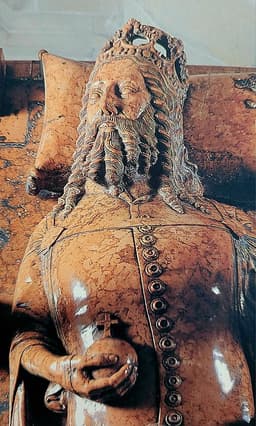
Casimir III the Great
Emperor · Medieval
60.2Total

Julius Caesar
General · Ancient
82.8Total
Basic Information
Born
1310
-100
Died
1370
-44
Era
Medieval
Ancient
Nationality
Poland
Roman Republic
Occupation
Emperor
General
Civilization
Western
Western
Score Comparison
Military (10%)
40.0
88.0
Political (20%)
70.3
78.0
Influence (20%)
56.7
85.0
Legacy (20%)
55.0
82.0
Leadership (15%)
78.0
80.0
Strategy (15%)
60.0
85.0
TOTAL
60.2
82.8
Casimir III the Great — Complete Timeline
1333 AD
Construction of Wawel CastleCultural
Casimir III initiated the reconstruction of Wawel Castle in Krakow in Gothic style, replacing earlier Romanesque structures. The castle became the royal residence and a symbol of Polish statehood, embodying the king's building program that left Poland 'in stone'.
ArchitectureRoyal PatronageCultural Heritage
Impact: nationalconstructive
1340 AD
Annexation of Red RutheniaWar◆ Major
Following the death of Boles
ExpansionTerritorial GainEastern Europe
Impact: regionalconstructive
1343 AD
Peace of KaliszPolitical Action◆ Major
Casimir III signed the Peace of Kalisz with the Teutonic Order, renouncing Polish claims to Pomerelia and Che
Teutonic OrderDiplomacyTerritorial Settlement
Impact: nationalconstructive
1347 AD
Codification of LawsReform◆ Major
Casimir III issued the Statutes of Wi
Legal ReformAdministrationJustice
Impact: nationalprogressive
1364 AD
Foundation of the University of KrakowCultural
Casimir III established the University of Krakow (later Jagiellonian University), the second university in Central Europe after Prague. The institution became a major center of learning, though it declined after Casimir's death until revived in the 15th century.
EducationRenaissanceCulture
Impact: regionalprogressive
Congress of KrakowPolitical Action◆ Major
Casimir III hosted the Congress of Krakow, a meeting of European monarchs including Holy Roman Emperor Charles IV, King Louis I of Hungary, and King Valdemar IV of Denmark. The congress discussed peace and cooperation, enhancing Poland's prestige.
DiplomacyInternational RelationsPrestige
Impact: regionalconstructive
Julius Caesar — Complete Timeline
58 BC
Gallic WarsWar◆ Major
Caesar, as proconsul of Gaul, launched a series of campaigns that conquered all of Gaul (modern France, Belgium, and parts of Switzerland). He fought numerous battles, including against the Helvetii, the Belgae, and the Gallic chieftain Vercingetorix. The wars brought immense wealth and a loyal army to Caesar.
Gallic WarsConquestRoman Expansion
Impact: regional
49 BC
Crossing the RubiconPolitical Action◆ Major
Caesar led Legio XIII across the Rubicon River into Italy, defying the Roman Senate's order to disband his army. This act triggered a civil war against Pompey and the Optimates, ultimately leading to Caesar's dictatorship and the end of the Roman Republic.
Roman Civil WarEnd of RepublicPower Struggle
Impact: global
48 BC
Battle of PharsalusWar◆ Major
Caesar's outnumbered army defeated the larger forces of Pompey the Great at Pharsalus in Greece. Caesar's tactical use of a reserve line to counter Pompey's cavalry charge proved decisive. Pompey fled to Egypt, where he was assassinated, leaving Caesar as the undisputed master of the Roman world.
Roman Civil WarBattleDecisive Victory
Impact: regional
44 BC
Appointment as Dictator for LifePolitical Action◆ Major
The Roman Senate appointed Caesar dictator perpetuo (dictator for life), granting him unprecedented personal power. This move concentrated military, legislative, and judicial authority in one person, effectively ending the Roman Republic's traditional system of checks and balances and alarming many senators.
DictatorshipEnd of RepublicPower Consolidation
Impact: regionaldestructive
Assassination on the Ides of MarchPolitical Action◆ Major
A group of Roman senators, led by Marcus Junius Brutus and Gaius Cassius Longinus, stabbed Caesar to death at a meeting of the Senate in the Theatre of Pompey. The assassination was intended to restore the Republic, but instead triggered another civil war that led to the rise of the Roman Empire.
AssassinationRoman PoliticsEnd of Republic
Impact: globaldestructive
Expert Analysis
casimir-iii-the-great-vs-julius-caesar
# The Stone and the Sword: Casimir III and Julius Caesar
On a spring morning in 1347, King Casimir III of Poland stood before a gathering of nobles in the castle of Wiślica, unrolling a parchment that would change his kingdom forever. Across the continent and fourteen centuries earlier, on a January day in 49 BCE, Julius Caesar paused at the banks of a small river called the Rubicon, knowing that the step he was about to take would either make him master of Rome or destroy him utterly. These two men, separated by time, geography, and the very nature of their ambitions, represent two radically different answers to the same question: what does it mean to be a great leader? One built an empire through conquest and paid for it with his life; the other built a nation through law and left it standing in stone.
Origins
Julius Caesar was born into the twilight of the Roman Republic, a world of senatorial intrigue, civil wars, and restless ambition. His family, the Julii, claimed descent from the goddess Venus, but they were patricians of modest means. The young Caesar grew up in the shadow of his uncle Gaius Marius, a populist general who had reformed the Roman army, and he witnessed firsthand the bloody proscriptions that followed Marius’s defeat. This was a world where political survival demanded ruthlessness, where a man could rise only by crushing his rivals. Caesar learned early that the Republic was a theater of wolves, and he intended to be the hungriest among them.
Casimir III, by contrast, was born in 1310 into a kingdom that seemed to have no future. Poland was a patchwork of warring duchies, surrounded by the Teutonic Knights to the north, Bohemia to the south, and the Mongol hordes that still haunted European memory. His father, Władysław the Elbow-High, had spent his life stitching the kingdom back together after a century of fragmentation. Casimir inherited a crown that was more a burden than a prize—a realm of wooden forts, unwritten laws, and a nobility that obeyed only when it suited them. Where Caesar was forged in the furnace of civil war, Casimir was shaped by the patient craft of survival.
Rise to Power
Caesar’s path to power was a masterpiece of calculated audacity. He climbed the Roman political ladder—quaestor, aedile, praetor, consul—spending fortunes he did not yet have on games and bribes, forging alliances with the wealthy Crassus and the powerful Pompey. But his true springboard was Gaul. Between 58 and 50 BCE, Caesar conquered a territory larger than Italy itself, writing his own commentaries to ensure history remembered his genius. He amassed a veteran army loyal to him alone, and when the Senate ordered him to disband it, he instead crossed the Rubicon. The civil war that followed was brutal, but within four years Caesar was dictator for life, master of the Roman world.
Casimir III came to power in 1333 at the age of twenty-three, inheriting a kingdom that his father had barely held together. His rise was not a conquest but an acceptance of an impossible task. Poland’s neighbors had already carved away its richest provinces: Pomerelia belonged to the Teutonic Knights, Silesia to Bohemia. Casimir could not fight them all, so he chose to negotiate. In 1343, he signed the Peace of Kalisz, renouncing Polish claims to Pomerelia and Chełmno Land in exchange for peace—a humiliating concession that saved his kingdom from annihilation. Where Caesar seized glory, Casimir accepted shame, because he understood that a dead king builds nothing.
Leadership & Governance
The contrast in their governing styles could not be starker. Caesar ruled through sheer force of personality and military might. He reformed the calendar, extended citizenship to provincials, and launched ambitious building projects, but his power rested on the swords of his legions. He was a brilliant strategist—his siege of Alesia remains a textbook example of military genius—but his political wisdom was undermined by his own arrogance. He centralized authority, packed the Senate with his supporters, and accepted divine honors, treating the Republic as his personal domain.
Casimir III governed through law, not legions. His military score of 31.4 is a telling number: he was no warrior king. Instead, in 1347, he issued the Statutes of Wiślica and Piotrków, codifying Polish law for the first time. He protected peasants from noble abuse, granted rights to Jewish immigrants, and founded the University of Krakow in 1364—the second university in Central Europe. He built castles not for conquest but for defense, replacing the wooden forts of his father with stone walls. His strategy was patience: he annexed Red Ruthenia in 1340 through a diplomatic marriage and a brief campaign, but he spent far more energy on trade agreements and legal reforms. The old Polish saying captures it perfectly: “Casimir found Poland built of wood and left it built of stone.”
Triumph & Tragedy
Caesar’s greatest triumph was his conquest of Gaul, which doubled Rome’s territory and made him the most powerful man in the Mediterranean. His greatest tragedy was his own success: on the Ides of March, 44 BCE, a conspiracy of senators stabbed him to death in the Theatre of Pompey. His last words, according to tradition, were “Et tu, Brute?”—a recognition that even his closest allies could not accept a king in Rome’s name.
Casimir’s triumph was the Congress of Krakow in 1364, where he hosted Holy Roman Emperor Charles IV and other European monarchs, demonstrating that Poland had become a respected player on the continental stage. His tragedy was personal: he had no legitimate male heir. The Piast dynasty, which had ruled Poland for nearly five centuries, ended with his death in 1370. His nephew Louis of Hungary inherited the throne, and Poland entered a period of foreign rule. Casimir had built a kingdom of stone, but he could not build a dynasty to guard it.
Character & Destiny
Caesar was driven by an insatiable hunger for glory. He believed himself destined for greatness, and his personality—charming, ruthless, brilliant, and reckless—shaped every decision. He pardoned his enemies because he was confident he could control them; that confidence killed him. His destiny was to destroy the Republic he sought to save, to pave the way for an empire he would not live to see.
Casimir was driven by a quieter ambition: the survival and strengthening of Poland. He was pragmatic where Caesar was passionate, patient where Caesar was impulsive. His personality was that of a builder, not a conqueror. He accepted limitations—the loss of Pomerelia, the lack of an heir—because he understood that history judges kings not by their intentions but by their foundations. His destiny was to be remembered not as a warrior but as “the Great,” a title earned not through blood but through stone and statute.
Legacy
Julius Caesar’s legacy is written in blood and fire. His name became synonymous with imperial power—Kaiser, Tsar, Caesar—and his reforms laid the groundwork for the Roman Empire. But his legacy is also a warning: ambition unchecked by institutions destroys itself. He is remembered as a genius and a tyrant, a liberator and a dictator, a man who changed the world and was destroyed by it.
Casimir III’s legacy is quieter but no less profound. The University of Krakow would later educate Nicolaus Copernicus. The legal codes he established shaped Polish governance for centuries. The stone castles he built still stand. He is remembered not as a conqueror but as a father of his country, the last Piast who gave Poland the foundations to survive the storms to come—the partitions, the wars, the centuries of occupation. His legacy is not a name on a throne but a nation that endured.
Conclusion
In the end, Caesar and Casimir offer two models of greatness. Caesar believed that history belongs to those who seize it, who burn bright and die young, who leave their mark on the world through sheer force of will. Casimir believed that history belongs to those who build, who accept imperfection, who lay stones that others will set in place. The Rubicon and the Statutes of Wiślica are both acts of courage, but they speak to different kinds of men. Caesar crossed his river and changed the world in a decade; Casimir built his kingdom stone by stone over a lifetime. Which one was greater? Perhaps the answer lies not in the question but in the stone walls that still stand, long after the swords have rusted.
Rankings
🥇
Julius CaesarLeader
Mil: 88.0Pol: 78.0Inf: 85.0
82.8
🥈
Casimir III the Great
Mil: 40.0Pol: 70.3Inf: 56.7
60.2
+22.6 behind
How This Comparison Works
Algorithm
Each figure is scored on 6 dimensions (0—100 scale) based on structured historical data: Military (10%), Political (20%), Influence (20%), Legacy (20%), Leadership (15%), Strategy (15%). The weighted total produces the final ranking.
Data Sources
Scores are computed from structured sub-indicators in the database. Scale factors adjust for era (Ancient ×0.85, Modern ×1.0) and civilization size (Eastern ×1.05, Other ×0.80) to account for differences in population and military scale.
Maximum 3 Figures
Comparisons are limited to 2—3 figures to ensure readability and statistical meaningfulness.
Error Margins
±5 points per dimension — Sub-scores are derived from historical records with inherent uncertainty. Two figures within 5 points on a dimension should be considered roughly equivalent in that area.
Total Score Accuracy
±3 points overall — The weighted combination of 6 dimensions produces a total score with approximately ±3 points of uncertainty. Differences of less than 3 points are not statistically significant— the figures are effectively tied.
Known Limitations
- Historical records are incomplete and uneven across civilizations
- Figures from oral-tradition societies may be underrepresented
- Occupation labels can misclassify multi-role figures
- Scores measure capability and impact, not moral character
- Quantitative scoring is a comparison tool, not absolute truth
Capability Radar
Military (10%) — Battles & Warfare
Battles
30
95
Win Rate
35
92
Expansion
45
97
Political (20%) — Governance & Reform
Reform
90
90
Diplomacy
80
85
Economy
85
82
Influence (20%) — Cultural & Global Reach
Cultural
70
88
Global
55
94
Legacy (20%) — Historical Impact
Historical
75
95
Longevity
70
96
Leadership (15%) — Power & Stability
Tenure
85
75
Stability
75
60
Strategy (15%) — Tactics & Innovation
Strategy
40
94
Tactics
25
96
Reform
60
88
Similar Comparisons
Comments & Discussion
Julius-Caesar’s-Wet-Dream6/17/2026
Casimir built walls and codified laws. Caesar built legions and crossed rivers. One left a kingdom that lasted centuries, the other left a corpse on the Senate floor. If you think these two compare, you don’t understand that building something that outlasts you is infinitely harder than breaking things for glory. Casimir’s Poland stood; Caesar’s empire was a bloodstain within a generation.
石头与法典6/17/2026
拿卡西米尔跟凯撒比?凯撒是靠内战和私生子上台的军阀,卡西米尔是靠和平与法律立国的君主。凯撒征服了高卢却死在元老院台阶上,卡西米尔立了法典让波兰昌盛两百年。一个用刀剑建起沙堡,一个用石材筑成城墙。你选谁做你的国王?我选石头匠。