Loading...
This comparison has not been analyzed yet.
One-time AI generation (~1 minute). Scores and timeline are already available below.
Carl XVI Gustaf vs M'Siri
Carl XVI Gustaf leads by 5.7 pts · 2 figures compared
…
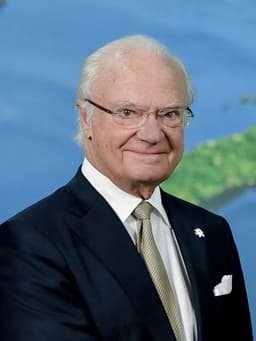
Carl XVI Gustaf
Emperor · Modern
50.1Total

M'Siri
Emperor · Modern
44.4Total
Basic Information
Born
1946
1830
Died
—
1891
Era
Modern
Modern
Nationality
Sweden
Katanga
Occupation
Emperor
Emperor
Civilization
Western
Other
Score Comparison
Military (10%)
47.3
30.0
Political (20%)
45.1
40.8
Influence (20%)
50.2
49.4
Legacy (20%)
40.0
38.3
Leadership (15%)
72.0
65.7
Strategy (15%)
52.5
35.0
TOTAL
50.1
44.4
Carl XVI Gustaf — Complete Timeline
1973 AD
Accession to the thronePolitical Action◆ Major
Carl XVI Gustaf became King of Sweden on September 15, 1973, following the death of his grandfather, Gustaf VI Adolf. He was the first Swedish monarch to reign under the 1974 constitution, which removed all political powers from the crown.
AccessionSuccession
Impact: national
1976 AD
Marriage to Silvia SommerlathCultural◆ Major
Carl XVI Gustaf married German-Brazilian Silvia Sommerlath on June 19, 1976. The wedding was a major media event and Silvia became a popular queen, known for her charitable work, especially for children with disabilities.
MarriageRoyal WeddingCharity
Impact: nationalconstructive
1980 AD
Introduction of the 1979 Act of SuccessionReform◆ Major
Carl XVI Gustaf signed the 1979 Act of Succession, which introduced absolute primogeniture, allowing the eldest child (regardless of gender) to inherit the throne. This made Crown Princess Victoria the heir apparent.
Succession ReformGender EqualityPrimogeniture
Impact: nationalprogressive
1990 AD
Environmental advocacyCultural
Carl XVI Gustaf became a prominent advocate for environmental issues, speaking at UN conferences and supporting sustainability initiatives. He used his ceremonial role to raise awareness about climate change and conservation.
EnvironmentalismClimate ChangeAdvocacy
Impact: globalconstructive
2016 AD
Controversy over statements on immigrationPolitical Action
In 2016, Carl XVI Gustaf made comments suggesting that Sweden's immigration policy had failed, sparking a debate about the monarchy's role in political discourse. He later clarified his remarks, but the incident highlighted tensions over immigration.
ImmigrationPolitical CommentaryControversy
Impact: national
M'Siri — Complete Timeline
1856 AD
Establishment of the Yeke KingdomPolitical Action◆ Major
M'Siri, a Nyamwezi trader and warlord, founded the Yeke kingdom in the Katanga region of Central Africa. He established control over local chiefdoms and trade routes for copper and ivory, creating a powerful state in the region.
State FormationCentral AfricaTrade
Impact: regionalconstructive
1891 AD
Resistance against Belgian colonial expansionWar◆ Major
M'Siri resisted the encroachment of the Congo Free State under King Leopold II of Belgium. He refused to sign a treaty ceding sovereignty, leading to a military confrontation with Belgian-led forces.
Colonial ResistanceCongo Free StateConflict
Impact: regionaldestructive
Death by shootingPolitical Action
M'Siri was shot and killed by a Belgian officer, Captain Bodson, during a parley. His death ended Yeke resistance and allowed the Congo Free State to annex Katanga, marking a key event in the Scramble for Africa.
AssassinationColonial ConquestKatanga
Impact: regionaltragic
This comparison has not been analyzed yet.
One-time AI generation (~1 minute). Scores and timeline are already available below.
Rankings
🥇
Carl XVI GustafLeader
Mil: 47.3Pol: 45.1Inf: 50.2
50.1
🥈
M'Siri
Mil: 30.0Pol: 40.8Inf: 49.4
44.4
+5.7 behind
How This Comparison Works
Algorithm
Each figure is scored on 6 dimensions (0—100 scale) based on structured historical data: Military (10%), Political (20%), Influence (20%), Legacy (20%), Leadership (15%), Strategy (15%). The weighted total produces the final ranking.
Data Sources
Scores are computed from structured sub-indicators in the database. Scale factors adjust for era (Ancient ×0.85, Modern ×1.0) and civilization size (Eastern ×1.05, Other ×0.80) to account for differences in population and military scale.
Maximum 3 Figures
Comparisons are limited to 2—3 figures to ensure readability and statistical meaningfulness.
Error Margins
±5 points per dimension — Sub-scores are derived from historical records with inherent uncertainty. Two figures within 5 points on a dimension should be considered roughly equivalent in that area.
Total Score Accuracy
±3 points overall — The weighted combination of 6 dimensions produces a total score with approximately ±3 points of uncertainty. Differences of less than 3 points are not statistically significant— the figures are effectively tied.
Known Limitations
- Historical records are incomplete and uneven across civilizations
- Figures from oral-tradition societies may be underrepresented
- Occupation labels can misclassify multi-role figures
- Scores measure capability and impact, not moral character
- Quantitative scoring is a comparison tool, not absolute truth
Capability Radar
Military (10%) — Battles & Warfare
Battles
25
30
Win Rate
27
35
Expansion
29
50
Political (20%) — Governance & Reform
Reform
30
30
Diplomacy
40
35
Economy
40
30
Influence (20%) — Cultural & Global Reach
Cultural
20
20
Global
20
15
Legacy (20%) — Historical Impact
Historical
20
25
Longevity
30
15
Leadership (15%) — Power & Stability
Tenure
50
40
Stability
60
25
Strategy (15%) — Tactics & Innovation
Strategy
33
45
Tactics
36
40
Reform
39
30
Similar Comparisons
Comments & Discussion
No comments yet. Be the first to share your thoughts!