Loading...
Caracalla vs Napoleon Bonaparte
Napoleon Bonaparte leads by 24.7 pts · 2 figures compared
…
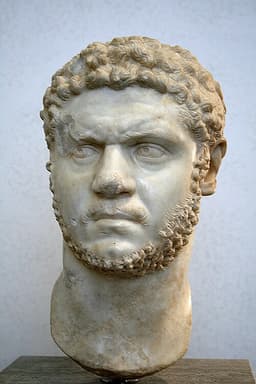
Caracalla
Emperor · Ancient
46.2Total

Napoleon Bonaparte
General · Modern
70.9Total
Basic Information
Born
188
1769
Died
217
1821
Era
Ancient
Modern
Nationality
Roman Empire
France
Occupation
Emperor
General
Civilization
Western
Western
Score Comparison
Military (10%)
10.0
94.0
Political (20%)
48.0
72.0
Influence (20%)
57.2
40.0
Legacy (20%)
50.0
80.0
Leadership (15%)
45.0
78.0
Strategy (15%)
45.0
90.0
TOTAL
46.2
70.9
Caracalla — Complete Timeline
211 AD
Assassination of GetaPolitical Action◆ Major
Caracalla murdered his brother and co-emperor Geta in their mother Julia Domna's arms, after a period of intense rivalry. Geta's supporters were purged, and his name was erased from inscriptions (damnatio memoriae).
AssassinationBrotherDamnatio Memoriae
Impact: nationaltragic
212 AD
Constitutio AntoninianaReform
Caracalla issued the Constitutio Antoniniana, granting Roman citizenship to all free inhabitants of the Roman Empire. This edict aimed to increase tax revenue and unify the empire, but also diluted the traditional privileges of Roman citizens.
CitizenshipReformTaxation
Impact: globalconstructive
213 AD
Campaign against the AlemanniWar
Caracalla campaigned against the Alemanni tribe on the Rhine frontier, winning a victory and adopting the title Germanicus Maximus. He also attempted to imitate Alexander the Great by forming a Macedonian-style phalanx.
CampaignAlemanniFrontier
Impact: regional
216 AD
Construction of the Baths of CaracallaCultural◆ Major
Caracalla commissioned the Baths of Caracalla in Rome, one of the largest and most luxurious public bath complexes in the ancient world. The baths served as a social and cultural center for the Roman populace.
ArchitecturePublic WorksBaths
Impact: nationalconstructive
217 AD
Assassination of CaracallaPolitical Action◆ Major
Caracalla was assassinated on the road to Carrhae by a soldier named Martialis, at the instigation of the praetorian prefect Macrinus. His death ended the Severan dynasty's direct line and led to Macrinus's brief reign.
AssassinationEnd of DynastyMacrinus
Impact: globaltragic
Napoleon Bonaparte — Complete Timeline
1799 AD
Coup of 18 BrumaireOther◆ Major
Napoleon Bonaparte, with support from his brother Lucien and key political figures, overthrew the Directory in a bloodless coup. He established the Consulate with himself as First Consul, effectively becoming the ruler of France. This event ended the French Revolution's most unstable period.
French RevolutionCoupRise to Power
Impact: regional
1804 AD
Promulgation of the Napoleonic CodeOther◆ Major
Napoleon enacted the Civil Code of the French, known as the Napoleonic Code, a comprehensive set of laws that replaced the fragmented feudal legal systems. The code established legal equality, protected property rights, and secularized law. It became the basis for legal systems in many European and world countries.
Legal ReformNapoleonic CodeCivil Law
Impact: globalconstructive
1805 AD
Battle of AusterlitzWar◆ Major
Napoleon's Grande Arm
Napoleonic WarsBattleDecisive Victory
Impact: global
1812 AD
Invasion of RussiaWar◆ Major
Napoleon led the Grande Arm
Napoleonic WarsInvasionDisaster
Impact: globaldestructive
1815 AD
Battle of WaterlooWar◆ Major
Napoleon's French army was defeated by the combined forces of the Duke of Wellington's Anglo-Allied army and Gebhard Leberecht von Bl
Napoleonic WarsBattleFinal Defeat
Impact: globaldestructive
Expert Analysis
Origins
Caracalla, born Lucius Septimius Bassianus in 188 AD in Lugdunum (modern Lyon, France), was the eldest son of Emperor Septimius Severus and Julia Domna. His family background was North African and Syrian, with his father founding the Severan dynasty after the Year of the Five Emperors. Caracalla was raised in the imperial court, receiving a Roman education but also exposed to the militaristic ethos of his father's reign. His early life was marked by the favoritism his father showed toward him over his younger brother Geta, a dynamic that fostered intense sibling rivalry.
Napoleon Bonaparte was born on August 15, 1769, in Ajaccio, Corsica, to Carlo Buonaparte and Letizia Ramolino, a family of minor Corsican nobility. His father was a lawyer who initially supported Corsican independence but later allied with the French. Napoleon studied at military schools in Brienne-le-Château and the École Militaire in Paris, graduating in 1785 as a second lieutenant in artillery. His Corsican upbringing and French education shaped his dual identity and ambition. Unlike Caracalla, Napoleon rose from relatively modest beginnings, though both were shaped by the political turmoil of their eras.
Rise to Power
Caracalla's rise was dynastic: he was appointed co-emperor by his father Septimius Severus in 198 AD at age 10, alongside his brother Geta. After Severus's death in 211 AD, Caracalla and Geta ruled jointly, but Caracalla quickly moved to eliminate his brother. In December 211 AD, he murdered Geta in their mother's arms and purged thousands of Geta's supporters, securing sole power at age 23. This brutal consolidation set the tone for his reign.
Napoleon's rise was revolutionary. He gained prominence during the French Revolutionary Wars, notably at the Siege of Toulon in 1793, where he was promoted to brigadier general at age 24. His 1795 suppression of a royalist uprising in Paris earned him command of the Army of Italy. In 1796-1797, he defeated Austrian and Sardinian forces, establishing himself as a military star. The Coup of 18 Brumaire in 1799 overthrew the Directory, and Napoleon became First Consul, effectively dictator. He crowned himself Emperor in 1804. Both leaders seized power through violence, but Napoleon's rise was meritocratic while Caracalla's was hereditary.
Leadership & Governance
Caracalla's governance was autocratic and militaristic. His most famous act was the Constitutio Antoniniana in 212 AD, granting Roman citizenship to all free inhabitants of the empire. This was primarily a fiscal measure to increase tax revenue, as citizens were subject to inheritance taxes. He also built the Baths of Caracalla, a massive public works project that demonstrated imperial largesse but strained finances. His leadership style was paranoid and cruel: he executed rivals, including his wife and brother, and relied on the military for support, increasing soldiers' pay and benefits. His political score of 49.7 reflects a mixed record of reform and tyranny.
Napoleon's governance was transformative. He centralized the French state, established the Napoleonic Code (a uniform legal system), reformed education, and created the Bank of France. He negotiated the Concordat of 1801 with the Catholic Church, stabilizing religious relations. However, he also curtailed press freedom and reestablished slavery in French colonies. His leadership style was charismatic but authoritarian, with a meritocratic system in the military and civil service. His political score of 75.0 reflects his administrative genius, though his governance became increasingly autocratic over time. Both leaders used law and infrastructure to cement power, but Napoleon's reforms had lasting global impact.
Triumph & Tragedy
Caracalla's triumphs include the Constitutio Antoniniana, which expanded citizenship and influenced Roman law for centuries. The Baths of Caracalla remain an architectural marvel. Militarily, he campaigned successfully against the Alemanni in 213 AD, earning the title Germanicus Maximus. His tragedies include the assassination of Geta, which made him hated by the Senate and elites, and his own assassination in 217 AD on the road to Carrhae, ending his reign at age 29. His military score of 31.7 reflects limited success; his strategy score of 67.9 suggests tactical ability marred by poor execution.
Napoleon's triumphs are legendary: the Battle of Austerlitz in 1805, where he defeated the Russian and Austrian armies, is considered his masterpiece. The Napoleonic Code influenced legal systems worldwide. He conquered most of continental Europe and established the Confederation of the Rhine. His tragedies include the disastrous Invasion of Russia in 1812, where his Grande Armée of over 600,000 men was destroyed by winter and scorched-earth tactics. His final defeat at Waterloo in 1815 ended his rule. His military score of 94.0 and strategy score of 93.0 reflect his genius, but his overreach led to catastrophic losses.
Character & Destiny
Caracalla was cruel, paranoid, and impulsive. He murdered his brother and thousands of supporters, alienating the Senate and elite. His decision to grant citizenship was pragmatic rather than idealistic. He was assassinated by a soldier, a fitting end for a ruler who relied on military favor but neglected political support. Historians view him as a tyrant who hastened the decline of the Roman Empire. His leadership score of 36.8 reflects his inability to inspire loyalty beyond the army.
Napoleon was ambitious, brilliant, and driven by a desire for glory. He micromanaged campaigns and administration, but his arrogance and refusal to compromise led to his downfall. His decision to invade Russia and his mishandling of the Continental System were strategic errors. He was exiled to Elba in 1814, returned briefly, and was finally defeated at Waterloo. He died in exile on Saint Helena in 1821. Historians see him as a military genius whose ambition ultimately consumed him. His leadership score of 80.0 indicates his ability to inspire, though his hubris was his undoing.
Legacy
Caracalla's legacy is mixed. The Constitutio Antoniniana fundamentally changed Roman citizenship, paving the way for a more inclusive empire but also diluting its value. The Baths of Caracalla influenced Roman architecture. However, his violent reign and fiscal policies contributed to the Crisis of the Third Century. His legacy score of 68.5 reflects his enduring but controversial impact.
Napoleon's legacy is immense. The Napoleonic Code is the basis of civil law in many countries, including France, Italy, and parts of the Americas. He reshaped European borders, spread nationalism, and influenced military strategy. His reforms modernized France and left a lasting institutional legacy. His legacy score of 78.0 reflects his profound and lasting influence, though his wars caused millions of deaths.
Conclusion
Napoleon Bonaparte had a far greater impact than Caracalla. While Caracalla's citizenship edict was significant, Napoleon's military conquests, legal reforms, and institutional changes shaped the modern world. Napoleon scores 82.4 overall versus Caracalla's 57.0, a gap of 25.4 points. Napoleon's military (94.0 vs 31.7) and strategy (93.0 vs 67.9) scores are vastly higher, and his leadership (80.0 vs 36.8) and political (75.0 vs 49.7) scores show superior governance. Even in influence (82.0 vs 72.6) and legacy (78.0 vs 68.5), Napoleon leads. Caracalla was a tyrant whose reign was brief and destructive, while Napoleon, despite his flaws, left a lasting blueprint for modern statehood. The data clearly supports Napoleon as the more consequential figure.
Rankings
🥇
Napoleon BonaparteLeader
Mil: 94.0Pol: 72.0Inf: 40.0
70.9
🥈
Caracalla
Mil: 10.0Pol: 48.0Inf: 57.2
46.2
+24.7 behind
How This Comparison Works
Algorithm
Each figure is scored on 6 dimensions (0—100 scale) based on structured historical data: Military (10%), Political (20%), Influence (20%), Legacy (20%), Leadership (15%), Strategy (15%). The weighted total produces the final ranking.
Data Sources
Scores are computed from structured sub-indicators in the database. Scale factors adjust for era (Ancient ×0.85, Modern ×1.0) and civilization size (Eastern ×1.05, Other ×0.80) to account for differences in population and military scale.
Maximum 3 Figures
Comparisons are limited to 2—3 figures to ensure readability and statistical meaningfulness.
Error Margins
±5 points per dimension — Sub-scores are derived from historical records with inherent uncertainty. Two figures within 5 points on a dimension should be considered roughly equivalent in that area.
Total Score Accuracy
±3 points overall — The weighted combination of 6 dimensions produces a total score with approximately ±3 points of uncertainty. Differences of less than 3 points are not statistically significant— the figures are effectively tied.
Known Limitations
- Historical records are incomplete and uneven across civilizations
- Figures from oral-tradition societies may be underrepresented
- Occupation labels can misclassify multi-role figures
- Scores measure capability and impact, not moral character
- Quantitative scoring is a comparison tool, not absolute truth
Capability Radar
Military (10%) — Battles & Warfare
Battles
45
95
Win Rate
40
90
Expansion
25
95
Political (20%) — Governance & Reform
Reform
80
95
Diplomacy
30
80
Economy
25
85
Influence (20%) — Cultural & Global Reach
Cultural
50
85
Global
55
90
Legacy (20%) — Historical Impact
Historical
65
95
Longevity
60
90
Leadership (15%) — Power & Stability
Tenure
40
85
Stability
15
70
Strategy (15%) — Tactics & Innovation
Strategy
30
95
Tactics
35
98
Reform
20
92
Similar Comparisons
Comments & Discussion
No comments yet. Be the first to share your thoughts!