Loading...
Caracalla vs Julius Caesar
Julius Caesar leads by 36.6 pts · 2 figures compared
…
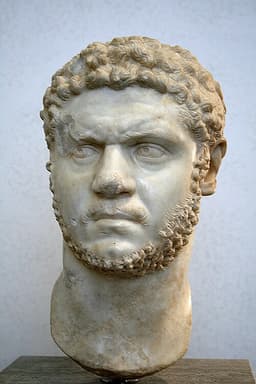
Caracalla
Emperor · Ancient
46.2Total

Julius Caesar
General · Ancient
82.8Total
Basic Information
Born
188
-100
Died
217
-44
Era
Ancient
Ancient
Nationality
Roman Empire
Roman Republic
Occupation
Emperor
General
Civilization
Western
Western
Score Comparison
Military (10%)
10.0
88.0
Political (20%)
48.0
78.0
Influence (20%)
57.2
85.0
Legacy (20%)
50.0
82.0
Leadership (15%)
45.0
80.0
Strategy (15%)
45.0
85.0
TOTAL
46.2
82.8
Caracalla — Complete Timeline
211 AD
Assassination of GetaPolitical Action◆ Major
Caracalla murdered his brother and co-emperor Geta in their mother Julia Domna's arms, after a period of intense rivalry. Geta's supporters were purged, and his name was erased from inscriptions (damnatio memoriae).
AssassinationBrotherDamnatio Memoriae
Impact: nationaltragic
212 AD
Constitutio AntoninianaReform
Caracalla issued the Constitutio Antoniniana, granting Roman citizenship to all free inhabitants of the Roman Empire. This edict aimed to increase tax revenue and unify the empire, but also diluted the traditional privileges of Roman citizens.
CitizenshipReformTaxation
Impact: globalconstructive
213 AD
Campaign against the AlemanniWar
Caracalla campaigned against the Alemanni tribe on the Rhine frontier, winning a victory and adopting the title Germanicus Maximus. He also attempted to imitate Alexander the Great by forming a Macedonian-style phalanx.
CampaignAlemanniFrontier
Impact: regional
216 AD
Construction of the Baths of CaracallaCultural◆ Major
Caracalla commissioned the Baths of Caracalla in Rome, one of the largest and most luxurious public bath complexes in the ancient world. The baths served as a social and cultural center for the Roman populace.
ArchitecturePublic WorksBaths
Impact: nationalconstructive
217 AD
Assassination of CaracallaPolitical Action◆ Major
Caracalla was assassinated on the road to Carrhae by a soldier named Martialis, at the instigation of the praetorian prefect Macrinus. His death ended the Severan dynasty's direct line and led to Macrinus's brief reign.
AssassinationEnd of DynastyMacrinus
Impact: globaltragic
Julius Caesar — Complete Timeline
58 BC
Gallic WarsWar◆ Major
Caesar, as proconsul of Gaul, launched a series of campaigns that conquered all of Gaul (modern France, Belgium, and parts of Switzerland). He fought numerous battles, including against the Helvetii, the Belgae, and the Gallic chieftain Vercingetorix. The wars brought immense wealth and a loyal army to Caesar.
Gallic WarsConquestRoman Expansion
Impact: regional
49 BC
Crossing the RubiconPolitical Action◆ Major
Caesar led Legio XIII across the Rubicon River into Italy, defying the Roman Senate's order to disband his army. This act triggered a civil war against Pompey and the Optimates, ultimately leading to Caesar's dictatorship and the end of the Roman Republic.
Roman Civil WarEnd of RepublicPower Struggle
Impact: global
48 BC
Battle of PharsalusWar◆ Major
Caesar's outnumbered army defeated the larger forces of Pompey the Great at Pharsalus in Greece. Caesar's tactical use of a reserve line to counter Pompey's cavalry charge proved decisive. Pompey fled to Egypt, where he was assassinated, leaving Caesar as the undisputed master of the Roman world.
Roman Civil WarBattleDecisive Victory
Impact: regional
44 BC
Appointment as Dictator for LifePolitical Action◆ Major
The Roman Senate appointed Caesar dictator perpetuo (dictator for life), granting him unprecedented personal power. This move concentrated military, legislative, and judicial authority in one person, effectively ending the Roman Republic's traditional system of checks and balances and alarming many senators.
DictatorshipEnd of RepublicPower Consolidation
Impact: regionaldestructive
Assassination on the Ides of MarchPolitical Action◆ Major
A group of Roman senators, led by Marcus Junius Brutus and Gaius Cassius Longinus, stabbed Caesar to death at a meeting of the Senate in the Theatre of Pompey. The assassination was intended to restore the Republic, but instead triggered another civil war that led to the rise of the Roman Empire.
AssassinationRoman PoliticsEnd of Republic
Impact: globaldestructive
Expert Analysis
caracalla-vs-julius-caesar
# The Crossing and the Slaughter: Caesar and Caracalla on the Paths of Power
On a January morning in 49 BCE, Julius Caesar stood at the banks of the Rubicon River, a small stream that marked the boundary between his province and Italy proper. To cross it with an army was treason. To not cross was political oblivion. He hesitated, then spoke: *“Alea iacta est”*—the die is cast. Two and a half centuries later, another Roman ruler, Caracalla, stood in a different kind of threshold: the doorway of his mother’s chamber, dagger in hand, about to murder his own brother Geta in her arms. Both men understood that power demands terrible choices. But one would reshape the world; the other would merely stain it.
Origins
Caesar was born into the twilight of the Roman Republic, a world of senatorial intrigue, civil wars, and a constitution buckling under the weight of empire. His family, the Julii, claimed descent from the goddess Venus, but they were politically minor. Young Caesar learned early that in Rome, reputation was currency—and debt, whether financial or moral, was a tool. He was captured by pirates as a young man, laughed at their ransom demand, and later crucified them. This was a man who understood that audacity, not birth, made history.
Caracalla entered the world in 188 CE, a prince of the Severan dynasty, born into an empire already imperial, already absolute. His father Septimius Severus had seized power through civil war, and Caracalla grew up in a court where paranoia was a survival skill. He was named Marcus Aurelius Antoninus at birth—a deliberate echo of the philosopher-emperor—but history remembers him by his nickname, Caracalla, after the Gallic cloak he favored. His upbringing was one of privilege poisoned by rivalry: his brother Geta was co-heir, and their mother Julia Domna struggled to keep peace between two sons who loathed each other.
Rise to Power
Caesar’s ascent was a masterpiece of patience and risk. He climbed the *cursus honorum*—the ladder of Roman offices—step by step, borrowing fortunes to fund games and bribes. His military command in Gaul was not a gift but a gamble: eight years of brutal campaigns that conquered a territory larger than Italy itself. He wrote his own propaganda in elegant Latin, the *Commentarii*, which made him a legend while he still lived. When the Senate ordered him to disband his army, he chose the Rubicon. The civil war that followed lasted four years, but when it ended, Caesar was master of Rome.
Caracalla’s rise was faster and uglier. When his father died in 211, the empire passed to both sons jointly—a recipe for disaster. Caracalla could not tolerate even a nominal equal. Within months, he attempted to assassinate Geta during the Saturnalia festival; when that failed, he tried poison. Finally, he staged a reconciliation, lured Geta to their mother’s rooms, and had centurions cut him down. Julia Domna was splattered with her younger son’s blood. Caracalla then ordered a massacre of Geta’s supporters—some twenty thousand people, including the jurist Papinian. He had seized power, but he had also created a silence that would haunt his reign.
Leadership & Governance
Caesar governed as a revolutionary reformer. He restructured the calendar (the Julian calendar we still use), granted citizenship to Gauls and Spaniards, reformed debt laws, and initiated massive public works. As dictator, he centralized authority but respected the forms of the Republic—at least until he accepted the title *dictator perpetuo*, dictator for life. His military genius lay in speed and logistics: he won battles by marching faster than his enemies thought possible, building bridges across the Rhine in ten days, and besieging Alesia with a double ring of fortifications that trapped both the Gauls inside and their relief army outside.
Caracalla’s most famous act was the Constitutio Antoniniana of 212, which granted Roman citizenship to every free inhabitant of the empire. This sounds enlightened—and later historians have praised it—but its motive was not generosity. Caracalla needed more tax revenue to pay his soldiers, and citizens paid inheritance taxes that non-citizens did not. He effectively said: *“Now you are all Romans. Now you all owe me.”* His military record was mediocre: he campaigned against the Alemanni on the Rhine, winning a victory that earned him the title “Germanicus,” but his true passion was imitating Alexander the Great. He dressed in Macedonian armor, raised a phalanx of 16,000 men, and marched east to fight Parthia—but achieved nothing lasting. His greatest architectural legacy, the Baths of Caracalla, remains a monument to imperial excess: a pleasure palace of marble, mosaics, and heated pools that could hold 1,600 bathers at once.
Triumph & Tragedy
Caesar’s triumph was his conquest of Gaul, a feat that doubled Rome’s territory and made him the most successful general since Alexander. His tragedy came on the Ides of March, 44 BCE, when sixty senators surrounded him in the Curia of Pompey and stabbed him twenty-three times. He fell at the feet of a statue of his defeated rival Pompey—a bitter irony. The conspirators thought they were saving the Republic; instead, they unleashed another round of civil wars that ended with Augustus as emperor.
Caracalla’s triumph was hollow. The Constitutio Antoniniana was a bureaucratic stroke that changed the legal landscape of the empire, but it won him no love. His tragedy was his own paranoia: he trusted no one, not even his mother, and he surrounded himself with barbarian bodyguards. On April 8, 217, while traveling to Carrhae to visit a temple of the moon god, he stopped to relieve himself by the roadside. A soldier named Martialis, acting on orders from the praetorian prefect Macrinus, stabbed him to death. The emperor who had murdered his brother in his mother’s arms died alone in the dust, his body abandoned.
Character & Destiny
Caesar was ambitious, yes, but also magnanimous. He pardoned his enemies, promoted talent regardless of birth, and had a sense of humor even in crisis. When a soothsayer warned him to beware the Ides of March, he dismissed him—then joked about it on the way to the Senate. His flaw was not cruelty but overconfidence: he believed his charm could disarm any conspiracy. It could not.
Caracalla was cruel and suspicious. He had his brother killed, his father-in-law executed, and his wife exiled. He was also insecure: his obsession with Alexander the Great was a confession that he knew his own inadequacy. He wanted to be remembered as a conqueror, but he lacked the patience for real war and the wisdom for real reform. His destiny was to be a footnote—a name that appears in textbooks only because of one law and one set of baths.
Legacy
Caesar’s legacy is foundational. His name became a title: *Kaiser* in German, *Tsar* in Russian. His writings shaped Latin prose. His reforms outlived him, and his adopted heir Octavian built the empire that would last five centuries in the West and a thousand years in the East. He is the archetype of the military genius who remakes the world—for better and for worse.
Caracalla’s legacy is ambiguous. The Constitutio Antoniniana ultimately accelerated the empire’s transformation from a Roman state into a universal one, but it also diluted the privileges that had bound the elite to Rome. His baths are ruins, beautiful but empty. His murder of Geta set a precedent for imperial fratricide that would recur for centuries. He is remembered not as a great emperor but as a cautionary tale: a man who had all the power in the world and used it only to destroy.
Conclusion
Both Caesar and Caracalla crossed lines that could not be uncrossed. Caesar crossed the Rubicon and changed history. Caracalla crossed the threshold of his mother’s room and changed nothing except the number of bodies in the palace. The difference was not in their opportunities but in their vision. Caesar saw a world that could be made larger, richer, more just—even if he was the one to make it. Caracalla saw only threats, rivals, and mirrors. In the end, power does not corrupt; it reveals. And what it revealed in Caracalla was a small man in a large empire, while in Caesar it revealed a man large enough to fill the world—and then to fall from it.
Rankings
🥇
Julius CaesarLeader
Mil: 88.0Pol: 78.0Inf: 85.0
82.8
🥈
Caracalla
Mil: 10.0Pol: 48.0Inf: 57.2
46.2
+36.6 behind
How This Comparison Works
Algorithm
Each figure is scored on 6 dimensions (0—100 scale) based on structured historical data: Military (10%), Political (20%), Influence (20%), Legacy (20%), Leadership (15%), Strategy (15%). The weighted total produces the final ranking.
Data Sources
Scores are computed from structured sub-indicators in the database. Scale factors adjust for era (Ancient ×0.85, Modern ×1.0) and civilization size (Eastern ×1.05, Other ×0.80) to account for differences in population and military scale.
Maximum 3 Figures
Comparisons are limited to 2—3 figures to ensure readability and statistical meaningfulness.
Error Margins
±5 points per dimension — Sub-scores are derived from historical records with inherent uncertainty. Two figures within 5 points on a dimension should be considered roughly equivalent in that area.
Total Score Accuracy
±3 points overall — The weighted combination of 6 dimensions produces a total score with approximately ±3 points of uncertainty. Differences of less than 3 points are not statistically significant— the figures are effectively tied.
Known Limitations
- Historical records are incomplete and uneven across civilizations
- Figures from oral-tradition societies may be underrepresented
- Occupation labels can misclassify multi-role figures
- Scores measure capability and impact, not moral character
- Quantitative scoring is a comparison tool, not absolute truth
Capability Radar
Military (10%) — Battles & Warfare
Battles
45
95
Win Rate
40
92
Expansion
25
97
Political (20%) — Governance & Reform
Reform
80
90
Diplomacy
30
85
Economy
25
82
Influence (20%) — Cultural & Global Reach
Cultural
50
88
Global
55
94
Legacy (20%) — Historical Impact
Historical
65
95
Longevity
60
96
Leadership (15%) — Power & Stability
Tenure
40
75
Stability
15
60
Strategy (15%) — Tactics & Innovation
Strategy
30
94
Tactics
35
96
Reform
20
88
Similar Comparisons
Comments & Discussion
No comments yet. Be the first to share your thoughts!