Loading...
Burnaburiash II vs Napoleon Bonaparte
Napoleon Bonaparte leads by 27.8 pts · 2 figures compared
…
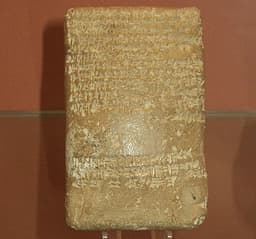
Burnaburiash II
Emperor · Ancient
43.1Total

Napoleon Bonaparte
General · Modern
70.9Total
Basic Information
Born
-1359
1769
Died
-1333
1821
Era
Ancient
Modern
Nationality
Kassite Dynasty
France
Occupation
Emperor
General
Civilization
Middle Eastern
Western
Score Comparison
Military (10%)
25.9
94.0
Political (20%)
40.8
72.0
Influence (20%)
47.1
40.0
Legacy (20%)
38.3
80.0
Leadership (15%)
62.2
78.0
Strategy (15%)
36.8
90.0
TOTAL
43.1
70.9
Burnaburiash II — Complete Timeline
1350 BC
Correspondence with AkhenatenPolitical Action◆ Major
Burnaburiash II exchanged diplomatic letters with the Egyptian pharaoh Akhenaten, as recorded in the Amarna letters. The correspondence dealt with marriage alliances, trade, and mutual recognition, reflecting the diplomatic network of the Late Bronze Age.
DiplomacyAmarna LettersEgypt
Impact: regional
1345 BC
Conflict with Assyria over Border TerritoriesWar
Burnaburiash II engaged in a conflict with Assyria over border territories, as mentioned in the Amarna letters. The dispute highlighted the shifting power dynamics in Mesopotamia, though the outcome was inconclusive and did not lead to major territorial changes.
ConflictAssyriaBorder
Impact: regional
Napoleon Bonaparte — Complete Timeline
1799 AD
Coup of 18 BrumaireOther◆ Major
Napoleon Bonaparte, with support from his brother Lucien and key political figures, overthrew the Directory in a bloodless coup. He established the Consulate with himself as First Consul, effectively becoming the ruler of France. This event ended the French Revolution's most unstable period.
French RevolutionCoupRise to Power
Impact: regional
1804 AD
Promulgation of the Napoleonic CodeOther◆ Major
Napoleon enacted the Civil Code of the French, known as the Napoleonic Code, a comprehensive set of laws that replaced the fragmented feudal legal systems. The code established legal equality, protected property rights, and secularized law. It became the basis for legal systems in many European and world countries.
Legal ReformNapoleonic CodeCivil Law
Impact: globalconstructive
1805 AD
Battle of AusterlitzWar◆ Major
Napoleon's Grande Arm
Napoleonic WarsBattleDecisive Victory
Impact: global
1812 AD
Invasion of RussiaWar◆ Major
Napoleon led the Grande Arm
Napoleonic WarsInvasionDisaster
Impact: globaldestructive
1815 AD
Battle of WaterlooWar◆ Major
Napoleon's French army was defeated by the combined forces of the Duke of Wellington's Anglo-Allied army and Gebhard Leberecht von Bl
Napoleonic WarsBattleFinal Defeat
Impact: globaldestructive
Expert Analysis
Origins
Burnaburiash II was a king of the Kassite dynasty of Babylon, reigning in the 14th century BCE. He was born into a ruling family that had controlled Babylonia for centuries. The Kassites, originally from the Zagros Mountains, had established a stable kingdom that engaged in extensive diplomacy. Burnaburiash II is best known from the Amarna letters, a cache of diplomatic correspondence between Egypt and other Near Eastern powers. His letters to Pharaoh Akhenaten reveal a ruler concerned with maintaining alliances and trade. Little is known of his early life, but his education would have included cuneiform writing, Akkadian language (the lingua franca of the time), and the arts of governance.
Napoleon Bonaparte was born in 1769 on the island of Corsica, just after its annexation by France. He came from a minor noble family and studied at military schools in mainland France. He graduated from the École Militaire in Paris in 1785. His early life was marked by the upheaval of the French Revolution, which opened opportunities for advancement. His Corsican heritage and modest background shaped his ambition and desire for glory. He was deeply influenced by Enlightenment ideas and military theorists.
Rise to Power
Burnaburiash II ascended the Kassite throne around 1359 BCE. His power was based on traditional kingship and control of Babylonian cities. His rise was not through military conquest but inheritance. His correspondence with Akhenaten, dating to around 1350-1330 BCE, shows him negotiating marriage alliances and complaining about Assyrian aggression. The Amarna letters (EA 6-11) detail his attempts to maintain parity with Egypt. He sought gold and gifts, and his letters reveal a king trying to assert his status in a world of great powers.
Napoleon rose rapidly during the French Revolution. He gained fame as a young artillery officer at the Siege of Toulon in 1793. He then married Joséphine de Beauharnais and commanded the Army of Italy in 1796, winning a series of victories that forced Austria to sue for peace. In 1798, he launched an expedition to Egypt, which included the Battle of the Pyramids. Upon returning, he staged the Coup of 18 Brumaire in 1799, becoming First Consul. By 1804, he crowned himself Emperor of the French. His rise was a product of his military success and political opportunism.
Leadership & Governance
Burnaburiash II ruled as a traditional Mesopotamian monarch. He relied on a bureaucracy of scribes and officials. His governance is evidenced by his diplomatic letters, which show a king concerned with protocol and reciprocity. He lacked a standing army of the scale of later empires; his military score of 60.0 reflects limited conquests. He engaged in conflict with Assyria over border territories, but his responses were diplomatic as much as military. His political score of 44.1 suggests a ruler constrained by the era's norms.
Napoleon's leadership was transformative. He consolidated power as First Consul and Emperor. He reformed France's legal system with the Napoleonic Code (1804), which influenced civil law worldwide. He centralized the state, established the Bank of France, and reformed education. His military leadership was exceptional, with a strategy score of 90.0. He used speed, deception, and massed artillery to defeat enemies. However, his governance became increasingly autocratic. He crowned himself emperor and placed family members on thrones. His political score of 72.0 reflects his ability to manipulate politics but also his overreach.
Triumph & Tragedy
Burnaburiash II's greatest success was maintaining Kassite Babylon as a major power during a period of transition. He secured a marriage alliance with Egypt (his daughter married Akhenaten) and kept Assyria in check. His correspondence shows he was respected by the great powers. However, his reign faced tragedy: the rising power of Assyria under Ashur-uballit I eventually eclipsed Babylon. His failure to assert military dominance (military score 60.0) left his kingdom vulnerable. After his death, the Kassite dynasty declined and fell.
Napoleon's triumphs were immense: he conquered most of Europe, from Spain to Poland. His victories at Austerlitz (1805), Jena (1806), and Friedland (1807) crushed coalitions. The Napoleonic Code remains a cornerstone of French law. However, his invasion of Russia in 1812 was a catastrophe: the Grande Armée of over 600,000 men was destroyed, with only about 100,000 returning. He was exiled to Elba, returned for 100 days, and was finally defeated at Waterloo in 1815. His ambition led to his downfall.
Character & Destiny
Burnaburiash II appears cautious and diplomatic. His letters reveal a king who values precedent and equality. He complains when Egyptian gifts are insufficient, showing a pride that could be seen as insecure. His character was suited to the stable world of Bronze Age diplomacy, but not to the rising militarism of Assyria. His fate was to be a footnote in history, remembered only because his letters survived.
Napoleon was supremely confident, driven, and ruthless. He had a prodigious memory and energy. His decisions were often brilliant but sometimes arrogant. He believed in his own destiny, which led him to overreach. His character shaped his fate: he could not stop until he was master of Europe. His exile and death on Saint Helena were a tragic end for a man who had changed the world. Historians debate whether his ambition was a flaw or a necessity for his achievements.
Legacy
Burnaburiash II's legacy is tied to the Amarna letters, which provide insight into ancient diplomacy. His influence score of 62.9 reflects this historical importance. He represents the Kassite period, which is often overshadowed by earlier and later Babylonian empires. His impact on later history is minimal; he did not create lasting institutions or ideas.
Napoleon's legacy is vast. He reshaped Europe: the Napoleonic Code influenced civil law in many countries. He spread nationalism, ended feudalism, and reorganized German and Italian states. His military innovations were studied for generations. His legacy score of 80.0 reflects his enduring impact. He is a figure of both admiration and criticism, but his influence on modern statecraft and law is undeniable.
Conclusion
Napoleon Bonaparte had a far greater impact on world history than Burnaburiash II. Napoleon's total score of 70.9 compared to Burnaburiash's 50.0 shows a clear gap. Napoleon's military score of 94.0 dwarfs Burnaburiash's 60.0, and his political score of 72.0 versus 44.1 reflects his ability to shape institutions. While Burnaburiash's diplomatic letters are valuable to historians, they did not change the course of history. Napoleon's reforms and campaigns redrew the map of Europe and modernized governance. In a direct comparison, Napoleon's influence is global and lasting, while Burnaburiash's is limited to a specific era and region. The data supports Napoleon as the more consequential figure.
Rankings
🥇
Napoleon BonaparteLeader
Mil: 94.0Pol: 72.0Inf: 40.0
70.9
🥈
Burnaburiash II
Mil: 25.9Pol: 40.8Inf: 47.1
43.1
+27.8 behind
How This Comparison Works
Algorithm
Each figure is scored on 6 dimensions (0—100 scale) based on structured historical data: Military (10%), Political (20%), Influence (20%), Legacy (20%), Leadership (15%), Strategy (15%). The weighted total produces the final ranking.
Data Sources
Scores are computed from structured sub-indicators in the database. Scale factors adjust for era (Ancient ×0.85, Modern ×1.0) and civilization size (Eastern ×1.05, Other ×0.80) to account for differences in population and military scale.
Maximum 3 Figures
Comparisons are limited to 2—3 figures to ensure readability and statistical meaningfulness.
Error Margins
±5 points per dimension — Sub-scores are derived from historical records with inherent uncertainty. Two figures within 5 points on a dimension should be considered roughly equivalent in that area.
Total Score Accuracy
±3 points overall — The weighted combination of 6 dimensions produces a total score with approximately ±3 points of uncertainty. Differences of less than 3 points are not statistically significant— the figures are effectively tied.
Known Limitations
- Historical records are incomplete and uneven across civilizations
- Figures from oral-tradition societies may be underrepresented
- Occupation labels can misclassify multi-role figures
- Scores measure capability and impact, not moral character
- Quantitative scoring is a comparison tool, not absolute truth
Capability Radar
Military (10%) — Battles & Warfare
Battles
10
95
Win Rate
10
90
Expansion
10
95
Political (20%) — Governance & Reform
Reform
30
95
Diplomacy
50
80
Economy
30
85
Influence (20%) — Cultural & Global Reach
Cultural
20
85
Global
20
90
Legacy (20%) — Historical Impact
Historical
30
95
Longevity
20
90
Leadership (15%) — Power & Stability
Tenure
40
85
Stability
40
70
Strategy (15%) — Tactics & Innovation
Strategy
10
95
Tactics
10
98
Reform
10
92
Similar Comparisons
Comments & Discussion
No comments yet. Be the first to share your thoughts!