Loading...
Burnaburiash II vs Julius Caesar
Julius Caesar leads by 39.7 pts · 2 figures compared
…
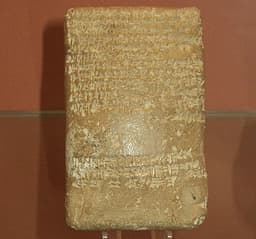
Burnaburiash II
Emperor · Ancient
43.1Total

Julius Caesar
General · Ancient
82.8Total
Basic Information
Born
-1359
-100
Died
-1333
-44
Era
Ancient
Ancient
Nationality
Kassite Dynasty
Roman Republic
Occupation
Emperor
General
Civilization
Middle Eastern
Western
Score Comparison
Military (10%)
25.9
88.0
Political (20%)
40.8
78.0
Influence (20%)
47.1
85.0
Legacy (20%)
38.3
82.0
Leadership (15%)
62.2
80.0
Strategy (15%)
36.8
85.0
TOTAL
43.1
82.8
Burnaburiash II — Complete Timeline
1350 BC
Correspondence with AkhenatenPolitical Action◆ Major
Burnaburiash II exchanged diplomatic letters with the Egyptian pharaoh Akhenaten, as recorded in the Amarna letters. The correspondence dealt with marriage alliances, trade, and mutual recognition, reflecting the diplomatic network of the Late Bronze Age.
DiplomacyAmarna LettersEgypt
Impact: regional
1345 BC
Conflict with Assyria over Border TerritoriesWar
Burnaburiash II engaged in a conflict with Assyria over border territories, as mentioned in the Amarna letters. The dispute highlighted the shifting power dynamics in Mesopotamia, though the outcome was inconclusive and did not lead to major territorial changes.
ConflictAssyriaBorder
Impact: regional
Julius Caesar — Complete Timeline
58 BC
Gallic WarsWar◆ Major
Caesar, as proconsul of Gaul, launched a series of campaigns that conquered all of Gaul (modern France, Belgium, and parts of Switzerland). He fought numerous battles, including against the Helvetii, the Belgae, and the Gallic chieftain Vercingetorix. The wars brought immense wealth and a loyal army to Caesar.
Gallic WarsConquestRoman Expansion
Impact: regional
49 BC
Crossing the RubiconPolitical Action◆ Major
Caesar led Legio XIII across the Rubicon River into Italy, defying the Roman Senate's order to disband his army. This act triggered a civil war against Pompey and the Optimates, ultimately leading to Caesar's dictatorship and the end of the Roman Republic.
Roman Civil WarEnd of RepublicPower Struggle
Impact: global
48 BC
Battle of PharsalusWar◆ Major
Caesar's outnumbered army defeated the larger forces of Pompey the Great at Pharsalus in Greece. Caesar's tactical use of a reserve line to counter Pompey's cavalry charge proved decisive. Pompey fled to Egypt, where he was assassinated, leaving Caesar as the undisputed master of the Roman world.
Roman Civil WarBattleDecisive Victory
Impact: regional
44 BC
Appointment as Dictator for LifePolitical Action◆ Major
The Roman Senate appointed Caesar dictator perpetuo (dictator for life), granting him unprecedented personal power. This move concentrated military, legislative, and judicial authority in one person, effectively ending the Roman Republic's traditional system of checks and balances and alarming many senators.
DictatorshipEnd of RepublicPower Consolidation
Impact: regionaldestructive
Assassination on the Ides of MarchPolitical Action◆ Major
A group of Roman senators, led by Marcus Junius Brutus and Gaius Cassius Longinus, stabbed Caesar to death at a meeting of the Senate in the Theatre of Pompey. The assassination was intended to restore the Republic, but instead triggered another civil war that led to the rise of the Roman Empire.
AssassinationRoman PoliticsEnd of Republic
Impact: globaldestructive
Expert Analysis
Origins
Burnaburiash II was a Kassite king of Babylonia who reigned around 1359–1333 BCE. He was born into the Kassite dynasty, which ruled Babylonia after the fall of the First Babylonian Dynasty. Details of his early life are sparse, but he was likely a member of the royal family and received training in administration and diplomacy. His correspondence with Egyptian pharaohs, particularly Akhenaten, shows he was educated in cuneiform and diplomatic protocol. In contrast, Gaius Julius Caesar was born in 100 BCE into a patrician Roman family, the gens Julia. His father was a praetor, and his mother, Aurelia Cotta, was of noble birth. Caesar received a thorough education in rhetoric, law, and military tactics, and he was exposed to politics from a young age. His early life was marked by the Social War and the rise of Sulla, which shaped his ambitions.
Rise to Power
Burnaburiash II ascended to the throne of Babylon around 1359 BCE, likely through hereditary succession. His rise was not marked by major military conquests but by diplomatic maneuvering. He maintained relations with Egypt, as evidenced by the Amarna letters, where he negotiated marriages and trade. He also faced pressure from Assyria, which was gaining strength. His conflict with Assyria over border territories highlighted his diplomatic rather than military approach. Julius Caesar's rise was driven by military success and political alliances. He gained prominence through his election as pontifex maximus in 63 BCE and as praetor in 62 BCE. His conquest of Gaul (58–50 BCE) made him immensely popular and wealthy. The turning point came in 49 BCE when he crossed the Rubicon, defying the Senate and starting a civil war. He defeated Pompey at Pharsalus in 48 BCE and became dictator, eventually being appointed dictator for life in 44 BCE.
Leadership & Governance
Burnaburiash II governed Babylon as a traditional Kassite monarch. His leadership style was diplomatic, focusing on maintaining alliances and trade. He corresponded with Pharaoh Akhenaten, addressing issues of gift exchange and marriage. His governance was typical of the period, with a centralized bureaucracy and reliance on local governors. In contrast, Caesar's leadership was transformative. As dictator, he implemented reforms: he reformed the calendar (Julian calendar), initiated land redistribution, granted citizenship to provincials, and reorganized local government. He centralized power in his own hands, reducing the Senate's authority. Caesar scored 82.0 in leadership and 78.0 in political skill, while Burnaburiash scored 39.2 and 44.1 respectively, reflecting their different contexts.
Triumph & Tragedy
Burnaburiash's greatest success was his diplomatic correspondence with Egypt, which demonstrated Babylon's continued importance. His failure was the inability to halt Assyria's rise; the conflict over border territories showed his limited military power. He scored 60.0 in military, reflecting modest capability. Caesar's triumphs were vast: his conquest of Gaul added immense territory to Rome, and his victories in the civil war made him supreme. His greatest tragedy was his assassination on the Ides of March 44 BCE, which plunged Rome into another civil war. Despite his political reforms, his concentration of power alienated the Senate. Caesar's military score of 88.0 and strategy of 88.0 underscore his dominance.
Character & Destiny
Burnaburiash appears cautious and diplomatic, focusing on maintaining the status quo. His character suggests a ruler more concerned with stability than expansion. His fate is obscure; he likely died naturally, and his dynasty continued. Caesar was ambitious, decisive, and ruthless. His character drove him to seek personal glory and power, leading to his rise but also his downfall. His assassination was a direct result of his accumulation of power. Historical assessments note Caesar's genius but also his hubris.
Legacy
Burnaburiash's legacy is primarily as a figure in the Amarna letters, providing insight into Late Bronze Age diplomacy. He scored 62.9 in influence and 50.8 in legacy. His dynasty continued, but Babylon later fell to Assyria. Caesar's legacy is immense: his military campaigns influenced warfare, his political reforms shaped the Roman Empire, and his writings (Commentaries) are studied. The term 'Caesar' became a title for emperors. His influence score of 85.0 and legacy of 82.0 reflect his enduring impact.
Conclusion
While Burnaburiash II played a role in ancient diplomacy, his impact is limited compared to Julius Caesar. Caesar's military, political, and cultural influence transformed the ancient world and echoed through history. With a total score of 83.3 against 50.0, Caesar's greater impact is clear. The Kassite king was a product of his time, but Caesar changed the course of history.
Rankings
🥇
Julius CaesarLeader
Mil: 88.0Pol: 78.0Inf: 85.0
82.8
🥈
Burnaburiash II
Mil: 25.9Pol: 40.8Inf: 47.1
43.1
+39.7 behind
How This Comparison Works
Algorithm
Each figure is scored on 6 dimensions (0—100 scale) based on structured historical data: Military (10%), Political (20%), Influence (20%), Legacy (20%), Leadership (15%), Strategy (15%). The weighted total produces the final ranking.
Data Sources
Scores are computed from structured sub-indicators in the database. Scale factors adjust for era (Ancient ×0.85, Modern ×1.0) and civilization size (Eastern ×1.05, Other ×0.80) to account for differences in population and military scale.
Maximum 3 Figures
Comparisons are limited to 2—3 figures to ensure readability and statistical meaningfulness.
Error Margins
±5 points per dimension — Sub-scores are derived from historical records with inherent uncertainty. Two figures within 5 points on a dimension should be considered roughly equivalent in that area.
Total Score Accuracy
±3 points overall — The weighted combination of 6 dimensions produces a total score with approximately ±3 points of uncertainty. Differences of less than 3 points are not statistically significant— the figures are effectively tied.
Known Limitations
- Historical records are incomplete and uneven across civilizations
- Figures from oral-tradition societies may be underrepresented
- Occupation labels can misclassify multi-role figures
- Scores measure capability and impact, not moral character
- Quantitative scoring is a comparison tool, not absolute truth
Capability Radar
Military (10%) — Battles & Warfare
Battles
10
95
Win Rate
10
92
Expansion
10
97
Political (20%) — Governance & Reform
Reform
30
90
Diplomacy
50
85
Economy
30
82
Influence (20%) — Cultural & Global Reach
Cultural
20
88
Global
20
94
Legacy (20%) — Historical Impact
Historical
30
95
Longevity
20
96
Leadership (15%) — Power & Stability
Tenure
40
75
Stability
40
60
Strategy (15%) — Tactics & Innovation
Strategy
10
94
Tactics
10
96
Reform
10
88
Similar Comparisons
Comments & Discussion
No comments yet. Be the first to share your thoughts!