Loading...
Borommakot vs Napoleon Bonaparte
Napoleon Bonaparte leads by 13.7 pts · 2 figures compared
…
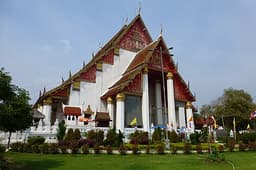
Borommakot
Emperor · Modern
57.2Total

Napoleon Bonaparte
General · Modern
70.9Total
Basic Information
Born
1680
1769
Died
1758
1821
Era
Modern
Modern
Nationality
Thailand
France
Occupation
Emperor
General
Civilization
Eastern
Western
Score Comparison
Military (10%)
55.0
94.0
Political (20%)
59.3
72.0
Influence (20%)
59.0
40.0
Legacy (20%)
47.5
80.0
Leadership (15%)
78.0
78.0
Strategy (15%)
45.0
90.0
TOTAL
57.2
70.9
Borommakot — Complete Timeline
1733 AD
Accession to the thronePolitical Action◆ Major
Borommakot became king of Ayutthaya after a civil war with his brother, Prince Aphai. His reign is considered the last golden age of the Ayutthaya Kingdom.
SuccessionCivil War
Impact: national
1740 AD
Construction of Wat PhutthaisawanCultural
Borommakot built Wat Phutthaisawan, a large Buddhist temple complex in Ayutthaya. The temple housed a famous Buddha image and became a major pilgrimage site.
Temple BuildingBuddhism
Impact: nationalconstructive
1745 AD
Restoration of Wat MahathatCultural
Borommakot ordered the restoration of Wat Mahathat, one of Ayutthaya's oldest temples. The restoration included rebuilding the main prang and adding new monastic quarters.
Temple RestorationBuddhism
Impact: nationalconstructive
1750 AD
Sending of Buddhist mission to Sri LankaCultural◆ Major
Borommakot dispatched a Siamese Buddhist mission to Sri Lanka to re-establish the higher ordination lineage. The mission successfully revived the Siam Nikaya order in Sri Lanka, which continues to this day.
BuddhismDiplomacySri Lanka
Impact: globalconstructive
1755 AD
Construction of Wat Na Phra MenCultural
Borommakot built Wat Na Phra Men, a temple located opposite the royal palace. The temple was used for royal ceremonies and housed a large bronze Buddha image.
Temple BuildingBuddhism
constructive
Napoleon Bonaparte — Complete Timeline
1799 AD
Coup of 18 BrumaireOther◆ Major
Napoleon Bonaparte, with support from his brother Lucien and key political figures, overthrew the Directory in a bloodless coup. He established the Consulate with himself as First Consul, effectively becoming the ruler of France. This event ended the French Revolution's most unstable period.
French RevolutionCoupRise to Power
Impact: regional
1804 AD
Promulgation of the Napoleonic CodeOther◆ Major
Napoleon enacted the Civil Code of the French, known as the Napoleonic Code, a comprehensive set of laws that replaced the fragmented feudal legal systems. The code established legal equality, protected property rights, and secularized law. It became the basis for legal systems in many European and world countries.
Legal ReformNapoleonic CodeCivil Law
Impact: globalconstructive
1805 AD
Battle of AusterlitzWar◆ Major
Napoleon's Grande Arm
Napoleonic WarsBattleDecisive Victory
Impact: global
1812 AD
Invasion of RussiaWar◆ Major
Napoleon led the Grande Arm
Napoleonic WarsInvasionDisaster
Impact: globaldestructive
1815 AD
Battle of WaterlooWar◆ Major
Napoleon's French army was defeated by the combined forces of the Duke of Wellington's Anglo-Allied army and Gebhard Leberecht von Bl
Napoleonic WarsBattleFinal Defeat
Impact: globaldestructive
Expert Analysis
borommakot-vs-napoleon-bonaparte
# The Conqueror and the Builder
On a June morning in 1815, Napoleon Bonaparte watched his Imperial Guard march for the last time across the muddy fields of Waterloo. In that moment, the man who had redrawn the map of Europe saw his empire crumble into dust. Half a world away and decades earlier, in the gilded halls of Ayutthaya, King Borommakot was laying bricks. Not the bricks of fortresses or arsenals, but those of temples—silent, prayerful monuments meant to outlast any emperor. Two rulers, two visions of power. One sought to conquer the world; the other sought to perfect it. Why did they choose such different paths, and what drove their starkly different outcomes?
Origins
Napoleon was born in 1769 on the rugged island of Corsica, a place that had only recently become French. His family was minor nobility, poor enough to feel hunger but proud enough to nurse grievances. From his father, he inherited a lawyer's cunning; from his mother, a fierce ambition. The France of his youth was a powder keg—the old monarchy crumbling, the Revolution erupting. This was a world where a brilliant young artillery officer could rise faster than any nobleman ever could. Napoleon learned early that in chaos lay opportunity.
Borommakot, born in 1680, entered a world of stable hierarchies. The Kingdom of Ayutthaya had ruled central Siam for over four centuries. Its kings were semi-divine figures, their authority woven into Buddhist cosmology. Borommakot was a prince of many brothers, and his path to the throne was not paved with military glory but with patience and courtly maneuvering. In Siam, power came not from conquering new lands but from accumulating merit—through building temples, sponsoring monks, and maintaining cosmic order.
Rise to Power
Napoleon's ascent was a masterpiece of speed and audacity. By 1796, at age twenty-six, he was commanding the Army of Italy. His victories there were not just military—they were political theater. He sent captured enemy flags back to Paris like trophies, and the French public fell in love. The coup of 18 Brumaire in 1799 made him First Consul, and by 1804 he crowned himself Emperor. Every step was a gamble, and every gamble paid off—until it didn't.
Borommakot's rise was a slow, careful dance. In 1733, after the death of King Thai Sa, he faced his brother Prince Aphai in a civil war. He won, but the victory was not a conquest—it was a restoration. He did not purge his rivals; he absorbed them into a system of patronage and Buddhist merit. His power came from legitimacy, not fear. As the chronicles record, he "ascended the throne with the consent of all the nobles and the sangha"—the monkhood. This was power earned through consensus, not cannon fire.
Leadership & Governance
Napoleon ruled through will and brilliance. His Napoleonic Code reformed French law into a rational, secular system that still influences Europe today. He built roads, established the Bank of France, and created a centralized bureaucracy. But his governance was always a tool for war. He needed soldiers, taxes, and loyalty—and he got them by force when persuasion failed. His military score of 94 reflects his genius on the battlefield, but his political score of 75 reveals the brittleness of his regime. He could conquer Vienna but not pacify Spain.
Borommakot governed through piety and patronage. His political score of 80—higher than Napoleon's—reflected a deeper, more durable form of authority. He did not write new laws; he restored old ones. He did not conquer; he built. In 1740, he constructed Wat Phutthaisawan, a vast temple complex housing a revered Buddha image. In 1745, he restored Wat Mahathat, one of Ayutthaya's oldest temples. In 1750, he dispatched a Buddhist mission to Sri Lanka to re-establish the higher ordination lineage—an act that rippled across the Buddhist world. These were not mere religious gestures; they were acts of statecraft. A king who sponsored the faith secured the loyalty of monks, nobles, and peasants alike.
Triumph & Tragedy
Napoleon's greatest triumph was Austerlitz in 1805, where he crushed the combined armies of Russia and Austria. His greatest tragedy was the invasion of Russia in 1812—half a million men marched east, fewer than a hundred thousand returned. Waterloo was the final act, but the seeds of destruction were sown in his own arrogance. He once said, "There are only two forces in the world: the sword and the spirit. In the long run, the sword will always be conquered by the spirit." He did not live to see the irony.
Borommakot's triumph was quieter but more lasting. His reign is remembered as the last golden age of Ayutthaya. The temples he built still stand—though the city itself was destroyed by the Burmese in 1767, just nine years after his death. His tragedy was that he could not prevent what came after. He built for eternity, but eternity had other plans. His military score of 31.5 reflects a kingdom that chose prayer over preparedness.
Character & Destiny
Napoleon was restless, brilliant, and insatiable. "I live only for posterity," he claimed, but he lived for the present—for the next battle, the next crown, the next woman. His personality drove him to overreach, to believe that his star would never set. He was a man of the Enlightenment who became a tyrant, a liberator who enslaved nations.
Borommakot was patient, devout, and cautious. He understood that a king's job was not to expand the kingdom but to maintain its harmony. In Buddhist terms, he was accumulating merit for his next life. His personality was shaped by a worldview that saw power as temporary and the soul as eternal. He built temples not for his own glory, but because he believed that "the gift of the Dhamma conquers all gifts."
Legacy
Napoleon's legacy is written in law codes, national borders, and the very idea of modern warfare. He is remembered as a genius and a monster, a liberator and a tyrant. His total score of 82.4 reflects a figure of immense impact but deep ambiguity.
Borommakot's legacy is quieter but no less real. In Thailand today, his temples are national treasures. The Buddhist ordination lineage he restored in Sri Lanka continues unbroken. He is remembered as a good king—not a great conqueror, but a great builder. His total score of 68.2 understates his importance, because it cannot measure the peace of a well-tended temple or the faith of a monk who traces his ordination to a mission sent in 1750.
Conclusion
Standing at Waterloo, Napoleon saw his world end. Standing before Wat Phutthaisawan, Borommakot saw his world begin. One man's ambition burned bright and fast, consuming everything it touched. The other's faith burned slow and steady, lighting a path that still guides pilgrims today. In the end, the sword and the spirit both fade—but the spirit, as Napoleon himself once admitted, tends to outlast the sword.
Rankings
🥇
Napoleon BonaparteLeader
Mil: 94.0Pol: 72.0Inf: 40.0
70.9
🥈
Borommakot
Mil: 55.0Pol: 59.3Inf: 59.0
57.2
+13.7 behind
How This Comparison Works
Algorithm
Each figure is scored on 6 dimensions (0—100 scale) based on structured historical data: Military (10%), Political (20%), Influence (20%), Legacy (20%), Leadership (15%), Strategy (15%). The weighted total produces the final ranking.
Data Sources
Scores are computed from structured sub-indicators in the database. Scale factors adjust for era (Ancient ×0.85, Modern ×1.0) and civilization size (Eastern ×1.05, Other ×0.80) to account for differences in population and military scale.
Maximum 3 Figures
Comparisons are limited to 2—3 figures to ensure readability and statistical meaningfulness.
Error Margins
±5 points per dimension — Sub-scores are derived from historical records with inherent uncertainty. Two figures within 5 points on a dimension should be considered roughly equivalent in that area.
Total Score Accuracy
±3 points overall — The weighted combination of 6 dimensions produces a total score with approximately ±3 points of uncertainty. Differences of less than 3 points are not statistically significant— the figures are effectively tied.
Known Limitations
- Historical records are incomplete and uneven across civilizations
- Figures from oral-tradition societies may be underrepresented
- Occupation labels can misclassify multi-role figures
- Scores measure capability and impact, not moral character
- Quantitative scoring is a comparison tool, not absolute truth
Capability Radar
Military (10%) — Battles & Warfare
Battles
30
95
Win Rate
40
90
Expansion
20
95
Political (20%) — Governance & Reform
Reform
65
95
Diplomacy
60
80
Economy
70
85
Influence (20%) — Cultural & Global Reach
Cultural
65
85
Global
30
90
Legacy (20%) — Historical Impact
Historical
55
95
Longevity
40
90
Leadership (15%) — Power & Stability
Tenure
70
85
Stability
75
70
Strategy (15%) — Tactics & Innovation
Strategy
30
95
Tactics
35
98
Reform
20
92
Similar Comparisons
Comments & Discussion
No comments yet. Be the first to share your thoughts!