Loading...
Bimbisara vs Napoleon Bonaparte
Napoleon Bonaparte leads by 13.6 pts · 2 figures compared
…
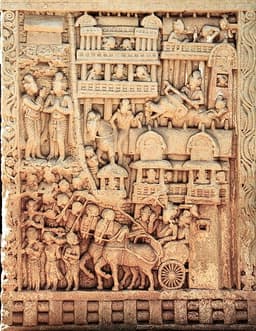
Bimbisara
Emperor · Ancient
57.3Total

Napoleon Bonaparte
General · Modern
70.9Total
Basic Information
Born
-558
1769
Died
-491
1821
Era
Ancient
Modern
Nationality
India
France
Occupation
Emperor
General
Civilization
Indian
Western
Score Comparison
Military (10%)
60.0
94.0
Political (20%)
60.0
72.0
Influence (20%)
55.7
40.0
Legacy (20%)
49.2
80.0
Leadership (15%)
72.0
78.0
Strategy (15%)
52.5
90.0
TOTAL
57.3
70.9
Bimbisara — Complete Timeline
550 BC
Married Princess Chellana of LicchaviPolitical Action
Bimbisara married Chellana, daughter of the Licchavi chief Chetaka of Vaishali. This marriage alliance strengthened Magadha's ties with the powerful Licchavi republic and produced his son Ajatashatru.
Marriage AllianceDiplomacy
Impact: regional
540 BC
Conquered AngaWar◆ Major
Bimbisara annexed the kingdom of Anga (modern Bihar) to the Magadha empire. This conquest gave Magadha control over the Ganges river trade route and access to the sea, strengthening its economic and military power.
ConquestMagadha Expansion
Impact: regional
530 BC
Established Diplomatic Relations with the BuddhaPolitical Action◆ Major
Bimbisara met Gautama Buddha and became a lay follower, donating the Veluvana Bamboo Grove monastery near Rajagriha. This patronage helped establish Buddhism in Magadha and provided the Buddha with a permanent residence during the rainy season.
BuddhismPatronageReligion
Impact: regionalconstructive
491 BC
Imprisoned and Killed by AjatashatruPolitical Action◆ Major
Bimbisara was imprisoned by his son Ajatashatru, who seized the throne. According to Buddhist sources, Bimbisara died in captivity, possibly by starvation or suicide. This event marked a violent succession in Magadha.
Succession CrisisPatricide
Impact: nationaltragic
Napoleon Bonaparte — Complete Timeline
1799 AD
Coup of 18 BrumaireOther◆ Major
Napoleon Bonaparte, with support from his brother Lucien and key political figures, overthrew the Directory in a bloodless coup. He established the Consulate with himself as First Consul, effectively becoming the ruler of France. This event ended the French Revolution's most unstable period.
French RevolutionCoupRise to Power
Impact: regional
1804 AD
Promulgation of the Napoleonic CodeOther◆ Major
Napoleon enacted the Civil Code of the French, known as the Napoleonic Code, a comprehensive set of laws that replaced the fragmented feudal legal systems. The code established legal equality, protected property rights, and secularized law. It became the basis for legal systems in many European and world countries.
Legal ReformNapoleonic CodeCivil Law
Impact: globalconstructive
1805 AD
Battle of AusterlitzWar◆ Major
Napoleon's Grande Arm
Napoleonic WarsBattleDecisive Victory
Impact: global
1812 AD
Invasion of RussiaWar◆ Major
Napoleon led the Grande Arm
Napoleonic WarsInvasionDisaster
Impact: globaldestructive
1815 AD
Battle of WaterlooWar◆ Major
Napoleon's French army was defeated by the combined forces of the Duke of Wellington's Anglo-Allied army and Gebhard Leberecht von Bl
Napoleonic WarsBattleFinal Defeat
Impact: globaldestructive
Expert Analysis
bimbisara-vs-napoleon-bonaparte
# The Emperor and the King: Napoleon and Bimbisara
On a June morning in 1815, Napoleon Bonaparte stood on a muddy field near Waterloo, watching his Imperial Guard march into cannon fire for the last time. Twenty-three centuries earlier and half a world away, another ruler—Bimbisara of Magadha—sat in a dark prison cell, starved by his own son. Both men built empires. Both were undone by those closest to them. But the paths they walked, the worlds they shaped, and the legacies they left could not be more different. What drives such divergent outcomes? The answer lies not in ambition alone, but in the soil from which they grew.
Origins
Napoleon was born in 1769 on the Mediterranean island of Corsica, a place conquered by France only a year before his birth. His family was minor nobility, poor and resentful of French rule. Young Napoleon spoke Italian, not French, and was mocked at military school for his accent and small stature. He was an outsider who burned to prove himself—and France, in the chaos of revolution, gave him that chance.
Bimbisara was born in 558 BC into the royal family of Magadha, a kingdom in the eastern Gangetic plain of India. Unlike Napoleon, he inherited power. But his world was no less turbulent. The Indian subcontinent was a patchwork of warring republics and monarchies, with new religious movements—Buddhism and Jainism—challenging ancient Vedic orthodoxy. Bimbisara’s task was not to rise from nothing, but to consolidate and expand what was given.
Napoleon’s era was one of revolutionary upheaval, where a gifted soldier could become emperor. Bimbisara’s was an age of spiritual ferment, where a king’s legitimacy depended as much on dharma as on armies. These different starting points shaped everything that followed.
Rise to Power
Napoleon’s ascent was meteoric. At 24, he drove the British out of Toulon. By 26, he was commanding the Army of Italy, winning battle after battle against Austria. In 1799, at 30, he staged a coup and became First Consul of France. By 1804, he crowned himself Emperor. Each step was a gamble—and each gamble paid off, until the last one.
Bimbisara’s rise was quieter. He inherited the throne of Magadha around 543 BC, when he was about 15 years old. His first major act was not a battle but a marriage: around 550 BC, he wed Princess Chellana of the Licchavi clan, a powerful republic in what is now Bihar. This alliance gave him influence over a region that would later become the heart of his empire. Then, around 540 BC, he conquered the neighboring kingdom of Anga, securing control of the Ganges River trade routes.
Where Napoleon seized power through sheer audacity, Bimbisara built it through strategic marriage and measured conquest. Napoleon was a storm; Bimbisara was a rising tide.
Leadership & Governance
Napoleon ruled with a blend of military genius and administrative brilliance. His Napoleonic Code standardized French law, abolished feudal privileges, and established merit-based bureaucracy. He built roads, schools, and a centralized state that outlasted his empire. But his leadership was also autocratic and restless—he could not stop conquering. His military strategy was revolutionary: rapid marches, massed artillery, and decisive battles that shattered old European armies. At Austerlitz in 1805, he destroyed a larger Austro-Russian force with a feigned retreat that remains a textbook maneuver.
Bimbisara governed differently. He did not seek to crush his neighbors but to absorb them through diplomacy and patronage. His most remarkable act was not military but spiritual: around 530 BC, he met Gautama Buddha and became a lay follower. He donated the Veluvana Bamboo Grove monastery near his capital, Rajagriha, to the Buddhist sangha. This was not mere piety—it was statecraft. By aligning with a rising religious movement, Bimbisara gave Magadha a moral authority that brute force could not provide.
Napoleon’s military score of 94 reflects his battlefield dominance. But Bimbisara’s political score of 80.6—higher than Napoleon’s 75—reveals a ruler who understood that lasting power requires more than victory.
Triumph & Tragedy
Napoleon’s greatest triumph was the height of his empire in 1811, when he controlled most of Europe from Spain to Poland. His greatest tragedy was the invasion of Russia in 1812. He marched with 600,000 men; fewer than 100,000 returned. The disaster broke his aura of invincibility. Exiled to Elba in 1814, he escaped and ruled for 100 days before his final defeat at Waterloo in 1815. He died in exile on Saint Helena in 1821, at age 51.
Bimbisara’s triumph was more subtle. He expanded Magadha from a minor kingdom into the dominant power of northern India, laying the foundation for the Maurya Empire that would arise a century later. His tragedy was personal. In 491 BC, his son Ajatashatru imprisoned him in a dungeon. According to Buddhist sources, the queen was allowed to bring him food, but Ajatashatru forbade it. Bimbisara died of starvation—not in battle, but in a cell, betrayed by his own blood.
Napoleon fell because he overreached. Bimbisara fell because he trusted too much. Both were undone by the very qualities that made them great.
Character & Destiny
Napoleon was a man of relentless will. He once said, “Impossible is a word to be found only in the dictionary of fools.” His confidence drove him to conquer Europe—and also to invade Russia. He could not delegate, could not rest, could not accept limits. His personality was his destiny.
Bimbisara was pragmatic and patient. He built alliances, cultivated religion, and ruled for over 50 years. But his very success may have bred resentment in his son. Ajatashatru’s coup was not a military defeat but a family tragedy—a reminder that in ancient monarchies, the throne is always a target.
Napoleon’s strategy score of 93 and leadership of 80 reflect a commander who inspired men to die for him. Bimbisara’s strategy of 64.6 and leadership of 80.7 reflect a ruler who kept his kingdom stable for half a century. Different metrics, different worlds.
Legacy
Napoleon’s legacy is global. His legal code influences civil law systems in Europe, the Americas, and beyond. His military tactics are still studied. His name is synonymous with ambition and genius. But his legacy is also one of war—millions died in his campaigns, and his empire collapsed within a decade of his death.
Bimbisara’s legacy is quieter but perhaps deeper. He did not conquer the world, but he helped create the conditions for Buddhism to spread across Asia. His patronage of the Buddha, his support for monasteries, and his model of righteous kingship influenced rulers from Ashoka to modern times. The Maurya Empire, which would unify most of India, was built on foundations he laid.
Napoleon’s influence score is 82, Bimbisara’s 74.3. Yet one wonders: whose impact has lasted longer? Napoleon’s empire vanished in 1815; Bimbisara’s spiritual patronage echoes still in pagodas from Sri Lanka to Japan.
Conclusion
Standing at Waterloo, Napoleon saw his world end. Sitting in his prison, Bimbisara saw his world continue without him. One died in exile, the other in chains. Both were great, but greatness takes many forms. Napoleon showed what one man can achieve through force of will. Bimbisara showed what one man can build through patience and wisdom.
Perhaps the deepest difference lies in what they sought. Napoleon wanted to remake the world in his image. Bimbisara wanted to find his place within it. One burned bright and fast; the other glowed steady and long. In the end, history remembers both—but for very different reasons. And that is the truest measure of their divergence.
Rankings
🥇
Napoleon BonaparteLeader
Mil: 94.0Pol: 72.0Inf: 40.0
70.9
🥈
Bimbisara
Mil: 60.0Pol: 60.0Inf: 55.7
57.3
+13.6 behind
How This Comparison Works
Algorithm
Each figure is scored on 6 dimensions (0—100 scale) based on structured historical data: Military (10%), Political (20%), Influence (20%), Legacy (20%), Leadership (15%), Strategy (15%). The weighted total produces the final ranking.
Data Sources
Scores are computed from structured sub-indicators in the database. Scale factors adjust for era (Ancient ×0.85, Modern ×1.0) and civilization size (Eastern ×1.05, Other ×0.80) to account for differences in population and military scale.
Maximum 3 Figures
Comparisons are limited to 2—3 figures to ensure readability and statistical meaningfulness.
Error Margins
±5 points per dimension — Sub-scores are derived from historical records with inherent uncertainty. Two figures within 5 points on a dimension should be considered roughly equivalent in that area.
Total Score Accuracy
±3 points overall — The weighted combination of 6 dimensions produces a total score with approximately ±3 points of uncertainty. Differences of less than 3 points are not statistically significant— the figures are effectively tied.
Known Limitations
- Historical records are incomplete and uneven across civilizations
- Figures from oral-tradition societies may be underrepresented
- Occupation labels can misclassify multi-role figures
- Scores measure capability and impact, not moral character
- Quantitative scoring is a comparison tool, not absolute truth
Capability Radar
Military (10%) — Battles & Warfare
Battles
45
95
Win Rate
50
90
Expansion
65
95
Political (20%) — Governance & Reform
Reform
75
95
Diplomacy
70
80
Economy
65
85
Influence (20%) — Cultural & Global Reach
Cultural
55
85
Global
40
90
Legacy (20%) — Historical Impact
Historical
60
95
Longevity
55
90
Leadership (15%) — Power & Stability
Tenure
70
85
Stability
60
70
Strategy (15%) — Tactics & Innovation
Strategy
55
95
Tactics
40
98
Reform
60
92
Similar Comparisons
Comments & Discussion
No comments yet. Be the first to share your thoughts!