Loading...
Bertrand du Guesclin vs Hosokawa Takakuni
Bertrand du Guesclin leads by 9.6 pts · 2 figures compared
…
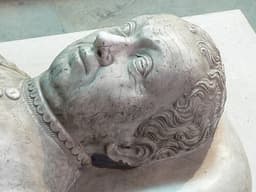
Bertrand du Guesclin
General · Medieval
60.0Total

Hosokawa Takakuni
General · Medieval
50.4Total
Basic Information
Born
1320
1484
Died
1380
1531
Era
Medieval
Medieval
Nationality
France
Japan
Occupation
General
General
Civilization
Western
Eastern
Score Comparison
Military (10%)
67.3
55.0
Political (20%)
54.7
45.1
Influence (20%)
56.4
50.2
Legacy (20%)
48.3
41.7
Leadership (15%)
80.0
61.1
Strategy (15%)
69.1
60.0
TOTAL
60.0
50.4
Bertrand du Guesclin — Complete Timeline
1364 AD
Battle of CocherelWar◆ Major
Bertrand du Guesclin led French forces to victory at the Battle of Cocherel against the forces of Charles II of Navarre. The victory secured the French throne for Charles V and established du Guesclin as a leading commander.
Hundred Years' WarBattle
Impact: regional
Battle of AurayWar◆ Major
Du Guesclin was defeated and captured at the Battle of Auray while fighting for the French in the Breton War of Succession. The defeat was a setback for French ambitions in Brittany.
Hundred Years' WarBattleDefeat
Impact: regionaltragic
1370 AD
Campaign in AquitaineWar◆ Major
Du Guesclin led a successful campaign in Aquitaine, using Fabian tactics to avoid pitched battles and recapture castles and towns from the English. His strategy weakened English control in the region.
Hundred Years' WarCampaign
Impact: regional
Appointment as Constable of FrancePolitical Action◆ Major
King Charles V appointed Bertrand du Guesclin as Constable of France, the highest military office. Du Guesclin was tasked with leading the French campaign to recover territory from the English.
FranceAppointment
Impact: nationalconstructive
1380 AD
Death at the Siege of Châteauneuf-de-RandonWar◆ Major
Bertrand du Guesclin died during the siege of Ch
Hundred Years' WarSiegeDeath
Impact: nationaltragic
Hosokawa Takakuni — Complete Timeline
1504 AD
Hosokawa Takakuni's succession strugglePolitical Action◆ Major
Takakuni, a daimyo, engaged in the succession struggles of the Hosokawa clan. He fought against other claimants to become the head of the clan, a position that gave him control over the shogunate in Kyoto.
Hosokawa clanSuccessionKyoto
Impact: regional
1527 AD
Battle of Katsura RiverWar◆ Major
Takakuni fought against the forces of Hosokawa Harumoto and Miyoshi Nagayoshi at the Battle of Katsura River. He was defeated, leading to his loss of control over Kyoto and the shogunate.
BattleDefeatKyoto
Impact: regionaldestructive
1531 AD
Death in battleWar◆ Major
Takakuni was killed in battle while attempting to regain power. His death marked the end of his faction's influence in the Hosokawa clan's internal conflicts.
DeathBattleHosokawa
Impact: regionaltragic
Expert Analysis
Origins
Bertrand du Guesclin was born around 1320 in Brittany, France, into a minor noble family. His unattractive appearance and poor education led to early dismissal from knightly training, but he proved his martial prowess in local tournaments. His early military experience came during the Breton War of Succession, fighting for Charles of Blois against the English-backed John de Montfort. Du Guesclin's rise was rooted in his tactical acumen and relentless pursuit of French interests.
Hosokawa Takakuni was born in 1484 into the powerful Hosokawa clan, a leading samurai family in Muromachi-era Japan. As a daimyo, he inherited a position of influence but faced constant internal clan strife. His early life was shaped by the complex web of alliances and betrayals characteristic of the Sengoku period. Takakuni's ambition drove him to seek control of the Hosokawa clan, leading him into a succession struggle that defined his career.
Rise to Power
Du Guesclin's rise began with his victory at the Battle of Cocherel in 1364, where he defeated the forces of Charles II of Navarre, securing French control over Normandy. This victory earned him the favor of King Charles V. However, his defeat and capture at the Battle of Auray in 1364, where he fought for Charles of Blois, was a setback. After ransom, he entered the service of the French crown. In 1370, Charles V appointed him Constable of France, the highest military office, tasking him with expelling the English from French territories.
Takakuni's rise was marked by the Hosokawa clan's internal power struggles. He emerged as a contender for clan leadership after the death of Hosokawa Masamoto in 1508. Takakuni allied with the shogun Ashikaga Yoshitane and fought against other claimants. His success in early skirmishes allowed him to become the de facto head of the clan, controlling the shogunate from behind the scenes. However, his authority was constantly challenged by rivals within the clan.
Leadership & Governance
Du Guesclin's leadership style emphasized Fabian tactics—avoiding pitched battles and instead focusing on siege warfare and attrition. He recaptured numerous castles and towns in Aquitaine and Poitou through a combination of military pressure and diplomacy. His governance as Constable involved reorganizing the French army, improving logistics, and fostering loyalty among the troops. He scored 80.0 in leadership, reflecting his ability to inspire and command effectively.
Takakuni's leadership was marked by political maneuvering and military campaigns. He ruled through the shogun, but his governance was unstable due to constant factional conflicts. He attempted to consolidate power by eliminating rivals, but his reliance on shifting alliances weakened his position. His leadership score of 61.1 indicates a less effective command compared to du Guesclin. Takakuni's strategy score of 60.0 shows moderate strategic ability, but his political score of 45.1 highlights his struggles in maintaining power.
Triumph & Tragedy
Du Guesclin's greatest triumph was his successful campaign in Aquitaine (1370-1374), where he used Fabian tactics to recapture territories from the English without a major battle. His death at the Siege of Châteauneuf-de-Randon in 1380 was a tragedy for France, but he died a hero, having restored French morale and territory. His legacy as a skilled commander was cemented by his ability to adapt to circumstances.
Takakuni's triumph was his seizure of power within the Hosokawa clan, becoming the dominant figure in Kyoto for a time. However, his tragedy was his defeat at the Battle of Katsura River in 1531, where he was killed while trying to regain power. His failure to secure lasting control led to the decline of the Hosokawa clan's influence. Takakuni's military score of 55.0 reflects his inability to achieve decisive victories.
Character & Destiny
Du Guesclin was known for his tenacity, tactical cunning, and loyalty to the French crown. He was pragmatic, often choosing strategic retreat over glory. His character shaped his destiny as a national hero who revived French fortunes in the Hundred Years' War. Historians praise his ability to adapt to the realities of medieval warfare.
Takakuni was ambitious and ruthless, but his character was marred by indecisiveness and overreliance on alliances. His destiny was sealed by his inability to unite his clan and his failure to defeat his rivals decisively. Japanese historical assessments view him as a capable but ultimately unsuccessful daimyo, overshadowed by figures like Oda Nobunaga.
Legacy
Du Guesclin's legacy is enduring: he is remembered as a national hero who laid the groundwork for French victories in the Hundred Years' War. His tactics influenced later French commanders, and he is celebrated in French history as the "Eagle of Brittany." His influence score of 56.4 reflects his lasting impact on French military tradition.
Takakuni's legacy is more limited. His role in the Hosokawa clan's succession struggles contributed to the fragmentation of the clan, but he is not a widely recognized figure outside of Japanese medieval history. His influence score of 50.2 indicates a modest impact, overshadowed by the broader Sengoku period developments.
Conclusion
Bertrand du Guesclin had a greater impact than Hosokawa Takakuni. With a total score of 60.0 compared to Takakuni's 50.4, du Guesclin's military achievements, leadership quality, and lasting legacy far surpass his counterpart. Du Guesclin's strategic use of Fabian tactics helped shape the outcome of the Hundred Years' War and established him as a model of medieval generalship. Takakuni, while a significant figure in Japanese clan politics, failed to achieve lasting influence or decisive victories. The evidence clearly supports du Guesclin's superior historical significance.
Rankings
🥇
Bertrand du GuesclinLeader
Mil: 67.3Pol: 54.7Inf: 56.4
60.0
🥈
Hosokawa Takakuni
Mil: 55.0Pol: 45.1Inf: 50.2
50.4
+9.6 behind
How This Comparison Works
Algorithm
Each figure is scored on 6 dimensions (0—100 scale) based on structured historical data: Military (10%), Political (20%), Influence (20%), Legacy (20%), Leadership (15%), Strategy (15%). The weighted total produces the final ranking.
Data Sources
Scores are computed from structured sub-indicators in the database. Scale factors adjust for era (Ancient ×0.85, Modern ×1.0) and civilization size (Eastern ×1.05, Other ×0.80) to account for differences in population and military scale.
Maximum 3 Figures
Comparisons are limited to 2—3 figures to ensure readability and statistical meaningfulness.
Error Margins
±5 points per dimension — Sub-scores are derived from historical records with inherent uncertainty. Two figures within 5 points on a dimension should be considered roughly equivalent in that area.
Total Score Accuracy
±3 points overall — The weighted combination of 6 dimensions produces a total score with approximately ±3 points of uncertainty. Differences of less than 3 points are not statistically significant— the figures are effectively tied.
Known Limitations
- Historical records are incomplete and uneven across civilizations
- Figures from oral-tradition societies may be underrepresented
- Occupation labels can misclassify multi-role figures
- Scores measure capability and impact, not moral character
- Quantitative scoring is a comparison tool, not absolute truth
Capability Radar
Military (10%) — Battles & Warfare
Battles
65
30
Win Rate
60
35
Expansion
60
30
Political (20%) — Governance & Reform
Reform
45
30
Diplomacy
70
40
Economy
40
25
Influence (20%) — Cultural & Global Reach
Cultural
55
20
Global
45
10
Legacy (20%) — Historical Impact
Historical
60
25
Longevity
50
15
Leadership (15%) — Power & Stability
Tenure
60
45
Stability
55
20
Strategy (15%) — Tactics & Innovation
Strategy
75
35
Tactics
70
40
Reform
55
20
Similar Comparisons
Comments & Discussion
No comments yet. Be the first to share your thoughts!