Loading...
Benito Mussolini vs Lee Hsien Loong
Lee Hsien Loong leads by 2.3 pts · 2 figures compared
…

Benito Mussolini
Politician · Modern
53.1Total
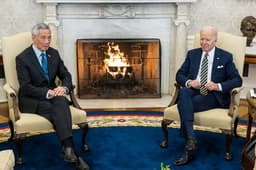
Lee Hsien Loong
Politician · Modern
55.4Total
Basic Information
Born
1883
1952
Died
1945
—
Era
Modern
Modern
Nationality
Italy
Singapore
Occupation
Politician
Politician
Civilization
Western
Eastern
Score Comparison
Military (10%)
50.0
14.8
Political (20%)
54.7
75.0
Influence (20%)
61.0
55.0
Legacy (20%)
47.5
58.0
Leadership (15%)
65.0
72.0
Strategy (15%)
30.3
36.4
TOTAL
53.1
55.4
Benito Mussolini — Complete Timeline
1919 AD
Founded the Fasci Italiani di CombattimentoOther◆ Major
On March 23, 1919, Mussolini founded the Fasci Italiani di Combattimento (Italian Combat League) in Milan. This paramilitary political movement combined nationalist, anti-socialist, and corporatist ideas, forming the nucleus of the future Fascist Party that would seize power in Italy.
FascismPolitical FoundingItalian Politics
Impact: nationaldestructive
1922 AD
Led the March on RomeOther◆ Major
On October 28, 1922, Mussolini orchestrated the March on Rome, where thousands of Blackshirt fascists converged on the capital. King Victor Emmanuel III refused to declare martial law and instead appointed Mussolini Prime Minister on October 31, giving him legal power to form a government.
Fascist Seizure of PowerMarch on RomeItalian Government
Impact: nationaldestructive
1924 AD
Assassinated Giacomo MatteottiOther◆ Major
On June 10, 1924, socialist deputy Giacomo Matteotti was kidnapped and murdered by fascist squadristi after giving a speech denouncing fascist electoral fraud. The assassination caused a political crisis, but Mussolini took direct responsibility in January 1925 and established a full dictatorship.
AssassinationDictatorshipPolitical Repression
Impact: nationaldestructive
1929 AD
Signed the Lateran TreatyOther◆ Major
On February 11, 1929, Mussolini signed the Lateran Treaty with the Holy See, ending the 'Roman Question' that had existed since 1870. The treaty recognized Vatican City as an independent state, granted Catholicism official status, and gave the Church financial compensation, securing fascist legitimacy with Italian Catholics.
Church-State RelationsVaticanTreaty
Impact: national
1935 AD
Invaded EthiopiaOther◆ Major
On October 3, 1935, Mussolini ordered the invasion of Ethiopia (Abyssinia) from Italian Eritrea and Somaliland. Italian forces used poison gas, tanks, and aircraft against poorly equipped Ethiopian troops, conquering the country by May 1936. The League of Nations imposed sanctions but failed to stop the aggression.
Colonial WarEthiopiaLeague of Nations
Impact: globaldestructive
1940 AD
Declared War on France and BritainOther◆ Major
On June 10, 1940, Mussolini declared war on France and Britain, believing Germany had already won World War II. Italian forces attacked France but performed poorly, requiring German assistance. This decision committed Italy to a war it was unprepared for, leading to military disasters in Greece, North Africa, and the Mediterranean.
World War IIDeclaration of WarAxis Alliance
Impact: globaldestructive
1943 AD
Deposed and Arrested by the Grand Council of FascismPolitical Action◆ Major
On July 25, 1943, the Grand Council of Fascism passed a motion of no confidence against Mussolini, led by Dino Grandi. King Victor Emmanuel III then dismissed and arrested Mussolini, ending 21 years of fascist rule. Italy subsequently signed an armistice with the Allies in September 1943.
Fall of FascismCoupWorld War II
Impact: nationaldestructive
1945 AD
Executed by PartisansOther◆ Major
On April 28, 1945, as World War II ended in Europe, Mussolini was captured by Italian communist partisans near Lake Como while attempting to flee to Switzerland. He was executed by firing squad along with his mistress Clara Petacci. Their bodies were later displayed publicly in Milan's Piazzale Loreto.
ExecutionWorld War IIEnd of Fascism
Impact: nationaldestructive
Lee Hsien Loong — Complete Timeline
2004 AD
Became Prime Minister of SingaporePolitical Action◆ Major
Lee Hsien Loong succeeded Goh Chok Tong as Prime Minister of Singapore. As the eldest son of founding leader Lee Kuan Yew, his appointment continued the People's Action Party's dominance and was seen as a continuation of the country's development model.
LeadershipSingaporeTransition
Impact: national
2015 AD
Introduced the 'SG50' CelebrationsCultural
Lee's government organized the SG50 celebrations to mark Singapore's 50th anniversary of independence. The year-long events fostered national pride and unity, highlighting the country's economic success and social harmony.
CelebrationSingaporeNational Identity
Impact: nationalconstructive
2020 AD
Navigated COVID-19 PandemicPolitical Action◆ Major
Lee's government implemented a series of measures to combat the COVID-19 pandemic, including circuit breaker lockdowns, contact tracing, and a massive vaccination drive. Singapore's response was praised for its effectiveness, though migrant worker dormitories saw major outbreaks.
PandemicSingaporePublic Health
Impact: nationalconstructive
2023 AD
Announced Intention to Step DownPolitical Action◆ Major
Lee Hsien Loong announced his intention to step down as Prime Minister by 2024, paving the way for Deputy Prime Minister Lawrence Wong to succeed him. The announcement marked a planned leadership transition in Singapore's long-ruling People's Action Party.
LeadershipSingaporeTransition
Impact: national
Expert Analysis
Origins
Benito Mussolini was born on July 29, 1883, in Predappio, Italy, to a blacksmith father and a schoolteacher mother. His early life was marked by socialist activism; he became a journalist and editor of "Avanti!" (the Italian Socialist Party newspaper). He was expelled from the party in 1914 for supporting Italian entry into World War I. Lee Hsien Loong was born on February 10, 1952, in Singapore, the eldest son of Lee Kuan Yew, Singapore's founding prime minister. He studied at Trinity College, Cambridge, earning a degree in mathematics, and later a Master's in Public Administration from Harvard Kennedy School. His early career included service in the Singapore Armed Forces, where he rose to Brigadier-General.
Rise to Power
Mussolini's rise began with the founding of the Fasci Italiani di Combattimento in 1919. His paramilitary Blackshirts gained notoriety through violent suppression of socialists. The March on Rome in October 1922 pressured King Victor Emmanuel III to appoint him Prime Minister at age 39. Lee Hsien Loong entered politics in 1984, winning a parliamentary seat. He held key ministerial posts including Minister for Trade and Industry and Deputy Prime Minister. He became Prime Minister on August 12, 2004, succeeding Goh Chok Tong, continuing the People's Action Party's dominance.
Leadership & Governance
Mussolini established a totalitarian fascist regime, abolishing democratic institutions, controlling the press, and creating a cult of personality. He signed the Lateran Treaty in 1929, securing Church support. His economic policies included autarky and public works, but were inefficient. Lee Hsien Loong led a technocratic, pragmatic government focused on economic growth, social stability, and national resilience. Under his leadership, Singapore navigated the 2008 financial crisis and the COVID-19 pandemic with effective measures like circuit breakers and contact tracing. His political score of 75.0 contrasts with Mussolini's 54.7, reflecting Lee's democratic mandate versus Mussolini's dictatorial rule.
Triumph & Tragedy
Mussolini's greatest success was the Lateran Treaty, which normalized relations with the Vatican. His invasion of Ethiopia in 1935 initially boosted popularity but led to international isolation and economic sanctions. His alliance with Nazi Germany dragged Italy into World War II, resulting in military disasters and his own downfall. He was executed on April 28, 1945. Lee Hsien Loong's triumphs include overseeing Singapore's continued economic success and maintaining social harmony. His legacy score of 58.0 reflects positive long-term impact. However, his tenure saw rising income inequality and political opposition, though Singapore remains stable.
Character & Destiny
Mussolini was charismatic, ruthless, and impulsive. His grand ambitions led to overreach and catastrophic decisions, scoring only 30.3 in strategy. Lee Hsien Loong is methodical, analytical, and cautious, with a strategic score of 36.4. His character emphasizes consensus and long-term planning, shaped by his father's legacy.
Legacy
Mussolini's legacy is overwhelmingly negative: fascism is discredited, and his actions caused immense suffering. His influence score of 61.0 reflects the historical impact of fascist ideology. Lee Hsien Loong's legacy is more positive: Singapore remains a prosperous, stable city-state. His leadership style influenced regional governance models. His legacy score of 58.0 is higher than Mussolini's 47.5.
Conclusion
Lee Hsien Loong has had a greater positive impact than Mussolini. Despite Mussolini's higher influence, his destructive legacy and lower total score (53.1 vs 55.4) indicate a net negative. Lee's pragmatic governance improved millions of lives, while Mussolini's ideology led to war and ruin. The data supports Lee as the more effective leader.
Rankings
🥇
Lee Hsien LoongLeader
Mil: 14.8Pol: 75.0Inf: 55.0
55.4
🥈
Benito Mussolini
Mil: 50.0Pol: 54.7Inf: 61.0
53.1
+2.3 behind
How This Comparison Works
Algorithm
Each figure is scored on 6 dimensions (0—100 scale) based on structured historical data: Military (10%), Political (20%), Influence (20%), Legacy (20%), Leadership (15%), Strategy (15%). The weighted total produces the final ranking.
Data Sources
Scores are computed from structured sub-indicators in the database. Scale factors adjust for era (Ancient ×0.85, Modern ×1.0) and civilization size (Eastern ×1.05, Other ×0.80) to account for differences in population and military scale.
Maximum 3 Figures
Comparisons are limited to 2—3 figures to ensure readability and statistical meaningfulness.
Error Margins
±5 points per dimension — Sub-scores are derived from historical records with inherent uncertainty. Two figures within 5 points on a dimension should be considered roughly equivalent in that area.
Total Score Accuracy
±3 points overall — The weighted combination of 6 dimensions produces a total score with approximately ±3 points of uncertainty. Differences of less than 3 points are not statistically significant— the figures are effectively tied.
Known Limitations
- Historical records are incomplete and uneven across civilizations
- Figures from oral-tradition societies may be underrepresented
- Occupation labels can misclassify multi-role figures
- Scores measure capability and impact, not moral character
- Quantitative scoring is a comparison tool, not absolute truth
Capability Radar
Military (10%) — Battles & Warfare
Battles
30
12
Win Rate
20
17
Expansion
35
21
Political (20%) — Governance & Reform
Reform
55
80
Diplomacy
30
85
Economy
40
90
Influence (20%) — Cultural & Global Reach
Cultural
45
60
Global
50
70
Legacy (20%) — Historical Impact
Historical
55
65
Longevity
30
60
Leadership (15%) — Power & Stability
Tenure
65
85
Stability
15
95
Strategy (15%) — Tactics & Innovation
Strategy
20
25
Tactics
25
24
Reform
40
27
Similar Comparisons
Comments & Discussion
No comments yet. Be the first to share your thoughts!