Loading...
Begum Samru vs Salvador Allende
Salvador Allende leads by 12.0 pts · 2 figures compared
…

Begum Samru
Politician · Modern
43.9Total
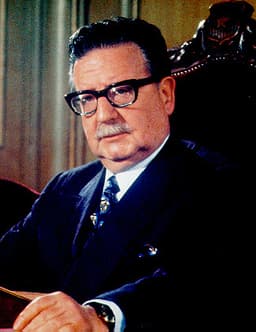
Salvador Allende
Politician · Modern
55.9Total
Basic Information
Born
1753
1908
Died
1836
1973
Era
Modern
Modern
Nationality
India
Chile
Occupation
Politician
Politician
Civilization
Indian
Western
Score Comparison
Military (10%)
14.9
50.0
Political (20%)
54.7
68.0
Influence (20%)
50.2
58.3
Legacy (20%)
40.8
52.0
Leadership (15%)
40.0
58.8
Strategy (15%)
54.8
43.5
TOTAL
43.9
55.9
Begum Samru — Complete Timeline
1778 AD
Became ruler of SardhanaPolitical Action◆ Major
After the death of her husband, the European mercenary Walter Reinhardt Sombre, Begum Samru inherited the principality of Sardhana in present-day Uttar Pradesh. She successfully maintained her rule as a Catholic Christian convert, commanding a mercenary army and navigating the turbulent politics of late 18th-century India.
SuccessionPrincely StateFemale Ruler
Impact: regionalconstructive
1803 AD
Allied with the British East India CompanyPolitical Action◆ Major
During the Second Anglo-Maratha War, Begum Samru sided with the British East India Company against the Maratha Confederacy. Her decision secured her principality's autonomy under British suzerainty and demonstrated her pragmatic political acumen.
Anglo-Maratha WarAllianceBritish East India Company
Impact: regional
1822 AD
Commissioned the Basilica of Our Lady of GracesCultural
Begum Samru commissioned the construction of the Basilica of Our Lady of Graces in Sardhana, a large Catholic church. The building became a significant architectural landmark and a center for Christian worship in the region, reflecting her personal faith and patronage.
ArchitectureCatholic ChurchPatronage
constructive
Salvador Allende — Complete Timeline
1970 AD
Election as PresidentPolitical Action
Allende won the presidential election with a narrow plurality of 36.6%, confirmed by Congress. He became the first democratically elected Marxist president, promising a peaceful transition to socialism.
ElectionSocialismDemocracy
Impact: globalprogressive
1971 AD
Nationalization of CopperReform◆ Major
Allende's government nationalized Chile's copper mines, owned by U.S. companies Anaconda and Kennecott. The move was approved unanimously by Congress and aimed to use copper revenues for social programs.
NationalizationEconomic ReformCopper
Impact: nationalprogressive
Agrarian Reform AccelerationReform◆ Major
Allende accelerated land reform, expropriating large estates and distributing land to peasants. The policy aimed to break up the latifundia system but led to agricultural disruption and opposition from landowners.
Land ReformPeasant RightsSocial Change
Impact: nationalprogressive
1973 AD
1973 Chilean Coup d'ÉtatPolitical Action
Allende was overthrown in a military coup led by General Pinochet. He died in the presidential palace during the attack, ending his socialist experiment and ushering in a 17-year dictatorship.
CoupDeathEnd of Socialism
Impact: globaltragic
Expert Analysis
Origins
Begum Samru (born 1750s) began life as a Kashmiri dancing girl named Farzana Zeb un-Nissa. She was sold into the court of the European mercenary Walter Reinhardt Sombre, whom she later married. After his death in 1778, she inherited the principality of Sardhana in present-day Uttar Pradesh, India. Her early life was marked by a lack of formal education but a shrewd understanding of power dynamics.
Salvador Allende (born 1908) came from a middle-class Chilean family with a tradition of political involvement. He studied medicine at the University of Chile, graduating in 1932. His father was a notary, and his grandfather was a prominent physician. Allende's formative years were shaped by the Great Depression and his exposure to Marxist ideas, leading him to become a founding member of the Socialist Party of Chile in 1933.
Rise to Power
Begum Samru's rise came through inheritance and strategic alliances. Upon her husband's death, she took control of Sardhana, a small principality with a private army. During the Second Anglo-Maratha War (1803-1805), she allied with the British East India Company against the Maratha Confederacy, securing her position. In 1823, she commissioned the Basilica of Our Lady of Graces, a large Catholic church, signaling her conversion to Christianity and her alignment with European powers.
Salvador Allende rose through democratic politics. He served as a deputy (1937-1939), Minister of Health (1939-1942), and senator (1945-1970). He ran for president four times, finally winning in 1970 with a narrow plurality of 36.6%. His victory was confirmed by Congress after a contentious debate, making him the first democratically elected Marxist president. His rise was built on a coalition of leftist parties, including Socialists, Communists, and Radicals.
Leadership & Governance
Begum Samru ruled Sardhana with an iron fist but also with pragmatism. She maintained a private army of about 2,000 soldiers, including European mercenaries. She was known for her justice system, which was harsh but fair, and she kept her territory stable despite the chaos of the declining Mughal Empire. She also promoted Catholicism, building churches and supporting missionaries, which strengthened her ties with the British. Her military score of 14.9 reflects limited direct warfare, but her political score of 54.7 shows her diplomatic acumen.
Salvador Allende's governance was marked by ambitious socialist reforms. He nationalized copper mines, owned by U.S. companies Anaconda and Kennecott, with unanimous congressional approval in 1971. He accelerated agrarian reform, expropriating large estates and distributing land to peasants. His economic policies included price controls and wage increases, but they led to hyperinflation and shortages. His political score of 68.0 indicates strong ideological commitment, but his strategy score of 43.5 reveals poor economic management.
Triumph & Tragedy
Begum Samru's greatest triumph was maintaining her rule for over 50 years in a turbulent era. She successfully navigated between the British and Maratha powers, preserving Sardhana's autonomy. Her greatest failure was her inability to secure a lasting dynasty; she had no children, and after her death in 1836, Sardhana was annexed by the British.
Allende's triumph was the nationalization of copper, a symbol of economic sovereignty. His tragedy was the 1973 coup led by General Augusto Pinochet, which overthrew his government and ended his life. The coup resulted in a brutal dictatorship that lasted 17 years. Allende's policies, while popular among the poor, alienated the middle class, the military, and the United States, leading to his downfall.
Character & Destiny
Begum Samru was pragmatic and adaptable, converting to Christianity and allying with the British to survive. Her character was marked by resilience and political savvy. Her destiny was to be a footnote in Indian history, but her legacy as a female ruler in a patriarchal society is notable.
Allende was idealistic and stubborn, committed to democratic socialism even as his economic policies failed. His character was shaped by a deep belief in Marxism and a willingness to take risks. His destiny was to become a martyr for the left, his death symbolizing the struggle against imperialism.
Legacy
Begum Samru's legacy is localized: she is remembered in Sardhana for her church and her rule. Her influence score of 50.2 reflects her regional impact, but her overall legacy score of 40.8 is modest. She did not create institutions that outlasted her.
Allende's legacy is global. He is a symbol of democratic socialism and a cautionary tale about the limits of reform within capitalism. His influence score of 58.3 and legacy score of 52.0 reflect his enduring impact on leftist movements worldwide. The Pinochet dictatorship that followed his death became a symbol of human rights abuses.
Conclusion
Salvador Allende had greater impact than Begum Samru, as reflected in his total score of 55.9 versus her 43.9. Allende's policies, though flawed, inspired generations of socialists and highlighted the tensions between democracy and capitalism. Begum Samru was a skilled ruler but her influence was confined to a small territory and a brief historical moment. Allende's experiment in democratic socialism, though tragic, remains a benchmark for political change. Thus, Allende's legacy is more significant and enduring.
Rankings
🥇
Salvador AllendeLeader
Mil: 50.0Pol: 68.0Inf: 58.3
55.9
🥈
Begum Samru
Mil: 14.9Pol: 54.7Inf: 50.2
43.9
+12.0 behind
How This Comparison Works
Algorithm
Each figure is scored on 6 dimensions (0—100 scale) based on structured historical data: Military (10%), Political (20%), Influence (20%), Legacy (20%), Leadership (15%), Strategy (15%). The weighted total produces the final ranking.
Data Sources
Scores are computed from structured sub-indicators in the database. Scale factors adjust for era (Ancient ×0.85, Modern ×1.0) and civilization size (Eastern ×1.05, Other ×0.80) to account for differences in population and military scale.
Maximum 3 Figures
Comparisons are limited to 2—3 figures to ensure readability and statistical meaningfulness.
Error Margins
±5 points per dimension — Sub-scores are derived from historical records with inherent uncertainty. Two figures within 5 points on a dimension should be considered roughly equivalent in that area.
Total Score Accuracy
±3 points overall — The weighted combination of 6 dimensions produces a total score with approximately ±3 points of uncertainty. Differences of less than 3 points are not statistically significant— the figures are effectively tied.
Known Limitations
- Historical records are incomplete and uneven across civilizations
- Figures from oral-tradition societies may be underrepresented
- Occupation labels can misclassify multi-role figures
- Scores measure capability and impact, not moral character
- Quantitative scoring is a comparison tool, not absolute truth
Capability Radar
Military (10%) — Battles & Warfare
Battles
15
28
Win Rate
20
31
Expansion
15
33
Political (20%) — Governance & Reform
Reform
30
60
Diplomacy
55
45
Economy
40
40
Influence (20%) — Cultural & Global Reach
Cultural
30
55
Global
10
55
Legacy (20%) — Historical Impact
Historical
25
60
Longevity
20
50
Leadership (15%) — Power & Stability
Tenure
50
35
Stability
45
20
Strategy (15%) — Tactics & Innovation
Strategy
20
37
Tactics
25
43
Reform
10
45
Similar Comparisons
Comments & Discussion
No comments yet. Be the first to share your thoughts!