Loading...
Batu Khan vs Napoleon Bonaparte
Napoleon Bonaparte leads by 6.1 pts · 2 figures compared
…
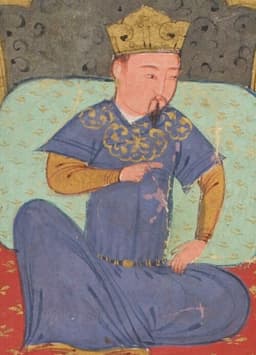
Batu Khan
Emperor · Medieval
64.8Total

Napoleon Bonaparte
General · Modern
70.9Total
Basic Information
Born
1207
1769
Died
1255
1821
Era
Medieval
Modern
Nationality
Golden Horde
France
Occupation
Emperor
General
Civilization
Eastern
Western
Score Comparison
Military (10%)
79.9
94.0
Political (20%)
55.0
72.0
Influence (20%)
68.0
40.0
Legacy (20%)
55.0
80.0
Leadership (15%)
72.0
78.0
Strategy (15%)
70.0
90.0
TOTAL
64.8
70.9
Batu Khan — Complete Timeline
1223 AD
Battle of the Kalka RiverWar◆ Major
Batu Khan, as a subordinate commander under Subutai, participated in the Mongol victory over a coalition of Rus' princes and Cumans at the Kalka River. This battle was a precursor to the full-scale invasion of the Rus' lands.
Mongol EmpireKievan Rus'BattleCumans
Impact: regional
1240 AD
Sack of KievWar
Batu Khan led the Mongol army in the siege and sack of Kiev, the capital of the Kievan Rus'. The city was destroyed, and its population was massacred. This event marked the subjugation of the Rus' principalities to Mongol rule.
Mongol EmpireKievan Rus'SiegeDestruction
Impact: globaldestructive
1241 AD
Invasion of Hungary and PolandWar◆ Major
Batu Khan led the Mongol invasion of Central Europe, defeating the Hungarian army at the Battle of Mohi and the Polish army at the Battle of Legnica. The campaign devastated Hungary and Poland before the Mongols withdrew due to the death of
Mongol EmpireHungaryPolandInvasion
Impact: globaldestructive
1242 AD
Foundation of the Golden HordePolitical Action
After the Mongol invasion of Europe, Batu Khan established the Golden Horde, a khanate that controlled the western part of the Mongol Empire. The Golden Horde's territory stretched from the Ural Mountains to the Danube River, with Sarai as its capital.
Mongol EmpireGolden HordeFoundationSarai
Impact: global
Napoleon Bonaparte — Complete Timeline
1799 AD
Coup of 18 BrumaireOther◆ Major
Napoleon Bonaparte, with support from his brother Lucien and key political figures, overthrew the Directory in a bloodless coup. He established the Consulate with himself as First Consul, effectively becoming the ruler of France. This event ended the French Revolution's most unstable period.
French RevolutionCoupRise to Power
Impact: regional
1804 AD
Promulgation of the Napoleonic CodeOther◆ Major
Napoleon enacted the Civil Code of the French, known as the Napoleonic Code, a comprehensive set of laws that replaced the fragmented feudal legal systems. The code established legal equality, protected property rights, and secularized law. It became the basis for legal systems in many European and world countries.
Legal ReformNapoleonic CodeCivil Law
Impact: globalconstructive
1805 AD
Battle of AusterlitzWar◆ Major
Napoleon's Grande Arm
Napoleonic WarsBattleDecisive Victory
Impact: global
1812 AD
Invasion of RussiaWar◆ Major
Napoleon led the Grande Arm
Napoleonic WarsInvasionDisaster
Impact: globaldestructive
1815 AD
Battle of WaterlooWar◆ Major
Napoleon's French army was defeated by the combined forces of the Duke of Wellington's Anglo-Allied army and Gebhard Leberecht von Bl
Napoleonic WarsBattleFinal Defeat
Impact: globaldestructive
Expert Analysis
batu-khan-vs-napoleon-bonaparte
# The Conqueror and the Khan
On a June morning in 1815, Napoleon Bonaparte watched his elite Imperial Guard march up the muddy slopes of Mont-Saint-Jean, their bearskin caps and blue coats a final, defiant splash of color against the gray sky. Twenty miles away, across the English Channel, the Duke of Wellington would later call it "the nearest-run thing you ever saw in your life." Six centuries earlier and a thousand miles to the east, another conqueror had stood on the banks of the Sajo River in Hungary, watching his Mongol horsemen drive terrified Magyar knights into a frozen marsh. Batu Khan, grandson of Genghis, had just destroyed an army of fifty thousand men in a single afternoon. Two men, two worlds, two kinds of conquest—one who built an empire of laws, and another who built an empire of fear.
Origins
Napoleon Bonaparte was born in 1769 on the island of Corsica, a place that had belonged to Genoa, then briefly to its own republic, and finally to France. His family were minor nobility, poor enough to need patronage but proud enough to resent it. He spoke French with a thick Italian accent, and his schoolmates at Brienne mocked him for it. He was small, intense, and utterly convinced of his own destiny. The French Revolution, which erupted when he was twenty, shattered the old order and opened paths that had been closed for centuries. A young artillery officer of modest birth could now become emperor—if he had the talent and the ruthlessness.
Batu Khan was born in 1207 into a world where destiny was not earned but inherited. His grandfather was Genghis Khan, the man who had united the Mongol tribes and launched the greatest land empire in history. But Batu was not the eldest grandson, nor the most favored. His father, Jochi, had been born under a cloud of illegitimacy—Genghis never fully trusted him—and Jochi's descendants were always treated as second-class princes. Batu grew up in the shadow of doubt, surrounded by cousins who wielded more power and prestige. He learned early that in the Mongol world, respect was not given; it was taken.
Rise to Power
Napoleon rose through talent and timing. In 1793, at the age of twenty-four, he commanded the artillery at the Siege of Toulon, driving the British fleet from the harbor with a precision that stunned his superiors. By 1796, he was commanding the Army of Italy, winning six victories in as many months against the Austrians. He was not just brilliant—he was lucky. The Revolution had killed off or exiled most of France's senior generals, leaving room for young men of ability. Napoleon exploited every opportunity, every political connection, every battlefield. By 1799, he was First Consul. By 1804, he crowned himself Emperor.
Batu rose through patience and delegation. In 1223, at the age of sixteen, he participated in the Battle of the Kalka River, a stunning Mongol victory over a coalition of Rus' princes. But the credit went to Subutai, the aging general who actually planned the campaign. Batu was a figurehead, a prince whose name lent legitimacy to the army. He learned to trust Subutai absolutely, and that trust would define his career. In 1236, when the Great Khan Ögedei ordered a full-scale invasion of Europe, Batu was named supreme commander—not because he was the best general, but because he was the senior prince in the region. He led the army that sacked Kiev in 1240, destroyed the Hungarian army at Mohi in 1241, and annihilated the Poles at Legnica. But Subutai planned the battles; Batu managed the politics.
Leadership & Governance
Napoleon governed as he conquered—with relentless energy and total control. He reformed French law into the Napoleonic Code, a system that enshrined equality before the law, protected property rights, and abolished feudal privileges. He centralized the bureaucracy, created the Bank of France, and established lycées to train a new elite. He was a master of propaganda, presenting himself as the savior of the Revolution even as he crushed its democratic spirit. His military genius was unmatched: he understood logistics, terrain, and morale better than any commander of his age. At Austerlitz in 1805, he lured the Austro-Russian army into a trap and destroyed it with a feigned retreat. He was a man who thought in three dimensions, seeing the battlefield as a chessboard where every piece had a purpose.
Batu governed as he conquered—through fear and delegation. The Golden Horde, which he founded in 1242 after the European campaign, was not a centralized state but a tribute machine. The Mongols did not impose their laws or religion on the conquered peoples; they simply demanded submission and taxes. Batu ruled from Sarai, a city of tents and palaces on the Volga, where Russian princes came to grovel for his approval. He was a master of the politics of terror: when the city of Vladimir resisted, he massacred every inhabitant and piled their heads in a pyramid. When the Prince of Galicia refused to pay tribute, Batu's armies burned his lands to ash. But he also knew when to show mercy. He protected the Orthodox Church, exempting it from taxes, because he understood that religion could pacify the conquered.
Triumph & Tragedy
Napoleon's greatest triumph was also the seed of his tragedy. In 1812, he invaded Russia with the largest army Europe had ever seen—over six hundred thousand men. He won every battle, took Moscow, and then watched the city burn. The Russian winter, the scorched earth, and the endless steppes destroyed his army. Of the six hundred thousand, fewer than forty thousand returned. He never recovered. In 1814, the Allies invaded France and forced his abdication. He returned in 1815 for a hundred days, raised another army, and was crushed at Waterloo. He died in 1821 on the remote island of Saint Helena, a prisoner of the British, dictating his memoirs and blaming everyone but himself.
Batu's triumph was more lasting. He conquered the richest cities of Eastern Europe—Kiev, Buda, Krakow—and then stopped. When news arrived in 1241 that the Great Khan Ögedei had died, Batu withdrew his armies from the gates of Vienna. Some historians argue he could have conquered all of Europe; others say his supply lines were already stretched to breaking. Whatever the reason, Batu chose consolidation over expansion. He built the Golden Horde into a state that would dominate the Russian steppes for two hundred years. His tragedy was personal: he never became the Great Khan. His cousin Güyük was elected instead, and the two men hated each other. Batu spent his final years in a cold war with the Mongol heartland, ruling his territory but never achieving the supreme power he had once seemed destined for.
Character & Destiny
Napoleon was driven by an insatiable hunger for glory. "I am not a man like other men," he once said, and he meant it. He believed he was a force of history, a figure whose destiny was to reshape the world. This conviction gave him extraordinary courage and energy, but also a fatal arrogance. He could not stop, could not compromise, could not accept limits. His character demanded constant victory, and when victory failed him, he had nothing left.
Batu was driven by a different hunger: legitimacy. He was the son of a doubted father, a prince who had to prove his worth to cousins who looked down on him. He learned patience, cunning, and the art of delegation. He knew when to fight and when to withdraw. He built his empire not on his own genius but on the loyalty of his generals and the fear of his enemies. His character was colder than Napoleon's, more calculating, less romantic. But it was also more sustainable.
Legacy
Napoleon's legacy is written in the laws and institutions of modern Europe. The Napoleonic Code influenced legal systems from Italy to Brazil to Japan. He standardized weights and measures, promoted education, and broke the power of feudal aristocracy. But he also left a legacy of war: over three million people died in the Napoleonic Wars, and the map of Europe was redrawn in blood. Today, he is remembered as both a liberator and a tyrant, a genius and a madman.
Batu's legacy is quieter but no less real. The Golden Horde shaped Russia's development for centuries, isolating it from Western Europe and creating a tradition of autocratic rule. The "Mongol Yoke" became a central myth of Russian identity—a period of suffering that forged the nation's soul. Batu himself is not remembered as a great reformer or lawgiver; he left no code, no system, no ideology. But he built a state that lasted, and his descendants ruled the steppes until the sixteenth century.
Conclusion
Standing on the opposite ends of the Eurasian landmass, Napoleon and Batu Khan achieved conquests that would define their regions for centuries. One built with laws, the other with fear. One burned bright and fast, the other burned slow and steady. Their differences are not just differences of personality but of civilization—the Western drive to impose order through reason, the Eastern pragmatism that rules through power. Both were conquerors, but they conquered different worlds, and the worlds they conquered still bear their marks.
Rankings
🥇
Napoleon BonaparteLeader
Mil: 94.0Pol: 72.0Inf: 40.0
70.9
🥈
Batu Khan
Mil: 79.9Pol: 55.0Inf: 68.0
64.8
+6.1 behind
How This Comparison Works
Algorithm
Each figure is scored on 6 dimensions (0—100 scale) based on structured historical data: Military (10%), Political (20%), Influence (20%), Legacy (20%), Leadership (15%), Strategy (15%). The weighted total produces the final ranking.
Data Sources
Scores are computed from structured sub-indicators in the database. Scale factors adjust for era (Ancient ×0.85, Modern ×1.0) and civilization size (Eastern ×1.05, Other ×0.80) to account for differences in population and military scale.
Maximum 3 Figures
Comparisons are limited to 2—3 figures to ensure readability and statistical meaningfulness.
Error Margins
±5 points per dimension — Sub-scores are derived from historical records with inherent uncertainty. Two figures within 5 points on a dimension should be considered roughly equivalent in that area.
Total Score Accuracy
±3 points overall — The weighted combination of 6 dimensions produces a total score with approximately ±3 points of uncertainty. Differences of less than 3 points are not statistically significant— the figures are effectively tied.
Known Limitations
- Historical records are incomplete and uneven across civilizations
- Figures from oral-tradition societies may be underrepresented
- Occupation labels can misclassify multi-role figures
- Scores measure capability and impact, not moral character
- Quantitative scoring is a comparison tool, not absolute truth
Capability Radar
Military (10%) — Battles & Warfare
Battles
85
95
Win Rate
88
90
Expansion
90
95
Political (20%) — Governance & Reform
Reform
70
95
Diplomacy
75
80
Economy
70
85
Influence (20%) — Cultural & Global Reach
Cultural
60
85
Global
75
90
Legacy (20%) — Historical Impact
Historical
75
95
Longevity
70
90
Leadership (15%) — Power & Stability
Tenure
75
85
Stability
65
70
Strategy (15%) — Tactics & Innovation
Strategy
85
95
Tactics
80
98
Reform
70
92
Similar Comparisons
Comments & Discussion
红河屠夫6/17/2026
拿什么不拿?拿破仑打的是文艺复兴后的欧洲,火炮精准、参谋部制度健全;巴图打的是分裂的东欧公国,连像样的城墙都没有。换巴图来面对惠灵顿的方阵和英国海军,他的骑兵连塞纳河都过不去。吹游牧民族?先把蒙古弓拉开再说吧,不是骑个马就能叫征服。
NumericHeretic6/17/2026
These comparisons always cherry-pick. Batu's "50,000" at Mohi? Chronicle inflation. Napoleon's losses in Russia? 400,000 dead. Scale matters. The Khan covered 3,000 miles on horseback without supply lines; Napoleon couldn't keep his Grande Armée fed for three weeks past Moscow. When you normalize for technology and population, Batu's speed and range exceed any European commander before the railroad age. Apples to kumis.
斜阳铁骑6/17/2026
拿破仑的魅力在于他让敌人也敬佩他——流放后还有人献花。巴图留下的是“鞑靼桎梏”,俄语里至今骂人用“蒙古人”。一个建立枫丹白露宫,一个把基辅烧成废墟。谁更文明?立场决定答案。但别忘了,拿破仑的欧洲法律体系也伴随着战争赔款和饥荒,赢家的历史从来都是血染的。
CorpusClassicus6/17/2026
The comparison misses the philosophical chasm. Napoleon saw himself as Caesar's heir—lawgiver, reformer, modernizer. Batu saw himself as Tengri's whip—divine punishment for a corrupt world. One built schools and roads; the other taxed survival. The Khan's empire was a cattle ranch with tribute; Napoleon's was a nation-state prototype. Different species of ambition. Genghisid conquest was extractive; Napoleonic conquest was transformative, however brutal.
Chronicler25936/17/2026
Napoleon's system-building gave him staying power Batu lacked. Sure, the Khan conquered more territory faster, but his empire fractured within a generation. Napoleon's Civil Code still shapes European law. That's the difference between a hurricane and a tide—one destroys, the other transforms. A tactical genius who leaves nothing behind is just a bandit with better logistics.