Loading...
Batu Khan vs Julius Caesar
Julius Caesar leads by 18.0 pts · 2 figures compared
…
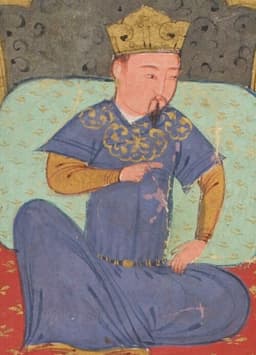
Batu Khan
Emperor · Medieval
64.8Total

Julius Caesar
General · Ancient
82.8Total
Basic Information
Born
1207
-100
Died
1255
-44
Era
Medieval
Ancient
Nationality
Golden Horde
Roman Republic
Occupation
Emperor
General
Civilization
Eastern
Western
Score Comparison
Military (10%)
79.9
88.0
Political (20%)
55.0
78.0
Influence (20%)
68.0
85.0
Legacy (20%)
55.0
82.0
Leadership (15%)
72.0
80.0
Strategy (15%)
70.0
85.0
TOTAL
64.8
82.8
Batu Khan — Complete Timeline
1223 AD
Battle of the Kalka RiverWar◆ Major
Batu Khan, as a subordinate commander under Subutai, participated in the Mongol victory over a coalition of Rus' princes and Cumans at the Kalka River. This battle was a precursor to the full-scale invasion of the Rus' lands.
Mongol EmpireKievan Rus'BattleCumans
Impact: regional
1240 AD
Sack of KievWar
Batu Khan led the Mongol army in the siege and sack of Kiev, the capital of the Kievan Rus'. The city was destroyed, and its population was massacred. This event marked the subjugation of the Rus' principalities to Mongol rule.
Mongol EmpireKievan Rus'SiegeDestruction
Impact: globaldestructive
1241 AD
Invasion of Hungary and PolandWar◆ Major
Batu Khan led the Mongol invasion of Central Europe, defeating the Hungarian army at the Battle of Mohi and the Polish army at the Battle of Legnica. The campaign devastated Hungary and Poland before the Mongols withdrew due to the death of
Mongol EmpireHungaryPolandInvasion
Impact: globaldestructive
1242 AD
Foundation of the Golden HordePolitical Action
After the Mongol invasion of Europe, Batu Khan established the Golden Horde, a khanate that controlled the western part of the Mongol Empire. The Golden Horde's territory stretched from the Ural Mountains to the Danube River, with Sarai as its capital.
Mongol EmpireGolden HordeFoundationSarai
Impact: global
Julius Caesar — Complete Timeline
58 BC
Gallic WarsWar◆ Major
Caesar, as proconsul of Gaul, launched a series of campaigns that conquered all of Gaul (modern France, Belgium, and parts of Switzerland). He fought numerous battles, including against the Helvetii, the Belgae, and the Gallic chieftain Vercingetorix. The wars brought immense wealth and a loyal army to Caesar.
Gallic WarsConquestRoman Expansion
Impact: regional
49 BC
Crossing the RubiconPolitical Action◆ Major
Caesar led Legio XIII across the Rubicon River into Italy, defying the Roman Senate's order to disband his army. This act triggered a civil war against Pompey and the Optimates, ultimately leading to Caesar's dictatorship and the end of the Roman Republic.
Roman Civil WarEnd of RepublicPower Struggle
Impact: global
48 BC
Battle of PharsalusWar◆ Major
Caesar's outnumbered army defeated the larger forces of Pompey the Great at Pharsalus in Greece. Caesar's tactical use of a reserve line to counter Pompey's cavalry charge proved decisive. Pompey fled to Egypt, where he was assassinated, leaving Caesar as the undisputed master of the Roman world.
Roman Civil WarBattleDecisive Victory
Impact: regional
44 BC
Appointment as Dictator for LifePolitical Action◆ Major
The Roman Senate appointed Caesar dictator perpetuo (dictator for life), granting him unprecedented personal power. This move concentrated military, legislative, and judicial authority in one person, effectively ending the Roman Republic's traditional system of checks and balances and alarming many senators.
DictatorshipEnd of RepublicPower Consolidation
Impact: regionaldestructive
Assassination on the Ides of MarchPolitical Action◆ Major
A group of Roman senators, led by Marcus Junius Brutus and Gaius Cassius Longinus, stabbed Caesar to death at a meeting of the Senate in the Theatre of Pompey. The assassination was intended to restore the Republic, but instead triggered another civil war that led to the rise of the Roman Empire.
AssassinationRoman PoliticsEnd of Republic
Impact: globaldestructive
Expert Analysis
batu-khan-vs-julius-caesar
The Rubicon and the Volga
On a January morning in 49 BCE, Julius Caesar stood at the banks of a small river in northern Italy, the Rubicon. He knew that crossing it with his legions would mean civil war—a gamble for supreme power that could end in his execution or the destruction of the Roman Republic. On an autumn day in 1240, Batu Khan watched his Mongol horsemen surround the golden-domed city of Kiev. He knew that taking it would open the door to Europe—a conquest that would stretch his empire from the steppes of Asia to the plains of Hungary. Both men stood at thresholds of history, but their paths could not have been more different. One would transform the ancient world and die by the daggers of his friends; the other would build a kingdom that endured for centuries, yet remain a shadow in the Western imagination. Why did these two conquerors—each a master of war and politics—meet such different fates?
Origins
Julius Caesar was born into the patrician class of Rome in 100 BCE, but his family was neither wealthy nor powerful. The Republic he inherited was a cauldron of ambition: senators bribed voters, generals raised private armies, and the old aristocratic order was crumbling under the weight of empire. Caesar’s uncle by marriage, Gaius Marius, had been a populist reformer; his rival, Sulla, a brutal dictator. From childhood, Caesar understood that in Rome, survival meant not just playing the game, but rewriting its rules.
Batu Khan was born in 1207 on the Mongolian steppe, the grandson of Genghis Khan. His father, Jochi, was the eldest son of the Great Khan, but his legitimacy was always questioned—rumors whispered that Jochi was not Genghis’s blood. Batu inherited this stain. In Mongol society, where lineage was everything, he was an outsider within the ruling family. The steppe taught him patience and ruthlessness: he learned to wait for his moment, to let others exhaust themselves, and to strike when the iron was cold.
Rise to Power
Caesar’s ascent was a masterpiece of calculated risk. He borrowed fortunes to bribe his way into the office of pontifex maximus, then used a governorship in Spain to pay his debts with plunder. In 60 BCE, he formed the First Triumvirate with Pompey and Crassus—two men who thought they could use him. Instead, Caesar used them to secure command in Gaul. Over eight years (58–50 BCE), he conquered a territory larger than Italy, wrote his own propaganda in *Commentarii de Bello Gallico*, and trained an army that loved him more than the Senate.
Batu’s rise was quieter, but no less strategic. In 1223, at just sixteen, he fought at the Battle of the Kalka River under the legendary general Subutai, where the Mongols annihilated a coalition of Rus’ princes. But Batu was not the architect of that victory—Subutai was. For years, Batu served as a loyal subordinate, learning war from the greatest commander of his age. When Genghis died in 1227, the empire was divided among his sons. Batu’s father was dead, so he inherited the westernmost lands—a vast, empty claim that meant little until he could fill it with conquest.
Leadership & Governance
Caesar ruled through speed and charisma. He fought battles with such breathtaking rapidity—sometimes winning a war in a single campaign season—that his enemies never had time to unite. As dictator, he reformed the calendar, granted citizenship to Gauls, and began building public works. But his governance was a paradox: he centralized power while undermining the Senate, yet he pardoned his enemies. “I have lived long enough,” he once said, “both in years and in accomplishments.” His political score of 78 reflects a man who understood power but not its limits.
Batu ruled through patience and pragmatism. After sacking Kiev in 1240 and crushing Hungary at the Battle of Mohi in 1241, he had all of Europe at his mercy. But when the Great Khan Ögedei died, Batu withdrew—not from fear, but from calculation. He established the Golden Horde, a khanate that taxed Russian princes rather than occupying their lands. He was a conqueror who knew that ruling from horseback was impossible; instead, he let local elites govern, so long as they paid tribute. His political score of 72 is lower than Caesar’s, but his empire lasted far longer.
Triumph & Tragedy
Caesar’s greatest moment was his triumph over Pompey at Pharsalus in 48 BCE, where he defeated a larger army with veteran legions. His tragedy was the Ides of March, 44 BCE: stabbed twenty-three times by senators he had pardoned, including his protégé Brutus. “Et tu, Brute?”—whether he said it or not, the words capture the betrayal.
Batu’s triumph was the sack of Kiev, a city so rich that its destruction sent shockwaves across Europe. His tragedy was that he never became Great Khan. Despite his victories, the Mongol succession passed him by. He died in 1255, possibly poisoned by rivals, leaving a Golden Horde that would slowly fragment.
Character & Destiny
Caesar was a gambler. He crossed the Rubicon knowing it meant war, but he also believed in his own luck. His personality—arrogant, generous, and calculating—drove him to reach for absolute power, but it also blinded him to the resentment he sowed. He believed he could charm his enemies into submission; instead, he gave them the dagger.
Batu was a strategist. He knew when to advance and when to retreat. His personality—patient, ruthless, and pragmatic—allowed him to build a durable state. But his caution also cost him the ultimate prize: the Mongol throne. He was a man who conquered half a continent yet remained in the shadow of his grandfather.
Legacy
Caesar’s legacy is the Roman Empire. His name became synonymous with autocracy—*Kaiser* in German, *Tsar* in Russian. His writings shaped Western military thought for two millennia. Yet his assassination proved that even genius cannot escape the forces it unleashes.
Batu’s legacy is the Golden Horde, which ruled Russia for 250 years. He is remembered in Eastern Europe as a destroyer, but also as a founder. His Mongol state reshaped the trade routes of Eurasia, linking China to the Black Sea. Yet in the West, he is almost forgotten—a footnote to Caesar’s epic.
Conclusion
Standing at the Rubicon and the Dnieper, Caesar and Batu faced the same choice: to cross or not to cross. Caesar crossed, and changed the world in a blaze of glory and blood. Batu crossed, and built an empire that endured in silence. One became a legend; the other, a ghost. Perhaps the difference is not in what they achieved, but in who told their story. Caesar wrote his own; Batu left that to others. In the end, history belongs not to the conquerors, but to the storytellers.
Rankings
🥇
Julius CaesarLeader
Mil: 88.0Pol: 78.0Inf: 85.0
82.8
🥈
Batu Khan
Mil: 79.9Pol: 55.0Inf: 68.0
64.8
+18.0 behind
How This Comparison Works
Algorithm
Each figure is scored on 6 dimensions (0—100 scale) based on structured historical data: Military (10%), Political (20%), Influence (20%), Legacy (20%), Leadership (15%), Strategy (15%). The weighted total produces the final ranking.
Data Sources
Scores are computed from structured sub-indicators in the database. Scale factors adjust for era (Ancient ×0.85, Modern ×1.0) and civilization size (Eastern ×1.05, Other ×0.80) to account for differences in population and military scale.
Maximum 3 Figures
Comparisons are limited to 2—3 figures to ensure readability and statistical meaningfulness.
Error Margins
±5 points per dimension — Sub-scores are derived from historical records with inherent uncertainty. Two figures within 5 points on a dimension should be considered roughly equivalent in that area.
Total Score Accuracy
±3 points overall — The weighted combination of 6 dimensions produces a total score with approximately ±3 points of uncertainty. Differences of less than 3 points are not statistically significant— the figures are effectively tied.
Known Limitations
- Historical records are incomplete and uneven across civilizations
- Figures from oral-tradition societies may be underrepresented
- Occupation labels can misclassify multi-role figures
- Scores measure capability and impact, not moral character
- Quantitative scoring is a comparison tool, not absolute truth
Capability Radar
Military (10%) — Battles & Warfare
Battles
85
95
Win Rate
88
92
Expansion
90
97
Political (20%) — Governance & Reform
Reform
70
90
Diplomacy
75
85
Economy
70
82
Influence (20%) — Cultural & Global Reach
Cultural
60
88
Global
75
94
Legacy (20%) — Historical Impact
Historical
75
95
Longevity
70
96
Leadership (15%) — Power & Stability
Tenure
75
75
Stability
65
60
Strategy (15%) — Tactics & Innovation
Strategy
85
94
Tactics
80
96
Reform
70
88
Similar Comparisons
Comments & Discussion
StampedeShaman6/17/2026
Comparing Batu Khan to Caesar is like comparing a wildfire to a surgical strike. Caesar's crossing of the Rubicon was a constitutional crisis—he gambled on clemency and the rule of law, even as he broke it. Batu's siege of Kiev was pure extermination. Yes, Batu built a lasting empire, but he left ashes, not *De Bello Gallico*. Caesar wrote history; Batu just erased it. Give me the author of history over its eraser any day.
铁蹄遗风6/17/2026
别拿恺撒的元老院戏码去碰瓷拔都的上帝之鞭。恺撒跨过卢比孔河时,还想着跟庞培谈判呢,而拔都在基辅城下连话都懒得说——直接用投石机把城墙砸成齑粉。你说拔都的帝国更持久?那是蒙古人用屠城和断粮铸成的冰墙,冷得连太阳都照不暖。恺撒至少留下了罗马法和拉丁文,拔都留下了一堆没人想学的中亚方言。
StatCounter6/17/2026
I see no strategic parity here—Caesar's "conquest" of Gaul was a slow, debt-fueled genocide that nearly bankrupted Rome, while Batu's sweep into Europe was a rapid, self-financing raid. The "White Horde" didn't even try to govern Hungary; they extracted tribute and vanished. Caesar's longevity in the Western canon is pure propaganda—think Shakespeare and imperialist nostalgia. Batu's obscurity is more honest: he conquered, plundered, and left no delusions about "civilization."
北地孤狼6/17/2026
你们都在比较“为什么西方更记得恺撒”,那是因为欧洲的叙事霸权在作祟。拔都的金帐汗国统治东欧两百年,影响比恺撒的十三年独裁深远得多——鞑靼桎梏重塑了俄罗斯的民族性格,而恺撒不过是在罗马的坟墓上多添了一层涂鸦。你们敢不敢让基辅人投票:愿意被恺撒“文明化”还是被拔都“鞑靼化”?后者至少没强迫你信他们的神。
ClassicsChisel6/17/2026
Apples and horse archers. Caesar's genius was institutional—he invented dictatorship's PR machine. Batu's genius was logistical—he coordinated tumens across half a continent without radios. But here's the kicker: Caesar's legacy is *written* (his Commentarii, Plutarch, Shakespeare), while Batu's is *fossilized* (trade routes, census systems, the Yam postal network). The West remembers Caesar because he wrote his own press releases. Batu just sent riders. Which matters more? I'd say the rider who