Loading...
Basil II vs Julius Caesar
Julius Caesar leads by 19.0 pts · 2 figures compared
…
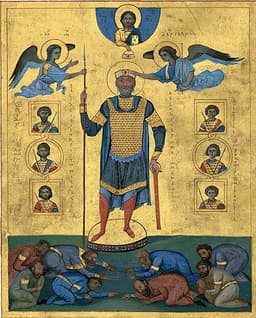
Basil II
Emperor · Medieval
63.8Total

Julius Caesar
General · Ancient
82.8Total
Basic Information
Born
958
-100
Died
1025
-44
Era
Medieval
Ancient
Nationality
Byzantine Empire
Roman Republic
Occupation
Emperor
General
Civilization
Western
Western
Score Comparison
Military (10%)
85.0
88.0
Political (20%)
59.3
78.0
Influence (20%)
56.7
85.0
Legacy (20%)
55.0
82.0
Leadership (15%)
78.0
80.0
Strategy (15%)
68.0
85.0
TOTAL
63.8
82.8
Basil II — Complete Timeline
986 AD
Battle of the Gates of TrajanWar◆ Major
Basil II led an invasion of Bulgaria but was ambushed and defeated at the Gates of Trajan pass. The Byzantine army was routed, and Basil barely escaped. This defeat forced him to adopt a more cautious strategy and delayed the conquest of Bulgaria.
Byzantine-Bulgarian WarsDefeatAmbush
Impact: regionaltragic
1000 AD
Reforms of the Military and Land SystemReform◆ Major
Basil II implemented reforms to strengthen the Byzantine military and economy. He increased the size of the army, improved fortifications, and curbed the power of the landed aristocracy by enforcing laws against the accumulation of large estates. These measures stabilized the empire.
Military ReformLand ReformByzantine Empire
Impact: nationalconstructive
1014 AD
Battle of KleidionWar
Basil II decisively defeated the Bulgarian army at the Battle of Kleidion. After the victory, he blinded 15,000 Bulgarian prisoners, leaving one in every hundred with one eye to lead them home. This earned him the epithet 'Bulgar-Slayer' and broke Bulgarian resistance.
Byzantine-Bulgarian WarsMass BlindingBulgar-Slayer
Impact: regionaldestructive
1018 AD
Annexation of BulgariaWar◆ Major
Following the death of Bulgarian Tsar Samuel and the collapse of Bulgarian resistance, Basil II formally annexed the First Bulgarian Empire into the Byzantine Empire. He established the Theme of Bulgaria, integrating the territory and ending the long war.
AnnexationBulgariaByzantine Expansion
Impact: regionalconstructive
Julius Caesar — Complete Timeline
58 BC
Gallic WarsWar◆ Major
Caesar, as proconsul of Gaul, launched a series of campaigns that conquered all of Gaul (modern France, Belgium, and parts of Switzerland). He fought numerous battles, including against the Helvetii, the Belgae, and the Gallic chieftain Vercingetorix. The wars brought immense wealth and a loyal army to Caesar.
Gallic WarsConquestRoman Expansion
Impact: regional
49 BC
Crossing the RubiconPolitical Action◆ Major
Caesar led Legio XIII across the Rubicon River into Italy, defying the Roman Senate's order to disband his army. This act triggered a civil war against Pompey and the Optimates, ultimately leading to Caesar's dictatorship and the end of the Roman Republic.
Roman Civil WarEnd of RepublicPower Struggle
Impact: global
48 BC
Battle of PharsalusWar◆ Major
Caesar's outnumbered army defeated the larger forces of Pompey the Great at Pharsalus in Greece. Caesar's tactical use of a reserve line to counter Pompey's cavalry charge proved decisive. Pompey fled to Egypt, where he was assassinated, leaving Caesar as the undisputed master of the Roman world.
Roman Civil WarBattleDecisive Victory
Impact: regional
44 BC
Appointment as Dictator for LifePolitical Action◆ Major
The Roman Senate appointed Caesar dictator perpetuo (dictator for life), granting him unprecedented personal power. This move concentrated military, legislative, and judicial authority in one person, effectively ending the Roman Republic's traditional system of checks and balances and alarming many senators.
DictatorshipEnd of RepublicPower Consolidation
Impact: regionaldestructive
Assassination on the Ides of MarchPolitical Action◆ Major
A group of Roman senators, led by Marcus Junius Brutus and Gaius Cassius Longinus, stabbed Caesar to death at a meeting of the Senate in the Theatre of Pompey. The assassination was intended to restore the Republic, but instead triggered another civil war that led to the rise of the Roman Empire.
AssassinationRoman PoliticsEnd of Republic
Impact: globaldestructive
Expert Analysis
basil-ii-vs-julius-caesar
# The Dictator and the Emperor
On the Ides of March, 44 BCE, Julius Caesar fell beneath twenty-three dagger strokes in the Senate chamber of Rome. A thousand years later, in 1025, Basil II died peacefully in his bed at the age of sixty-seven, having ruled the Byzantine Empire for nearly half a century. These two men, both towering figures of Western civilization, both generals who expanded their realms to unprecedented size, met vastly different ends. What drove Caesar to assassination and Basil to a quiet death? The answer lies not merely in their circumstances, but in the very fabric of their characters and the worlds they inhabited.
Origins
Julius Caesar was born into the twilight of the Roman Republic, a world of senatorial competition, civil strife, and crumbling traditions. His family, the Julii, claimed descent from the goddess Venus, but they were politically marginal. Rome in the first century BCE was a republic in name only, dominated by a narrow oligarchy that resisted change with ferocious tenacity. Caesar grew up watching his uncle Marius and his rival Sulla wage bloody civil wars, lessons in ambition and ruthlessness that would shape his entire career.
Basil II entered a very different world. Born in 958 CE, he was the son of Emperor Romanos II, inheriting a Byzantine Empire that, though diminished from Justinian's glory days, remained the most sophisticated state in Christendom. The empire was a sacred autocracy, where emperor and patriarch ruled together under God's authority. Basil's childhood was marked by instability—his father died when he was five, his mother was exiled, and for years he was a puppet of powerful courtiers and generals. This early powerlessness forged in him a cold, patient, and utterly unyielding temperament.
Rise to Power
Caesar's path was one of calculated risk. He climbed the Roman political ladder—the *cursus honorum*—through a combination of bribery, marriage alliances, and military command. His conquest of Gaul between 58 and 50 BCE made him fabulously rich and gave him a loyal army. But the Senate, led by his rival Pompey, demanded he return to Rome as a private citizen, stripped of his legions. Caesar chose war. When he crossed the Rubicon River in 49 BCE, he famously declared, "The die is cast." Within five years, he had defeated all his enemies and made himself dictator for life.
Basil II's rise was slower and more painful. He became co-emperor as a child but only began to rule in earnest after crushing a rebellion by the general Bardas Skleros in 979. Another revolt, led by Bardas Phokas in 987, nearly toppled him. Basil's response was methodical: he allied with the Rus' prince Vladimir in exchange for military aid and the conversion of the Rus' to Christianity. By 989, he had eliminated his rivals. Unlike Caesar, who seized power in a blaze of glory, Basil consolidated it through years of patient maneuvering and cold calculation.
Leadership & Governance
Caesar governed as a reformer and a revolutionary. He centralized authority, reformed the calendar, granted citizenship to provincials, and initiated massive building projects. His military genius was unquestioned—he conquered Gaul, invaded Britain, and defeated Pompey's superior forces in Greece. Yet his style was dangerously personal. He accepted divine honors, placed his image on coins, and treated the Senate with contempt. He once remarked that "the Republic is nothing, a mere name without body or form." This arrogance united his enemies.
Basil II governed as an emperor of iron discipline. He reformed the Byzantine military and land system around the year 1000, increasing the army's size and improving its supply lines. He personally led campaigns, sleeping on the ground with his soldiers and eating their rations. His political wisdom was that of a survivor: he broke the power of the great aristocratic families, curbed the influence of the church, and filled his administration with loyal, capable men. He never married, fearing that a powerful wife or son might challenge his authority. Where Caesar was charismatic and expansive, Basil was austere and focused.
Triumph & Tragedy
Caesar's greatest triumph was his conquest of Gaul, which added a vast, wealthy province to Rome and gave him the army that would make him master of the Republic. His tragedy was his assassination. On the Ides of March, 44 BCE, a conspiracy of senators, many of whom he had pardoned, stabbed him to death. His last words, according to tradition, were "Et tu, Brute?"—"And you, Brutus?" The Republic he had destroyed died with him, replaced by the empire he had unwittingly created.
Basil's greatest triumph was the Battle of Kleidion in 1014, where he decisively defeated the Bulgarian army. His tragedy was the horror that followed: he ordered the blinding of 15,000 Bulgarian prisoners, leaving one man in every hundred with one eye to lead the others back to their tsar. When Tsar Samuel saw the column of blind men, he died of shock. Basil earned the epithet "Bulgar-Slayer," a name that has haunted his legacy ever since. Yet his triumph was complete: by 1018, he annexed Bulgaria entirely, restoring the Danube frontier that had been lost for centuries.
Character & Destiny
Caesar was a gambler. He trusted his luck, his charm, and his genius. He pardoned his enemies, believing that generosity would win their loyalty. It did not. His character—bold, brilliant, and recklessly overconfident—led him to believe he could control the forces he had unleashed. He was wrong.
Basil was a calculator. He trusted nothing and no one. He never forgot a slight and never forgave a rival. His character—cold, patient, and utterly ruthless—allowed him to survive where Caesar perished. He understood that in an autocracy, there is no middle ground: either you destroy your enemies, or they destroy you.
Legacy
Caesar's legacy is immense. His name became synonymous with imperial power—"Caesar" evolved into "Kaiser" and "Tsar." His writings, especially his *Commentaries on the Gallic War*, remain classics of military literature. He transformed Rome from a republic into an empire, for better and for worse. He is remembered as a genius and a tyrant, a reformer and a destroyer.
Basil II's legacy is narrower but deeper within the Byzantine world. He restored the empire's military supremacy and expanded its borders to their greatest extent since the Arab conquests. But his empire did not long survive him. His successors, lacking his iron will, squandered his gains. He is remembered as a saint in the Eastern Orthodox Church, yet also as a figure of terrifying cruelty. His epitaph reads: "From the day that the Emperor of Heaven called me to be the ruler of the empire, I never rested."
Conclusion
Caesar and Basil II both ruled with absolute power, both expanded their realms through military genius, and both left indelible marks on Western civilization. Yet Caesar died by the sword, while Basil died in his bed. The difference was not luck but character. Caesar lived in a world where power was contested, where rivals could still gather in a Senate chamber. Basil lived in a world where the emperor was God's viceroy, where dissent was heresy. Caesar failed because he tried to transform a republic into a monarchy too quickly, trusting that his brilliance could overcome the resistance of ancient institutions. Basil succeeded because he understood that in an autocracy, there is no room for mercy or trust—only the cold, relentless application of power. Their stories remind us that history's greatest figures are not merely products of their times, but also of their choices, their virtues, and their fatal flaws.
Rankings
🥇
Julius CaesarLeader
Mil: 88.0Pol: 78.0Inf: 85.0
82.8
🥈
Basil II
Mil: 85.0Pol: 59.3Inf: 56.7
63.8
+19.0 behind
How This Comparison Works
Algorithm
Each figure is scored on 6 dimensions (0—100 scale) based on structured historical data: Military (10%), Political (20%), Influence (20%), Legacy (20%), Leadership (15%), Strategy (15%). The weighted total produces the final ranking.
Data Sources
Scores are computed from structured sub-indicators in the database. Scale factors adjust for era (Ancient ×0.85, Modern ×1.0) and civilization size (Eastern ×1.05, Other ×0.80) to account for differences in population and military scale.
Maximum 3 Figures
Comparisons are limited to 2—3 figures to ensure readability and statistical meaningfulness.
Error Margins
±5 points per dimension — Sub-scores are derived from historical records with inherent uncertainty. Two figures within 5 points on a dimension should be considered roughly equivalent in that area.
Total Score Accuracy
±3 points overall — The weighted combination of 6 dimensions produces a total score with approximately ±3 points of uncertainty. Differences of less than 3 points are not statistically significant— the figures are effectively tied.
Known Limitations
- Historical records are incomplete and uneven across civilizations
- Figures from oral-tradition societies may be underrepresented
- Occupation labels can misclassify multi-role figures
- Scores measure capability and impact, not moral character
- Quantitative scoring is a comparison tool, not absolute truth
Capability Radar
Military (10%) — Battles & Warfare
Battles
85
95
Win Rate
90
92
Expansion
80
97
Political (20%) — Governance & Reform
Reform
80
90
Diplomacy
70
85
Economy
75
82
Influence (20%) — Cultural & Global Reach
Cultural
60
88
Global
65
94
Legacy (20%) — Historical Impact
Historical
75
95
Longevity
70
96
Leadership (15%) — Power & Stability
Tenure
85
75
Stability
80
60
Strategy (15%) — Tactics & Innovation
Strategy
85
94
Tactics
80
96
Reform
75
88
Similar Comparisons
Comments & Discussion
No comments yet. Be the first to share your thoughts!