Loading...
Basarab I vs Julius Caesar
Julius Caesar leads by 27.7 pts · 2 figures compared
…
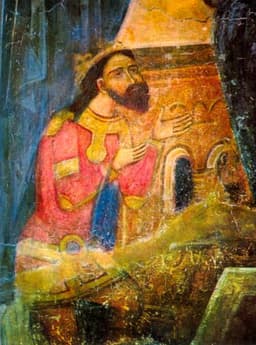
Basarab I
Emperor · Medieval
55.1Total

Julius Caesar
General · Ancient
82.8Total
Basic Information
Born
1271
-100
Died
1352
-44
Era
Medieval
Ancient
Nationality
Wallachia
Roman Republic
Occupation
Emperor
General
Civilization
Western
Western
Score Comparison
Military (10%)
47.5
88.0
Political (20%)
54.7
78.0
Influence (20%)
56.4
85.0
Legacy (20%)
50.0
82.0
Leadership (15%)
65.0
80.0
Strategy (15%)
57.5
85.0
TOTAL
55.1
82.8
Basarab I — Complete Timeline
1310 AD
Founded the Principality of WallachiaPolitical Action◆ Major
Basarab I unified the Romanian lands east of the Olt River and south of the Carpathians, establishing the independent principality of Wallachia. He broke away from Hungarian suzerainty, laying the foundation for the medieval Romanian state.
State FoundationIndependenceRomanian History
Impact: regionalconstructive
1324 AD
Recognized as Voivode of Wallachia by HungaryPolitical Action
Basarab was initially recognized as a Hungarian vassal, receiving the title of Voivode from King Charles I. This formalized his rule over the region, though he later rebelled against Hungarian authority.
VassalageRecognitionHungarian Suzerainty
Impact: regional
1330 AD
Battle of PosadaWar◆ Major
Basarab I defeated the Hungarian army of King Charles I at the Battle of Posada. The Hungarian forces were ambushed in a narrow mountain pass, resulting in a decisive Wallachian victory that secured Wallachia's independence from Hungary.
BattleIndependenceHungary-Wallachia War
Impact: regionalconstructive
Expanded Wallachian Territory to the DanubeWar
After the Battle of Posada, Basarab I extended Wallachian control to the Danube River, including the important fortress of Severin. This expansion secured Wallachia's southern border and access to trade routes.
Territorial ExpansionDanubeFortress
Impact: regionalconstructive
Julius Caesar — Complete Timeline
58 BC
Gallic WarsWar◆ Major
Caesar, as proconsul of Gaul, launched a series of campaigns that conquered all of Gaul (modern France, Belgium, and parts of Switzerland). He fought numerous battles, including against the Helvetii, the Belgae, and the Gallic chieftain Vercingetorix. The wars brought immense wealth and a loyal army to Caesar.
Gallic WarsConquestRoman Expansion
Impact: regional
49 BC
Crossing the RubiconPolitical Action◆ Major
Caesar led Legio XIII across the Rubicon River into Italy, defying the Roman Senate's order to disband his army. This act triggered a civil war against Pompey and the Optimates, ultimately leading to Caesar's dictatorship and the end of the Roman Republic.
Roman Civil WarEnd of RepublicPower Struggle
Impact: global
48 BC
Battle of PharsalusWar◆ Major
Caesar's outnumbered army defeated the larger forces of Pompey the Great at Pharsalus in Greece. Caesar's tactical use of a reserve line to counter Pompey's cavalry charge proved decisive. Pompey fled to Egypt, where he was assassinated, leaving Caesar as the undisputed master of the Roman world.
Roman Civil WarBattleDecisive Victory
Impact: regional
44 BC
Appointment as Dictator for LifePolitical Action◆ Major
The Roman Senate appointed Caesar dictator perpetuo (dictator for life), granting him unprecedented personal power. This move concentrated military, legislative, and judicial authority in one person, effectively ending the Roman Republic's traditional system of checks and balances and alarming many senators.
DictatorshipEnd of RepublicPower Consolidation
Impact: regionaldestructive
Assassination on the Ides of MarchPolitical Action◆ Major
A group of Roman senators, led by Marcus Junius Brutus and Gaius Cassius Longinus, stabbed Caesar to death at a meeting of the Senate in the Theatre of Pompey. The assassination was intended to restore the Republic, but instead triggered another civil war that led to the rise of the Roman Empire.
AssassinationRoman PoliticsEnd of Republic
Impact: globaldestructive
Expert Analysis
basarab-i-vs-julius-caesar
# The Dictator and the Founder
On a March morning in 44 BCE, the most powerful man in the Roman world lay bleeding at the foot of a statue of his rival Pompey, stabbed twenty-three times by senators he had once called friends. A thousand miles away and thirteen centuries later, another ruler died in his bed, having outmaneuvered a king on a mountain pass and built a nation from scattered fragments of land. Julius Caesar and Basarab I both rose from turbulent times to reshape the world around them. One built an empire that would echo through millennia; the other founded a principality that would endure for centuries. The question is not who was greater—the scores tell that story plainly enough, with Caesar’s total of 83.3 dwarfing Basarab’s 66.5—but why their paths diverged so dramatically, and what that tells us about the nature of power itself.
Origins
Caesar was born into the patrician Julian clan, a family that traced its lineage to the goddess Venus but had lost much of its political clout by the first century BCE. He grew up in a Rome convulsed by civil wars, slave revolts, and the collapse of republican norms. His uncle by marriage was Gaius Marius, a populist general who had defied the Senate and set a dangerous precedent: that military loyalty could override constitutional order. Caesar learned early that in Rome, the sword spoke louder than the law.
Basarab I emerged from a very different world. The late thirteenth century found the Carpathian Basin dominated by the Kingdom of Hungary, while the lands between the Carpathians and the Danube were a patchwork of petty Romanian voivodeships, often paying tribute to the Mongol Golden Horde. Basarab’s father, Thocomerius, had been a local ruler of uncertain status. Basarab himself appears in historical records only in 1324, when King Charles I of Hungary recognized him as Voivode of Wallachia—a formal acknowledgment of vassalage. Where Caesar inherited a name and a tradition of ambition, Basarab inherited a title that meant little more than permission to collect taxes for a foreign king.
Rise to Power
Caesar’s ascent was a masterpiece of calculated risk. He borrowed fortunes to fund public spectacles, built alliances with the wealthy Crassus and the popular Pompey, and spent eight years conquering Gaul—a campaign that made him both fabulously rich and dangerously popular with his legions. When the Senate ordered him to disband his army, he crossed the Rubicon River in 49 BCE, a act of war that launched a civil war from which he emerged as dictator. His rise was ruthless, brilliant, and utterly illegal by the old republican standards.
Basarab’s path was quieter but no less decisive. For six years after his recognition as voivode, he consolidated control over the Romanian lands east of the Olt River and south of the Carpathians. In 1310, he formally founded the Principality of Wallachia, unifying territories that had never before been governed as a single state. This was not a conquest but an act of political creation—a declaration that the scattered Romanian voivodeships were now one nation. The Hungarian king, preoccupied with his own wars, initially let it pass. But by 1330, Charles I realized what Basarab had done and marched south with a large army to crush the upstart.
Leadership & Governance
Caesar governed as a revolutionary. He reformed the calendar, granted citizenship to provincials, started public works projects, and packed the Senate with his supporters. His military strategy was aggressive and innovative: at Alesia in 52 BCE, he built a ring of fortifications around a Gallic army while simultaneously building an outer ring to hold off a relief force—a double siege that remains a textbook example of tactical genius. Yet his political wisdom was flawed. He accumulated honors recklessly, accepted the title “dictator for life,” and treated the Senate with contempt. He seems to have believed that his personal popularity could substitute for institutional reform.
Basarab governed as a survivor. His military strategy at the Battle of Posada in 1330 was the opposite of Caesar’s grand set-piece battles. He drew the Hungarian army deep into the Carpathian passes, then ambushed them from the wooded slopes. Archers and rocks rained down on the trapped knights; King Charles I barely escaped with his life, reportedly disguised as a common soldier. The victory was not about conquest but about deterrence: Basarab wanted the Hungarians to leave him alone. Afterward, he extended Wallachian control to the Danube, but he did not march on Buda. His political wisdom lay in knowing his limits.
Triumph & Tragedy
Caesar’s greatest triumph was his conquest of Gaul, which added a vast territory to the Roman sphere and gave him an army personally loyal to him. His greatest tragedy was his assassination on the Ides of March, 44 BCE—a direct consequence of his refusal to share power. He had pardoned many of his enemies, but he had not forgiven them their dignity. The senators who killed him thought they were saving the Republic; instead, they merely cleared the path for his adopted heir, Octavian, to become Augustus, the first Roman emperor.
Basarab’s greatest triumph was the Battle of Posada, which secured Wallachian independence and made him a legendary figure in Romanian history. His greatest tragedy is that we know so little about him. No contemporary biography survives. His death in 1352 is recorded without fanfare. He founded a state that would last until 1859, but he himself remains a shadowy figure, known primarily through Hungarian chronicles that describe him as a “treacherous” vassal who broke his oath.
Character & Destiny
Caesar was driven by an insatiable need for glory. Plutarch records that he once said, “It is better to be the first man in a poor village than the second man in Rome.” His personality—charismatic, arrogant, and relentlessly ambitious—shaped every decision he made. He could not stop pushing, could not stop winning, could not stop accumulating power until the only way to stop him was murder. His destiny was to destroy the old order and plant the seeds of a new one, even if he did not live to see it flower.
Basarab was driven by a more modest ambition: survival and consolidation. He seems to have been cautious, calculating, and patient. Where Caesar crossed the Rubicon, Basarab waited for the Hungarians to come to him. Where Caesar reformed the calendar, Basarab simply held what he had. His personality was suited to a world where power was local, where a single defeat could erase everything, and where the goal was not to conquer the world but to keep your people free from foreign domination.
Legacy
Caesar’s legacy is immeasurable. His name became synonymous with imperial rule—Kaiser and Tsar both derive from it. His military writings are still studied in war colleges. His reforms shaped the Roman Empire, which in turn shaped Western civilization. But his legacy is also tragic: he proved that republican institutions could not survive a general with a loyal army, a lesson that has haunted democracies ever since.
Basarab’s legacy is more contained but no less real. He is remembered as the founder of Wallachia, the first Romanian state. The battle of Posada is a cornerstone of Romanian national identity, a symbol of resistance against foreign domination. His scores reflect this: a political score of 75.1 and a leadership score of 83.7, both higher than his military or strategic ratings. He was not a great conqueror; he was a great founder.
Conclusion
Standing back, the contrast is almost painful. Caesar was a genius of war and politics who died a failure, stabbed by the very men he had tried to win over. Basarab was a provincial lord who succeeded beyond any reasonable expectation, dying in peace after founding a nation. The difference is not in their talent but in their context. Caesar lived in a world where the old rules were breaking down and the prize was an empire; Basarab lived in a world where the rules were fixed and the prize was simply to exist. One reached for everything and lost everything; the other reached for enough and gained everything. Which of them was wiser? That is a question that history, in its infinite ambiguity, refuses to answer.
Rankings
🥇
Julius CaesarLeader
Mil: 88.0Pol: 78.0Inf: 85.0
82.8
🥈
Basarab I
Mil: 47.5Pol: 54.7Inf: 56.4
55.1
+27.7 behind
How This Comparison Works
Algorithm
Each figure is scored on 6 dimensions (0—100 scale) based on structured historical data: Military (10%), Political (20%), Influence (20%), Legacy (20%), Leadership (15%), Strategy (15%). The weighted total produces the final ranking.
Data Sources
Scores are computed from structured sub-indicators in the database. Scale factors adjust for era (Ancient ×0.85, Modern ×1.0) and civilization size (Eastern ×1.05, Other ×0.80) to account for differences in population and military scale.
Maximum 3 Figures
Comparisons are limited to 2—3 figures to ensure readability and statistical meaningfulness.
Error Margins
±5 points per dimension — Sub-scores are derived from historical records with inherent uncertainty. Two figures within 5 points on a dimension should be considered roughly equivalent in that area.
Total Score Accuracy
±3 points overall — The weighted combination of 6 dimensions produces a total score with approximately ±3 points of uncertainty. Differences of less than 3 points are not statistically significant— the figures are effectively tied.
Known Limitations
- Historical records are incomplete and uneven across civilizations
- Figures from oral-tradition societies may be underrepresented
- Occupation labels can misclassify multi-role figures
- Scores measure capability and impact, not moral character
- Quantitative scoring is a comparison tool, not absolute truth
Capability Radar
Military (10%) — Battles & Warfare
Battles
45
95
Win Rate
60
92
Expansion
50
97
Political (20%) — Governance & Reform
Reform
45
90
Diplomacy
55
85
Economy
40
82
Influence (20%) — Cultural & Global Reach
Cultural
40
88
Global
30
94
Legacy (20%) — Historical Impact
Historical
55
95
Longevity
50
96
Leadership (15%) — Power & Stability
Tenure
50
75
Stability
50
60
Strategy (15%) — Tactics & Innovation
Strategy
50
94
Tactics
55
96
Reform
40
88
Similar Comparisons
Comments & Discussion
No comments yet. Be the first to share your thoughts!