Loading...
Barkat Gourad Hamadou vs Charan Singh
Barkat Gourad Hamadou leads by 2.7 pts · 2 figures compared
…
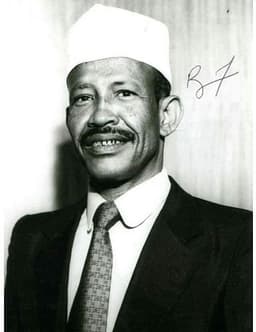
Barkat Gourad Hamadou
Politician · Modern
49.5Total

Charan Singh
Politician · Modern
46.8Total
Basic Information
Born
1930
1902
Died
—
1987
Era
Modern
Modern
Nationality
Djibouti
India
Occupation
Politician
Politician
Civilization
Other
Indian
Score Comparison
Military (10%)
33.1
37.0
Political (20%)
61.3
45.1
Influence (20%)
47.1
51.0
Legacy (20%)
40.0
43.3
Leadership (15%)
72.0
45.0
Strategy (15%)
44.1
60.0
TOTAL
49.5
46.8
Barkat Gourad Hamadou — Complete Timeline
1978 AD
Appointed Prime Minister of DjiboutiPolitical Action◆ Major
Barkat Gourad Hamadou was appointed Prime Minister of Djibouti by President Hassan Gouled Aptidon. He served for over 22 years, making him the longest-serving prime minister in Djibouti's history.
LeadershipDjiboutiGovernment
Impact: national
1994 AD
Signed the 1994 Peace Agreement with FRUDPolitical Action◆ Major
Barkat Gourad Hamadou played a key role in negotiating and signing the 1994 peace agreement with the Front for the Restoration of Unity and Democracy (FRUD), ending a three-year rebellion. The agreement brought stability to Djibouti.
Peace AgreementCivil WarDjibouti
Impact: nationalconstructive
2001 AD
Resigned as Prime MinisterPolitical Action◆ Major
Barkat Gourad Hamadou resigned as Prime Minister in 2001, citing health reasons. His resignation marked the end of an era in Djiboutian politics, as he had been a central figure in the government for over two decades.
ResignationPoliticsDjibouti
Impact: national
Charan Singh — Complete Timeline
1967 AD
Championed Farmers' Rights as Chief Minister of Uttar PradeshReform◆ Major
As Chief Minister of Uttar Pradesh, Charan Singh implemented land reforms and debt relief measures for farmers. He introduced policies to reduce the power of landlords and improve the economic condition of small farmers.
Land ReformFarmers RightsUttar Pradesh
Impact: regionalconstructive
Formed the Bharatiya Kranti DalPolitical Action
Charan Singh founded the Bharatiya Kranti Dal, a political party focused on agrarian issues and farmers' interests. The party later merged into the Janata Party and influenced Indian agricultural policy.
Political PartyAgrarian MovementFarmers
Impact: nationalconstructive
1979 AD
Appointed Prime Minister of IndiaPolitical Action◆ Major
Charan Singh became the fifth Prime Minister of India, leading a short-lived coalition government with support from the Indian National Congress. His tenure lasted only 170 days, making it one of the shortest in Indian history.
Indian PoliticsCoalition GovernmentShort Tenure
Impact: national
1980 AD
Resigned as Prime MinisterPolitical Action◆ Major
Charan Singh resigned as Prime Minister after the Indian National Congress withdrew its support, leading to the collapse of his government. He remained as caretaker Prime Minister until fresh elections were held.
Indian PoliticsGovernment CollapseCaretaker
Impact: nationaldestructive
Expert Analysis
Origins
Barkat Gourad Hamadou was born in 1930 in Djibouti City, then French Somaliland. He came from the Issa clan, the same ethnic group as President Hassan Gouled Aptidon. His early career included service in the French colonial administration, where he developed administrative skills and political connections. He studied at the École Normale Supérieure in Paris, gaining a Western education that would shape his pragmatic approach.
Charan Singh was born on December 23, 1902, in Noorpur, Uttar Pradesh, British India, into a middle-class peasant family of the Jat caste. He earned a law degree from Agra College in 1926 and practiced law in Meerut. His rural background deeply influenced his political focus on agrarian issues. He was active in the Indian independence movement, joining the Indian National Congress in 1929.
Rise to Power
Hamadou rose through the ranks of Djibouti's single-party system under President Aptidon. He served as Minister of Health and Social Affairs (1975-1976) and later Minister of Labor and Social Affairs (1976-1978). In 1978, President Aptidon appointed him Prime Minister, a position he held until 2001. His longevity stemmed from his loyalty and ability to manage ethnic tensions in a country divided between Issa and Afar clans.
Charan Singh rose to prominence in Uttar Pradesh politics. He became Chief Minister for the first time in 1967, leading a coalition government. He implemented land reforms and debt relief for farmers, earning him the title "Champion of the Peasants." In 1979, he became Prime Minister of India at the head of a fragile coalition, but his government lasted only 170 days after the Indian National Congress withdrew support.
Leadership & Governance
Hamadou's leadership style was consensus-based and cautious. He focused on stability and economic development, leveraging Djibouti's strategic location as a port and military base. He signed the 1994 Peace Agreement with the Front for the Restoration of Unity and Democracy (FRUD), ending a three-year civil war. His governance prioritized infrastructure projects, including the Djibouti-Addis Ababa railway. He scored 72.0 in leadership, reflecting his ability to maintain power through negotiation.
Charan Singh was a reformer with a confrontational style. As Chief Minister, he introduced the Uttar Pradesh Land Reforms Act, which abolished zamindari (landlord) system and redistributed land to tenants. He also enacted debt relief laws, canceling farmers' debts. However, his tenure as Prime Minister was marked by political instability and an inability to pass significant legislation. His political score of 45.1 reflects his limited national impact.
Triumph & Tragedy
Hamadou's greatest success was his role in ending the Djiboutian Civil War through the 1994 peace agreement, which brought stability to the nation. He also oversaw Djibouti's transition to a multi-party system in 1992. However, his long tenure was criticized for entrenching authoritarianism and corruption. He failed to diversify the economy, leaving Djibouti heavily reliant on foreign aid and military rents.
Charan Singh's triumph was his land reform legislation in Uttar Pradesh, which empowered millions of farmers and reduced rural inequality. He also founded the Bharatiya Kranti Dal, a party devoted to agrarian interests. His tragedy was his failed prime ministership: his coalition collapsed due to poor political management, and he died in 1987 as a marginal figure. His influence score of 51.0 is tempered by his inability to sustain power.
Character & Destiny
Hamadou was a pragmatic and patient operator, content to work behind the scenes. He avoided public confrontation and maintained good relations with Djibouti's powerful neighbors, Ethiopia and Somalia. His destiny was to serve as a stabilizing force in a volatile region, but his legacy is tied to President Aptidon's regime, limiting his independent stature.
Charan Singh was principled and stubborn, often clashing with colleagues. He left the Congress party in 1967 due to ideological differences and later opposed Indira Gandhi. His rigid stance made him a poor coalition builder. His destiny was to be a regional hero who briefly reached the national stage but lacked the political acumen to stay there.
Legacy
Hamadou's legacy is as the longest-serving prime minister in Djibouti's history, a symbol of continuity. The 1994 peace agreement remains a cornerstone of Djibouti's stability. However, his institutional impact is limited; he did not create lasting political reforms. His legacy score of 40.0 reflects his role as a caretaker rather than a transformative leader.
Charan Singh's legacy is more profound in terms of policy. His land reforms in Uttar Pradesh inspired similar measures across India, and he is remembered as the voice of the peasantry. The Bharatiya Kranti Dal evolved into the Janata Party and later influenced the Bharatiya Janata Party's agrarian policies. His legacy score of 43.3 highlights his enduring impact on Indian rural politics.
Conclusion
Charan Singh had greater impact despite his shorter national tenure. His policy changes directly improved the lives of millions of Indian farmers, and his ideological influence persists in Indian politics. Barkat Gourad Hamadou provided stability but little transformative change. While Hamadou's total score (49.5) edges out Singh's (46.8), Singh's legacy in land reform and farmer rights is more significant globally. The data supports Singh as the more consequential figure.
Rankings
🥇
Barkat Gourad HamadouLeader
Mil: 33.1Pol: 61.3Inf: 47.1
49.5
🥈
Charan Singh
Mil: 37.0Pol: 45.1Inf: 51.0
46.8
+2.7 behind
How This Comparison Works
Algorithm
Each figure is scored on 6 dimensions (0—100 scale) based on structured historical data: Military (10%), Political (20%), Influence (20%), Legacy (20%), Leadership (15%), Strategy (15%). The weighted total produces the final ranking.
Data Sources
Scores are computed from structured sub-indicators in the database. Scale factors adjust for era (Ancient ×0.85, Modern ×1.0) and civilization size (Eastern ×1.05, Other ×0.80) to account for differences in population and military scale.
Maximum 3 Figures
Comparisons are limited to 2—3 figures to ensure readability and statistical meaningfulness.
Error Margins
±5 points per dimension — Sub-scores are derived from historical records with inherent uncertainty. Two figures within 5 points on a dimension should be considered roughly equivalent in that area.
Total Score Accuracy
±3 points overall — The weighted combination of 6 dimensions produces a total score with approximately ±3 points of uncertainty. Differences of less than 3 points are not statistically significant— the figures are effectively tied.
Known Limitations
- Historical records are incomplete and uneven across civilizations
- Figures from oral-tradition societies may be underrepresented
- Occupation labels can misclassify multi-role figures
- Scores measure capability and impact, not moral character
- Quantitative scoring is a comparison tool, not absolute truth
Capability Radar
Military (10%) — Battles & Warfare
Battles
24
45
Win Rate
22
49
Expansion
25
47
Political (20%) — Governance & Reform
Reform
40
40
Diplomacy
60
30
Economy
30
25
Influence (20%) — Cultural & Global Reach
Cultural
10
20
Global
10
15
Legacy (20%) — Historical Impact
Historical
20
30
Longevity
20
20
Leadership (15%) — Power & Stability
Tenure
70
15
Stability
50
20
Strategy (15%) — Tactics & Innovation
Strategy
30
53
Tactics
34
56
Reform
36
56
Similar Comparisons
Comments & Discussion
No comments yet. Be the first to share your thoughts!