Loading...
This comparison has not been analyzed yet.
One-time AI generation (~1 minute). Scores and timeline are already available below.
Bakili Muluzi vs Nikola Gruevski
Bakili Muluzi leads by 7.4 pts · 2 figures compared
…
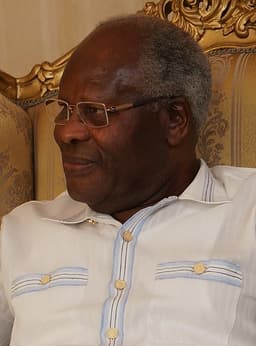
Bakili Muluzi
Politician · Modern
49.3Total
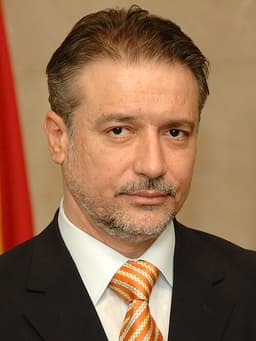
Nikola Gruevski
Politician · Modern
41.9Total
Basic Information
Born
1943
1970
Died
—
—
Era
Modern
Modern
Nationality
Malawi
North Macedonia
Occupation
Politician
Politician
Civilization
Other
Western
Score Comparison
Military (10%)
45.7
48.7
Political (20%)
48.0
26.4
Influence (20%)
51.8
46.3
Legacy (20%)
43.3
35.8
Leadership (15%)
65.0
55.3
Strategy (15%)
39.8
42.5
TOTAL
49.3
41.9
Bakili Muluzi — Complete Timeline
1994 AD
Elected President of MalawiPolitical Action
Muluzi won Malawi's first multi-party election since independence, defeating longtime dictator Hastings Kamuzu Banda. He became the first democratically elected president of Malawi, ending 30 years of one-party rule.
DemocracyElectionTransition
Impact: nationalprogressive
1999 AD
Re-elected President of MalawiPolitical Action◆ Major
Muluzi won a second term in office, defeating Gwanda Chakuamba. The election was marred by allegations of irregularities, but Muluzi's United Democratic Front retained power.
ElectionPresidency
Impact: national
2002 AD
Attempted Constitutional Amendment for Third TermPolitical Action◆ Major
Muluzi attempted to amend the Malawian constitution to allow a third presidential term. The effort failed due to opposition from civil society, parliament, and international pressure, forcing him to step down in 2004.
Constitutional CrisisTerm Limits
Impact: nationaldestructive
2009 AD
Arrested on Corruption ChargesPolitical Action◆ Major
Muluzi was arrested and charged with corruption and theft of public funds amounting to $11 million during his presidency. The case dragged on for years, with Muluzi eventually acquitted in 2012 due to lack of evidence.
CorruptionLegal Case
Impact: nationaldestructive
Nikola Gruevski — Complete Timeline
2006 AD
Elected Prime Minister of MacedoniaPolitical Action◆ Major
Gruevski became Prime Minister after his party VMRO-DPMNE won the parliamentary elections. He began a decade-long rule marked by nationalist policies and economic growth.
ElectionGovernmentMacedonia
Impact: nationalconstructive
2010 AD
Initiated the Skopje 2014 projectCultural◆ Major
Gruevski launched a large-scale urban renewal project in Skopje, building statues and buildings in a neoclassical style, including a statue of Alexander the Great. The project aimed to assert Macedonian identity but was criticized for cost and historical revisionism.
Urban DevelopmentNational IdentitySkopje
Impact: nationalconstructive
2015 AD
Wiretapping scandal revelationsPolitical Action◆ Major
Opposition leader Zoran Zaev released wiretapped conversations allegedly showing Gruevski's government involved in corruption, election rigging, and media control. This sparked massive protests and a political crisis.
ScandalCorruptionProtests
Impact: nationaldestructive
2016 AD
Resigned as Prime MinisterPolitical Action◆ Major
Under pressure from the wiretapping scandal and international mediation, Gruevski resigned, paving the way for early elections. His resignation ended his decade-long rule.
ResignationPolitical CrisisMacedonia
Impact: nationaldestructive
2018 AD
Fled to Hungary to avoid prisonPolitical Action◆ Major
After being sentenced to two years in prison for corruption related to the purchase of a luxury vehicle, Gruevski fled to Hungary, where he was granted political asylum. This caused a diplomatic rift between Macedonia and Hungary.
CorruptionAsylumEscape
Impact: nationaldestructive
This comparison has not been analyzed yet.
One-time AI generation (~1 minute). Scores and timeline are already available below.
Rankings
🥇
Bakili MuluziLeader
Mil: 45.7Pol: 48.0Inf: 51.8
49.3
🥈
Nikola Gruevski
Mil: 48.7Pol: 26.4Inf: 46.3
41.9
+7.4 behind
How This Comparison Works
Algorithm
Each figure is scored on 6 dimensions (0—100 scale) based on structured historical data: Military (10%), Political (20%), Influence (20%), Legacy (20%), Leadership (15%), Strategy (15%). The weighted total produces the final ranking.
Data Sources
Scores are computed from structured sub-indicators in the database. Scale factors adjust for era (Ancient ×0.85, Modern ×1.0) and civilization size (Eastern ×1.05, Other ×0.80) to account for differences in population and military scale.
Maximum 3 Figures
Comparisons are limited to 2—3 figures to ensure readability and statistical meaningfulness.
Error Margins
±5 points per dimension — Sub-scores are derived from historical records with inherent uncertainty. Two figures within 5 points on a dimension should be considered roughly equivalent in that area.
Total Score Accuracy
±3 points overall — The weighted combination of 6 dimensions produces a total score with approximately ±3 points of uncertainty. Differences of less than 3 points are not statistically significant— the figures are effectively tied.
Known Limitations
- Historical records are incomplete and uneven across civilizations
- Figures from oral-tradition societies may be underrepresented
- Occupation labels can misclassify multi-role figures
- Scores measure capability and impact, not moral character
- Quantitative scoring is a comparison tool, not absolute truth
Capability Radar
Military (10%) — Battles & Warfare
Battles
24
30
Win Rate
22
33
Expansion
28
35
Political (20%) — Governance & Reform
Reform
40
20
Diplomacy
45
15
Economy
35
10
Influence (20%) — Cultural & Global Reach
Cultural
30
5
Global
20
10
Legacy (20%) — Historical Impact
Historical
35
10
Longevity
25
5
Leadership (15%) — Power & Stability
Tenure
50
45
Stability
30
5
Strategy (15%) — Tactics & Innovation
Strategy
28
36
Tactics
31
40
Reform
35
46
Similar Comparisons
Comments & Discussion
No comments yet. Be the first to share your thoughts!