Loading...
Baibars al-Bunduqdari vs Napoleon Bonaparte
Napoleon Bonaparte leads by 2.2 pts · 2 figures compared
…
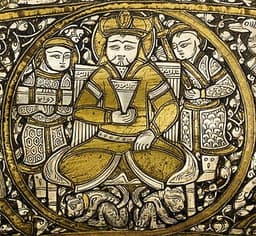
Baibars al-Bunduqdari
Emperor · Medieval
68.7Total

Napoleon Bonaparte
General · Modern
70.9Total
Basic Information
Born
1223
1769
Died
1277
1821
Era
Medieval
Modern
Nationality
Mamluk Sultanate
France
Occupation
Emperor
General
Civilization
Middle Eastern
Western
Score Comparison
Military (10%)
85.0
94.0
Political (20%)
72.0
72.0
Influence (20%)
72.0
40.0
Legacy (20%)
52.0
80.0
Leadership (15%)
72.0
78.0
Strategy (15%)
76.0
90.0
TOTAL
68.7
70.9
Baibars al-Bunduqdari — Complete Timeline
1260 AD
Battle of Ain JalutWar
Baibars led the Mamluk army to a decisive victory over the Mongols at Ain Jalut in Palestine. This battle halted the Mongol advance into the Middle East and established the Mamluk Sultanate as a major power.
MongolsMamlukBattleAin Jalut
Impact: global
Assassination of QutuzPolitical Action◆ Major
Baibars assassinated Sultan Qutuz shortly after the victory at Ain Jalut. He then seized the sultanate, beginning his reign as the most powerful Mamluk ruler and initiating a period of expansion.
MamlukAssassinationPower Struggle
Impact: regionaldestructive
1263 AD
Siege of AcreWar
Baibars launched a major but unsuccessful siege of Acre, the capital of the Kingdom of Jerusalem. Although he failed to take the city, he devastated its hinterland and weakened Crusader defenses.
CrusadesSiegeAcreMamluk
Impact: regional
1268 AD
Conquest of AntiochWar◆ Major
Baibars besieged and captured the Crusader city of Antioch. The city was sacked and its population massacred or enslaved, ending the Principality of Antioch and marking a major blow to the Crusader states.
CrusadesConquestAntiochMamluk
Impact: regionaldestructive
1270 AD
Campaign against the AssassinsWar◆ Major
Baibars subjugated the Nizari Ismaili state (the Assassins) in Syria. He captured their fortresses, including Masyaf, and forced their submission, eliminating a rival power and securing Mamluk control over the region.
MamlukAssassinsConquestSyria
Impact: regional
1277 AD
War against the MongolsWar◆ Major
Baibars fought a campaign against the Ilkhanate Mongols in Anatolia, defeating them at the Battle of Elbistan. He expanded Mamluk influence into Anatolia but died shortly after, leaving the region contested.
MongolsMamlukBattleAnatolia
Impact: regional
Napoleon Bonaparte — Complete Timeline
1799 AD
Coup of 18 BrumaireOther◆ Major
Napoleon Bonaparte, with support from his brother Lucien and key political figures, overthrew the Directory in a bloodless coup. He established the Consulate with himself as First Consul, effectively becoming the ruler of France. This event ended the French Revolution's most unstable period.
French RevolutionCoupRise to Power
Impact: regional
1804 AD
Promulgation of the Napoleonic CodeOther◆ Major
Napoleon enacted the Civil Code of the French, known as the Napoleonic Code, a comprehensive set of laws that replaced the fragmented feudal legal systems. The code established legal equality, protected property rights, and secularized law. It became the basis for legal systems in many European and world countries.
Legal ReformNapoleonic CodeCivil Law
Impact: globalconstructive
1805 AD
Battle of AusterlitzWar◆ Major
Napoleon's Grande Arm
Napoleonic WarsBattleDecisive Victory
Impact: global
1812 AD
Invasion of RussiaWar◆ Major
Napoleon led the Grande Arm
Napoleonic WarsInvasionDisaster
Impact: globaldestructive
1815 AD
Battle of WaterlooWar◆ Major
Napoleon's French army was defeated by the combined forces of the Duke of Wellington's Anglo-Allied army and Gebhard Leberecht von Bl
Napoleonic WarsBattleFinal Defeat
Impact: globaldestructive
Expert Analysis
baibars-al-bunduqdari-vs-napoleon-bonaparte
# The Conqueror and the Sultan
In the summer of 1277, a dying man in Damascus whispered orders that would echo through centuries. Sultan Baibars al-Bunduqdari, the former slave who had shattered the Mongol legend, was dictating his final campaign. Across the Mediterranean, nearly five hundred years later, another emperor would stand on a hill in Belgium, watching his own legend crumble. Napoleon Bonaparte, master of Europe, was about to lose everything at Waterloo. Two men, two worlds, yet both driven by the same burning ambition. What separates the slave who became a sultan from the general who became an emperor? The answer lies not in their triumphs, but in the soil from which they grew.
Origins
Napoleon Bonaparte was born in 1769 on the island of Corsica, a place that had only recently become French. His family were minor nobles, scraping by on a modest income. He was short, awkward, and spoke French with a thick Italian accent—a perpetual outsider in the salons of Paris. But the French Revolution, which erupted when he was twenty, shattered the old order. A young artillery officer of genius could rise as never before. Napoleon’s era was one of chaos and opportunity, where a man with a cannon and a vision could remake the world.
Baibars came from a far darker place. Born around 1223 in the Crimean steppes, he was a Kipchak Turk, captured as a child by Mongol raiders and sold into slavery. He ended up in Syria, purchased by a Mamluk emir—one of the elite slave-soldiers who served the Ayyubid sultans. In the medieval Middle East, the Mamluks were a unique institution: slaves who were trained as warriors, converted to Islam, and could rise to the highest ranks. But the system was brutal. Baibars was a blue-eyed giant with a cataract in one eye, a man forged in violence and betrayal. His era was one of apocalyptic threat: the Mongols, the greatest conquerors in history, were sweeping westward, crushing every army they met.
Rise to Power
Napoleon’s ascent was meteoric. In 1793, at age twenty-four, he drove the British fleet from Toulon. By 1796, he was commanding the Army of Italy, where his lightning campaigns humbled the Austrian Empire. He knew how to read a map, but more importantly, he knew how to read men. His soldiers adored him—he shared their rations, remembered their names, and promised them glory. In 1799, he returned from Egypt to a France weary of corruption and chaos. A coup made him First Consul; by 1804, he crowned himself Emperor. His rise was a masterpiece of ambition and timing.
Baibars rose through blood. He first distinguished himself at the Battle of La Forbie in 1244, fighting for the Mamluks against the Crusaders. But his defining moment came in 1260, outside the village of Ain Jalut in Palestine. The Mongols, under Kitbuqa, had conquered Baghdad and destroyed the Abbasid Caliphate. They seemed unstoppable. The Mamluk sultan, Qutuz, led an army to meet them. Baibars commanded the vanguard. At a critical moment, he feigned retreat, drawing the Mongols into a trap. The Mamluks closed in, and the Mongol army was annihilated. Ain Jalut was one of the most consequential battles in world history—it stopped the Mongol advance into Africa and the Middle East. But Baibars was not content to be a general. Shortly after the victory, he assassinated Qutuz on a hunting trip. He seized the sultanate, beginning a reign of seventeen years.
Leadership & Governance
Napoleon governed with a blend of genius and tyranny. His greatest achievement was the Napoleonic Code, a legal system that enshrined equality before the law, religious toleration, and the protection of property. It was a radical break from the feudal past, and it spread across Europe wherever his armies marched. He also reformed education, built roads, and stabilized the French economy. But his rule was a dictatorship. He suppressed dissent, censored the press, and crowned himself emperor. His military genius was beyond dispute—he won sixty battles, from Austerlitz in 1805 to Wagram in 1809. His strategy was simple: move fast, strike hard, and destroy the enemy army. He was a master of the decisive battle.
Baibars ruled a very different world. The Mamluk Sultanate was a military state, where power belonged to the strongest. Baibars centralized authority, built a professional army, and secured the borders. He fought relentlessly against the Crusaders, capturing the great city of Antioch in 1268 after a brutal siege. He subjugated the Assassins, the Nizari Ismaili state, in 1270, seizing their mountain fortresses. He also fought the Mongols again, defeating them at the Battle of Elbistan in 1277 and expanding Mamluk influence into Anatolia. But his governance was not just war. He repaired the caliphate, installing a puppet Abbasid caliph in Cairo to legitimize his rule. He built mosques, canals, and postal routes. His rule was harsh, but effective.
Triumph & Tragedy
Napoleon’s greatest triumph was Austerlitz in 1805, where he crushed the combined armies of Austria and Russia. His greatest tragedy was the invasion of Russia in 1812. He marched six hundred thousand men into the vastness of the Russian winter; fewer than forty thousand returned. He was exiled to Elba, escaped, and ruled for a hundred days—only to be defeated at Waterloo in 1815 by the Duke of Wellington and Gebhard Leberecht von Blücher. He spent his final years on the remote island of Saint Helena, dictating his memoirs and dying in 1821 at age fifty-one.
Baibars died in 1277, at the height of his power. He had just returned from a campaign in Anatolia, victorious but exhausted. He drank a cup of poisoned kumis—whether by accident or assassination, no one knows. His death was a shock to his empire. He had been the greatest sultan of the Mamluks, but he left no stable succession. His sons would fight over the throne, and the dynasty he founded would fade. Yet his greatest tragedy was not his own death, but the world he could not fully save. The Mongols would return, and the Crusaders would linger for another century.
Character & Destiny
Napoleon was a man of boundless energy and ego. He believed he was destiny’s chosen instrument. “I am not a man,” he once said, “but a thing.” He was brilliant, ruthless, and ultimately self-destructive. His ambition knew no limits, and that was his undoing. He could not stop, could not compromise, could not share power. His personality shaped his decisions: he invaded Russia because he could not bear to leave an enemy undefeated. He fought at Waterloo because he believed in his own star.
Baibars was a survivor. He had been a slave, a soldier, a murderer, a king. He trusted no one, and with good reason—he had killed his own sultan. His personality was forged in betrayal. He was cunning, patient, and ferocious. He knew when to strike and when to wait. His destiny was not to conquer the world, but to defend it. He did not seek glory for its own sake; he sought survival for his people and his faith.
Legacy
Napoleon’s legacy is immense. His legal code still shapes the laws of Europe and beyond. His military tactics are studied in war colleges. He redrew the map of Europe and inspired nationalism across the continent. But he is also a cautionary tale—a man who rose too high and fell too hard. He is remembered as both a liberator and a tyrant.
Baibars is a hero in the Arab and Muslim world. He is the man who stopped the Mongols, who fought the Crusaders, who built a state that would endure for centuries. His statue stands in Cairo, and his name is spoken with reverence. But his legacy is more local, more specific. He did not change the world; he saved it from destruction. He is a symbol of resistance, not conquest.
Conclusion
Two men, two empires, two different fates. Napoleon conquered Europe but lost everything. Baibars defended his world and died a king. What drove the difference? Perhaps it was the age. Napoleon’s Europe was a chessboard of competing powers, where one man could seize the crown. Baibars’s Middle East was a storm of Mongols and Crusaders, where the only choice was to fight or die. Or perhaps it was the man. Napoleon wanted to be remembered. Baibars wanted to survive. In the end, both got what they sought—but only one kept his kingdom.
Rankings
🥇
Napoleon BonaparteLeader
Mil: 94.0Pol: 72.0Inf: 40.0
70.9
🥈
Baibars al-Bunduqdari
Mil: 85.0Pol: 72.0Inf: 72.0
68.7
+2.2 behind
How This Comparison Works
Algorithm
Each figure is scored on 6 dimensions (0—100 scale) based on structured historical data: Military (10%), Political (20%), Influence (20%), Legacy (20%), Leadership (15%), Strategy (15%). The weighted total produces the final ranking.
Data Sources
Scores are computed from structured sub-indicators in the database. Scale factors adjust for era (Ancient ×0.85, Modern ×1.0) and civilization size (Eastern ×1.05, Other ×0.80) to account for differences in population and military scale.
Maximum 3 Figures
Comparisons are limited to 2—3 figures to ensure readability and statistical meaningfulness.
Error Margins
±5 points per dimension — Sub-scores are derived from historical records with inherent uncertainty. Two figures within 5 points on a dimension should be considered roughly equivalent in that area.
Total Score Accuracy
±3 points overall — The weighted combination of 6 dimensions produces a total score with approximately ±3 points of uncertainty. Differences of less than 3 points are not statistically significant— the figures are effectively tied.
Known Limitations
- Historical records are incomplete and uneven across civilizations
- Figures from oral-tradition societies may be underrepresented
- Occupation labels can misclassify multi-role figures
- Scores measure capability and impact, not moral character
- Quantitative scoring is a comparison tool, not absolute truth
Capability Radar
Military (10%) — Battles & Warfare
Battles
85
95
Win Rate
90
90
Expansion
80
95
Political (20%) — Governance & Reform
Reform
82
95
Diplomacy
78
80
Economy
80
85
Influence (20%) — Cultural & Global Reach
Cultural
65
85
Global
70
90
Legacy (20%) — Historical Impact
Historical
75
95
Longevity
60
90
Leadership (15%) — Power & Stability
Tenure
75
85
Stability
70
70
Strategy (15%) — Tactics & Innovation
Strategy
88
95
Tactics
92
98
Reform
85
92
Similar Comparisons
Comments & Discussion
SultanOfTheSteppes6/17/2026
Baibars was the real underdog story, not Napoleon. Born a slave on the Crimean steppes, sold by Mongol raiders, he clawed his way to the throne of Egypt. By 1260, he crushed the Mongols at Ain Jalut, a battle that saved Islam and the Near East. Napoleon, born a minor noble in Corsica, used the French Revolution as a ladder. Baibars started from zero—no noble blood, no revolutionary chaos, just raw will and a bloodstained sword. History’s true self-made king.
炮灰帝王分析员6/17/2026
拿什么跟拜巴尔斯比?拿破仑打的是欧洲内卷战争,拜巴尔斯直面的是蒙古铁骑——那个时代最恐怖的战争机器。1260年艾因贾鲁特之战,他用马穆鲁克骑兵的机动战术,在叙利亚平原上切碎了蒙古人不可战胜的神话。拿破仑在滑铁卢败给威灵顿的方阵,拜巴尔斯却让世界最大帝国的扩张止步。一个是将军,一个是文明拯救者,差距就这么简单。
TheAxeOfHistory6/17/2026
Napoleon’s victories were built on a century of French military reform and revolutionary fervor—he inherited a machine. Baibars built his from scratch, literally from slave barracks. He wasn't handed a Grande Armée; he forged the Mamluk sultanate out of a fractured Egypt, personally leading campaigns that crushed both Crusaders and Mongols. By 1271, he’d taken the last Crusader stronghold, Krak des Chevaliers. Napoleon’s legacy? Exile and a code. Baibars’? The survival of a civilization.
酸橙笔记6/17/2026
数据上看,拿破仑的战争规模的确更大——他指挥过60万大军征俄。但拜巴尔斯的地缘政治效率碾压他。拿破仑败于同盟车轮战,拜巴尔斯却用外交手腕同时牵制蒙古伊尔汗国、十字军残部、和安条克公国。1280年代,他通过联姻和条约巩固了马穆鲁克王朝,死后近百年无人能撼动。拿破仑死后,波旁王朝说回来就回来了。谁的战略更持久?一目了然。