Loading...
Babangida Ibrahim vs Fiyanggu
Fiyanggu leads by 9.5 pts · 2 figures compared
…
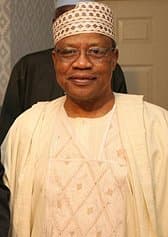
Babangida Ibrahim
General · Modern
46.0Total

Fiyanggu
General · Modern
55.5Total
Basic Information
Born
1941
1645
Died
—
1701
Era
Modern
Modern
Nationality
Nigeria
China
Occupation
General
General
Civilization
Other
Eastern
Score Comparison
Military (10%)
25.9
65.0
Political (20%)
39.4
46.6
Influence (20%)
51.8
52.5
Legacy (20%)
42.5
46.7
Leadership (15%)
65.7
80.0
Strategy (15%)
41.0
52.5
TOTAL
46.0
55.5
Babangida Ibrahim — Complete Timeline
1985 AD
Seized Power in CoupPolitical Action◆ Major
Babangida seized power in a bloodless coup in 1985, overthrowing Muhammadu Buhari. He cited Buhari's authoritarian rule and economic mismanagement as reasons for the takeover, promising a return to civilian rule.
NigeriaCoupMilitary
Impact: national
1986 AD
Implemented Structural Adjustment ProgramReform◆ Major
Babangida implemented a Structural Adjustment Program (SAP) in 1986, backed by the IMF and World Bank. The program included currency devaluation, trade liberalization, and privatization, but led to economic hardship and protests.
NigeriaEconomic ReformIMF
Impact: nationaldestructive
1993 AD
Annulled 1993 Presidential ElectionPolitical Action
Babangida annulled the 1993 presidential election, widely considered the freest in Nigeria's history, after preliminary results showed Moshood Abiola winning. The annulment sparked political crisis, protests, and international condemnation.
NigeriaElectionCrisis
Impact: nationaldestructive
Resigned as PresidentPolitical Action◆ Major
Babangida resigned as President in 1993 under pressure from protests and international criticism following the election annulment. He handed power to an interim government led by Ernest Shonekan, which was soon overthrown by Sani Abacha.
NigeriaResignationTransition
Impact: national
Fiyanggu — Complete Timeline
1696 AD
Battle of DsuunmodWar◆ Major
Fiyanggu commanded Qing forces against the Dzungar leader Galdan at Dsuunmod (also known as the Battle of Jao Modo). The Qing army decisively defeated Galdan's forces, leading to Galdan's suicide and the temporary stabilization of the Qing northern frontier.
Dzungar-Qing WarBattleMongolia
Impact: regional
Expert Analysis
Origins
**Babangida Ibrahim** was born on August 17, 1941, in Minna, Niger State, Nigeria. He attended the Nigerian Military Training College and the Royal Military Academy Sandhurst, later serving in the Nigerian Army. His early career included participation in peacekeeping missions and the Nigerian Civil War, where he commanded a battalion.
**Fiyanggu** (1630–1698) was a Manchu general of the Qing dynasty. He belonged to the Plain Yellow Banner and rose through military ranks during the reign of the Kangxi Emperor. His early life is less documented, but his military training and loyalty to the Qing court were shaped by the Manchu warrior tradition.
Rise to Power
**Babangida** gained prominence after the 1983 coup that brought Muhammadu Buhari to power. He served as Chief of Army Staff but grew dissatisfied with Buhari's authoritarian rule. On August 27, 1985, he seized power in a bloodless coup, citing the need to restore public confidence. He consolidated power by purging rivals and cultivating a network of loyalists.
**Fiyanggu** rose under the Kangxi Emperor, who tasked him with suppressing rebellions and defending the northern borders. His key turning point came in 1696 when the Dzungar leader Galdan threatened Qing control over Mongolia. Fiyanggu was appointed commander of the Qing forces, leading a campaign that culminated in the Battle of Dsuunmod.
Leadership & Governance
**Babangida** ruled Nigeria from 1985 to 1993. He implemented a Structural Adjustment Program (SAP) in 1986, devaluing the currency and cutting subsidies, which caused economic hardship but was supported by the IMF. Politically, he orchestrated a transition to civilian rule but repeatedly postponed handover dates. His leadership style was manipulative, using divide-and-rule tactics among the military and political elites.
**Fiyanggu** served as a military commander under the Kangxi Emperor, not as a sovereign ruler. His leadership was characterized by strict discipline and strategic acumen. He managed multi-ethnic forces, including Mongols and Han Chinese, and coordinated logistics across vast distances. His governance role was limited to military administration, but he enforced Qing authority in the frontier.
Triumph & Tragedy
**Babangida's** greatest triumph was overseeing the 1993 presidential election, widely praised as Nigeria's freest and fairest. However, his annulment of the election—after preliminary results showed Moshood Abiola winning—was a catastrophic failure. The annulment sparked protests, international condemnation, and plunged Nigeria into a political crisis. He resigned on August 27, 1993, under pressure, leaving a legacy of dashed democratic hopes.
**Fiyanggu's** greatest triumph was the victory at the Battle of Dsuunmod (1696), where his forces decisively defeated Galdan's army, killing thousands and forcing Galdan into retreat. This secured Qing control over Mongolia and eliminated the Dzungar threat for years. His failure was not recording a major defeat, but his achievements were limited to a single campaign; he did not shape broader Qing policy.
Character & Destiny
**Babangida** was a cunning and calculating leader, often described as a master of political maneuvering. His decision to annul the election reflected a fear of losing power and a misjudgment of public sentiment. Historians consider him a tragic figure whose actions undermined Nigeria's democratic progress. His military score of 25.9 reflects limited battlefield experience, while his political score of 39.4 underscores his flawed governance.
**Fiyanggu** was a disciplined and loyal commander, embodying the Manchu military ethos. His decisive victory at Dsuunmod was a product of careful planning and tactical flexibility. He did not seek political power, remaining a servant of the emperor. His military score of 65.0 and leadership score of 80.0 highlight his effectiveness as a general.
Legacy
**Babangida** is remembered as the general who annulled Nigeria's most credible election, a decision that continues to shape Nigerian politics. His SAP policies are blamed for worsening economic inequality, while his political manipulations set a precedent for military interference in democracy. His influence score of 51.8 reflects his impact on Nigeria's political trajectory.
**Fiyanggu** is commemorated in Chinese history as a loyal general who secured the northern frontier. His victory at Dsuunmod is a key event in the Qing expansion, contributing to the empire's stability. However, his legacy is less prominent than that of other Qing generals, and his influence score of 52.5 is modest.
Conclusion
Fiyanggu achieved a clear military victory that had lasting strategic importance for the Qing dynasty, while Babangida's political actions had profound but negative consequences for Nigeria. Fiyanggu's total score of 55.5 surpasses Babangida's 46.0, and his leadership score of 80.0 dwarfs Babangida's 65.7. While Babangida's influence on Nigeria is undeniable, Fiyanggu's effective generalship and decisive victory make him the more historically successful figure. Therefore, Fiyanggu had a greater impact in terms of achieving his objectives.
Rankings
🥇
FiyangguLeader
Mil: 65.0Pol: 46.6Inf: 52.5
55.5
🥈
Babangida Ibrahim
Mil: 25.9Pol: 39.4Inf: 51.8
46.0
+9.5 behind
How This Comparison Works
Algorithm
Each figure is scored on 6 dimensions (0—100 scale) based on structured historical data: Military (10%), Political (20%), Influence (20%), Legacy (20%), Leadership (15%), Strategy (15%). The weighted total produces the final ranking.
Data Sources
Scores are computed from structured sub-indicators in the database. Scale factors adjust for era (Ancient ×0.85, Modern ×1.0) and civilization size (Eastern ×1.05, Other ×0.80) to account for differences in population and military scale.
Maximum 3 Figures
Comparisons are limited to 2—3 figures to ensure readability and statistical meaningfulness.
Error Margins
±5 points per dimension — Sub-scores are derived from historical records with inherent uncertainty. Two figures within 5 points on a dimension should be considered roughly equivalent in that area.
Total Score Accuracy
±3 points overall — The weighted combination of 6 dimensions produces a total score with approximately ±3 points of uncertainty. Differences of less than 3 points are not statistically significant— the figures are effectively tied.
Known Limitations
- Historical records are incomplete and uneven across civilizations
- Figures from oral-tradition societies may be underrepresented
- Occupation labels can misclassify multi-role figures
- Scores measure capability and impact, not moral character
- Quantitative scoring is a comparison tool, not absolute truth
Capability Radar
Military (10%) — Battles & Warfare
Battles
10
60
Win Rate
10
70
Expansion
10
55
Political (20%) — Governance & Reform
Reform
30
30
Diplomacy
25
40
Economy
20
30
Influence (20%) — Cultural & Global Reach
Cultural
20
25
Global
20
20
Legacy (20%) — Historical Impact
Historical
30
40
Longevity
15
30
Leadership (15%) — Power & Stability
Tenure
55
50
Stability
10
45
Strategy (15%) — Tactics & Innovation
Strategy
15
60
Tactics
15
65
Reform
20
30
Similar Comparisons
Comments & Discussion
No comments yet. Be the first to share your thoughts!