Loading...
Askia Ismail vs Julius Caesar
Julius Caesar leads by 35.7 pts · 2 figures compared
…
Askia Ismail
Emperor · Medieval
47.1Total

Julius Caesar
General · Ancient
82.8Total
Basic Information
Born
1500
-100
Died
1539
-44
Era
Medieval
Ancient
Nationality
Songhai Empire
Roman Republic
Occupation
Emperor
General
Civilization
Other
Western
Score Comparison
Military (10%)
46.7
88.0
Political (20%)
39.4
78.0
Influence (20%)
48.6
85.0
Legacy (20%)
40.0
82.0
Leadership (15%)
65.7
80.0
Strategy (15%)
45.0
85.0
TOTAL
47.1
82.8
Askia Ismail — Complete Timeline
1528 AD
Accession as Askia of SonghaiPolitical Action◆ Major
Askia Ismail became ruler of the Songhai Empire following the deposition of his father, Askia Mohammed I. His reign was marked by efforts to restore stability after the internal conflicts that had arisen during his father's later years.
SuccessionSonghai Empire
Impact: national
1539 AD
Deposition of Askia IsmailPolitical Action◆ Major
Askia Ismail was deposed by his brother, Askia Ishaq I, after a reign of approximately 11 years. This event continued the pattern of dynastic instability within the Songhai Empire during the 16th century.
DepositionDynastic Conflict
Impact: nationaldestructive
Julius Caesar — Complete Timeline
58 BC
Gallic WarsWar◆ Major
Caesar, as proconsul of Gaul, launched a series of campaigns that conquered all of Gaul (modern France, Belgium, and parts of Switzerland). He fought numerous battles, including against the Helvetii, the Belgae, and the Gallic chieftain Vercingetorix. The wars brought immense wealth and a loyal army to Caesar.
Gallic WarsConquestRoman Expansion
Impact: regional
49 BC
Crossing the RubiconPolitical Action◆ Major
Caesar led Legio XIII across the Rubicon River into Italy, defying the Roman Senate's order to disband his army. This act triggered a civil war against Pompey and the Optimates, ultimately leading to Caesar's dictatorship and the end of the Roman Republic.
Roman Civil WarEnd of RepublicPower Struggle
Impact: global
48 BC
Battle of PharsalusWar◆ Major
Caesar's outnumbered army defeated the larger forces of Pompey the Great at Pharsalus in Greece. Caesar's tactical use of a reserve line to counter Pompey's cavalry charge proved decisive. Pompey fled to Egypt, where he was assassinated, leaving Caesar as the undisputed master of the Roman world.
Roman Civil WarBattleDecisive Victory
Impact: regional
44 BC
Appointment as Dictator for LifePolitical Action◆ Major
The Roman Senate appointed Caesar dictator perpetuo (dictator for life), granting him unprecedented personal power. This move concentrated military, legislative, and judicial authority in one person, effectively ending the Roman Republic's traditional system of checks and balances and alarming many senators.
DictatorshipEnd of RepublicPower Consolidation
Impact: regionaldestructive
Assassination on the Ides of MarchPolitical Action◆ Major
A group of Roman senators, led by Marcus Junius Brutus and Gaius Cassius Longinus, stabbed Caesar to death at a meeting of the Senate in the Theatre of Pompey. The assassination was intended to restore the Republic, but instead triggered another civil war that led to the rise of the Roman Empire.
AssassinationRoman PoliticsEnd of Republic
Impact: globaldestructive
Expert Analysis
askia-ismail-vs-julius-caesar
The Ides of March and the Sands of Time
On a March morning in 44 BCE, the most powerful man in the Mediterranean walked into the Senate chamber and was stabbed twenty-three times by men he had pardoned, promoted, and trusted. Julius Caesar fell dead at the foot of a statue of his great rival, Pompey. Half a world away and fifteen centuries later, another ruler—Askia Ismail of the Songhai Empire—faced a quieter but no less decisive end. In 1539, after eleven years of rule, he was deposed by his own brother and vanished into the obscurity of history. One death became the most famous assassination in Western history; the other became a footnote. What drove such different outcomes? The answer lies not in the stars, but in the men themselves—and the worlds they inherited.
Origins
Gaius Julius Caesar was born in 100 BCE into a patrician family that had once been powerful but had fallen on hard times. Rome was a Republic in crisis: the Senate was corrupt, the streets were violent, and generals like Marius and Sulla had already shown that armies could be used to seize personal power. Caesar grew up in this crucible of ambition and bloodshed, learning early that in Rome, glory was the only currency that mattered. He was not born a king, but he was born into a system that was ripe for one.
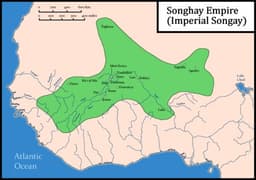
Askia Ismail, by contrast, was born around 1500 into the Songhai Empire at its zenith. His father, Askia Mohammed I, had transformed Songhai from a regional kingdom into a vast West African empire stretching from the Atlantic to the Niger River. Timbuktu was a center of learning; Islam was the official religion; trade in gold and salt flowed through imperial roads. Ismail was a prince in a stable dynasty—but stability was precisely the problem. The Songhai succession was not a matter of law but of force, and every new reign brought the threat of civil war.
Rise to Power
Caesar’s path was a masterclass in calculated risk. He borrowed fortunes to buy popularity, allied with the richest man in Rome (Crassus) and the greatest general (Pompey), and then conquered Gaul in a brutal eight-year campaign that made him a hero to his soldiers and a threat to the Senate. When the Senate ordered him to disband his army, he crossed the Rubicon River in 49 BCE, igniting a civil war. Within four years, he was dictator for life. Caesar rose by breaking rules—and by being willing to kill anyone who enforced them.
Askia Ismail rose by inheritance and coup. In 1528, his father, the great Askia Mohammed I, was old and blind. Ismail, along with his brothers, deposed the aging emperor and seized power. It was not a revolution; it was a palace struggle. Ismail became Askia not because he had conquered an empire, but because he had outmaneuvered his siblings in a game where the loser often died. His rise was less a dramatic arc than a sideways shuffle.
Leadership & Governance
Caesar governed as he conquered: with speed, brilliance, and ruthlessness. He reformed the calendar, granted citizenship to provincials, redistributed land to veterans, and centralized power in his own hands. His military genius was legendary—he wrote his own commentaries, defeated armies three times his size, and once said, “I came, I saw, I conquered.” But his political wisdom had limits. He pardoned his enemies, then let them live to plot against him. He accepted honors that made him seem a king, then refused a crown—leaving everyone confused and resentful.
Askia Ismail governed in the shadow of his father. He attempted to consolidate the empire, maintain trade routes, and uphold Islamic law. But his reign was defined by what he did not do: he did not expand the empire, he did not crush his rivals, and he did not inspire loyalty beyond his immediate circle. His military score of 39.0 and political score of 45.0 reflect a ruler who was competent but not commanding. Where Caesar inspired devotion unto death, Ismail inspired only a brief, fragile peace.
Triumph & Tragedy
Caesar’s greatest triumph was the conquest of Gaul, which added a vast territory to the Roman world and made him the richest man in the Republic. His greatest tragedy was his assassination—a death he could have avoided if he had listened to warnings, surrounded himself with loyal men, or simply stayed home. But Caesar believed in his own invincibility. “The die is cast,” he had said at the Rubicon. At the Senate, the die was cast again.
Askia Ismail’s triumph was simply holding the empire together for eleven years—no small feat in a system where brothers were natural enemies. His tragedy was that he could not hold it any longer. In 1539, his brother Askia Ishaq I deposed him, and Ismail disappeared from the historical record. He left no monuments, no writings, no legend. He was a caretaker in an era that demanded a conqueror.
Character & Destiny
Caesar was audacious, intelligent, and dangerously arrogant. He believed that fortune favored the bold—and for most of his life, it did. But his character also contained a fatal flaw: he could not imagine his own failure. He pardoned Brutus, then made him a praetor; Brutus repaid him with a knife. Caesar’s destiny was to be both the founder of an empire and the proof of its instability.
Askia Ismail was cautious, perhaps even timid. He ruled not by force of will but by force of circumstance. His character was shaped by the knowledge that his father had been deposed, and that he could be too. He tried to preserve what his father had built, but preservation is not the stuff of legend. In a world where power was taken, not given, Ismail’s moderation was his undoing.
Legacy
Caesar’s legacy is the Roman Empire itself. His adopted heir, Octavian, became Augustus, the first emperor. The title “Caesar” became synonymous with ruler—it survives in the German “Kaiser” and the Russian “Tsar.” His writings remain classics; his assassination is a cultural touchstone. His total score of 83.3 reflects a figure who reshaped the world.
Askia Ismail’s legacy is almost invisible. His name appears in chronicles of the Songhai Empire, but only as a brief interlude between his father’s greatness and his brother’s rule. The empire itself fell to Moroccan invaders just fifty years later. His total score of 51.6 places him in the ranks of the forgettable. He was not a bad ruler; he was simply not a great one.
Conclusion
The difference between Caesar and Ismail is not merely one of talent or luck. It is a difference of ambition, of context, of the willingness to risk everything for immortality. Caesar lived in a world where one man could reshape history through sheer audacity. Ismail lived in a world where the machinery of empire was already built, and his job was to keep it running. One built a bridge to the future; the other held a torch that was already flickering. In the end, history remembers not those who maintain, but those who break—and remake—the world.
Rankings
🥇
Julius CaesarLeader
Mil: 88.0Pol: 78.0Inf: 85.0
82.8
🥈
Askia Ismail
Mil: 46.7Pol: 39.4Inf: 48.6
47.1
+35.7 behind
How This Comparison Works
Algorithm
Each figure is scored on 6 dimensions (0—100 scale) based on structured historical data: Military (10%), Political (20%), Influence (20%), Legacy (20%), Leadership (15%), Strategy (15%). The weighted total produces the final ranking.
Data Sources
Scores are computed from structured sub-indicators in the database. Scale factors adjust for era (Ancient ×0.85, Modern ×1.0) and civilization size (Eastern ×1.05, Other ×0.80) to account for differences in population and military scale.
Maximum 3 Figures
Comparisons are limited to 2—3 figures to ensure readability and statistical meaningfulness.
Error Margins
±5 points per dimension — Sub-scores are derived from historical records with inherent uncertainty. Two figures within 5 points on a dimension should be considered roughly equivalent in that area.
Total Score Accuracy
±3 points overall — The weighted combination of 6 dimensions produces a total score with approximately ±3 points of uncertainty. Differences of less than 3 points are not statistically significant— the figures are effectively tied.
Known Limitations
- Historical records are incomplete and uneven across civilizations
- Figures from oral-tradition societies may be underrepresented
- Occupation labels can misclassify multi-role figures
- Scores measure capability and impact, not moral character
- Quantitative scoring is a comparison tool, not absolute truth
Capability Radar
Military (10%) — Battles & Warfare
Battles
35
95
Win Rate
40
92
Expansion
20
97
Political (20%) — Governance & Reform
Reform
40
90
Diplomacy
35
85
Economy
30
82
Influence (20%) — Cultural & Global Reach
Cultural
20
88
Global
10
94
Legacy (20%) — Historical Impact
Historical
25
95
Longevity
15
96
Leadership (15%) — Power & Stability
Tenure
45
75
Stability
40
60
Strategy (15%) — Tactics & Innovation
Strategy
35
94
Tactics
30
96
Reform
25
88
Similar Comparisons
Comments & Discussion
No comments yet. Be the first to share your thoughts!