Loading...
Ashok Gehlot vs Ma Ying-jeou
Ma Ying-jeou leads by 2.4 pts · 2 figures compared
…
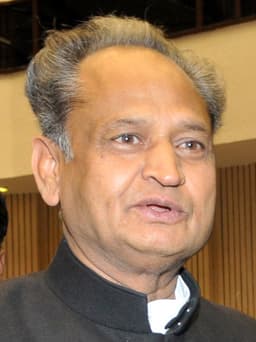
Ashok Gehlot
Politician · Modern
49.1Total
Ma Ying-jeou
Politician · Modern
51.5Total
Basic Information
Born
1951
1950
Died
—
—
Era
Modern
Modern
Nationality
India
China
Occupation
Politician
Politician
Civilization
Indian
Eastern
Score Comparison
Military (10%)
43.3
13.0
Political (20%)
68.0
72.0
Influence (20%)
49.4
58.0
Legacy (20%)
40.8
45.8
Leadership (15%)
40.0
66.0
Strategy (15%)
60.0
36.0
TOTAL
49.1
51.5
Ashok Gehlot — Complete Timeline
1998 AD
Became Chief Minister of Rajasthan for the first timePolitical Action◆ Major
Ashok Gehlot was sworn in as the Chief Minister of Rajasthan after leading the Indian National Congress to victory in the state assembly elections. This marked the beginning of his tenure as a three-time CM, overseeing various development and welfare schemes.
Chief MinisterRajasthanCongress
Impact: regionalconstructive
2004 AD
Appointed as Union Minister of TextilesPolitical Action
Gehlot served as the Union Minister of Textiles in the Manmohan Singh government. He oversaw the implementation of the National Textile Policy and initiatives to boost the textile sector, though his tenure was relatively low-profile.
Union MinisterTextilesUPA
Impact: nationalconstructive
2008 AD
Second term as Chief Minister of RajasthanPolitical Action◆ Major
Gehlot returned as Chief Minister after the Congress party won the 2008 Rajasthan assembly elections. His second term focused on education, health, and infrastructure, but also faced challenges like the 2008 financial crisis and drought.
Chief MinisterRajasthanCongress
Impact: regionalconstructive
2018 AD
Third term as Chief Minister of RajasthanPolitical Action◆ Major
Gehlot became Chief Minister for a third time after the Congress won the 2018 Rajasthan elections. His tenure included implementation of welfare schemes like the Chiranjeevi Health Insurance Scheme and faced political challenges from within the party.
Chief MinisterRajasthanCongress
Impact: regionalconstructive
Ma Ying-jeou — Complete Timeline
2008 AD
Elected President of TaiwanPolitical Action◆ Major
Ma Ying-jeou won the presidential election as the Kuomintang candidate, promising to improve relations with China. His victory marked a return to KMT rule after eight years of DPP governance.
ElectionCross-Strait Relations
Impact: nationalconstructive
Direct cross-strait flightsPolitical Action
Ma's administration established direct flights between Taiwan and mainland China, ending a 60-year ban. This facilitated tourism and business exchanges, significantly increasing cross-strait travel.
TransportationCross-Strait Relations
Impact: regionalconstructive
2010 AD
Economic Cooperation Framework AgreementPolitical Action◆ Major
Ma's government signed the ECFA with China, a preferential trade agreement that reduced tariffs and promoted economic integration. The deal was controversial in Taiwan, with critics fearing it increased dependence on China.
Trade AgreementCross-Strait Relations
Impact: regionalconstructive
Expert Analysis
Origins
Ashok Gehlot was born on May 3, 1951, in Jodhpur, Rajasthan, into a middle-class Jain family. His father, Laxman Singh Gehlot, was a small businessman. Gehlot studied at the University of Jodhpur, earning a B.Sc. and LL.B. He entered student politics through the National Students' Union of India (NSUI), the student wing of the Indian National Congress. His early activism included participation in the Emergency protests, which shaped his political identity.
Ma Ying-jeou was born on July 13, 1950, in the British colony of Hong Kong to a Hakka family with roots in Xiangtan, Hunan. His father, Ma Hao-ling, was a Kuomintang (KMT) official who fled to Taiwan after the Chinese Civil War. Ma studied law at National Taiwan University, then earned an S.J.D. from Harvard Law School. He returned to Taiwan as a legal scholar and became a key figure in the KMT's modernization.
Rise to Power
Gehlot's political ascent began as a student leader; he became the president of the Rajasthan University Students' Union in 1974. He was elected to the Rajasthan Legislative Assembly in 1981 from Sardarpura constituency. He held several ministerial portfolios in the state government, including Education and Health. In 1998, he led the Congress to victory and became Chief Minister for the first time, serving until 2003. After a decade in opposition, he returned as CM in 2008, winning again in 2013 and 2018. His rise was marked by loyalty to the Nehru-Gandhi family and effective grassroots networking.
Ma's rise was more national and international. After Harvard, he served as a visiting professor and later as a legal advisor to the KMT. He was elected to the Legislative Yuan in 1990 and served as Minister of Justice (1993-1996) under President Lee Teng-hui. He gained prominence for his role in the 1996 Taiwan Strait crisis. In 1998, he was elected Mayor of Taipei, a post he held for two terms. His popularity boosted his national profile, and in 2008, he won the presidential election with 58.4% of the vote, defeating the Democratic Progressive Party (DPP) candidate.
Leadership & Governance
Gehlot's leadership style is characterized by welfarism and populism. As CM, he implemented schemes like the Bhamashah Yojana (direct benefit transfer to women), free medicine and diagnostic services, and subsidized food grains. He prioritized education, building schools and colleges, and launched the "English as a subject" policy from Class 1. However, his governance faced criticism for corruption and bureaucratic inefficiency. His scores reflect this: Political 68.0, Leadership 40.0. He avoided economic reforms that could alienate rural voters, focusing instead on vote-bank politics.
Ma's governance emphasized legalism and cross-strait engagement. He pursued a policy of "three nos" (no unification, no independence, no use of force) and signed the Economic Cooperation Framework Agreement (ECFA) with China in 2010, reducing tariffs and boosting trade. He also established direct cross-strait flights and expanded tourism. Domestically, he focused on anti-corruption and judicial reform, but his popularity declined due to perceived subservience to China and a weak economy. His scores: Political 72.0, Leadership 66.0, Strategy 36.0.
Triumph & Tragedy
Gehlot's greatest success was winning three terms as CM, a rare feat in Rajasthan. His welfare schemes improved health and education indicators; the state's literacy rate rose from 60.4% (2001) to 66.1% (2011). However, his failure to diversify the economy or attract major investment left Rajasthan dependent on agriculture and tourism. The 2018 elections saw Congress win with a thin margin, and his third term was marred by internal party dissent and the COVID-19 pandemic.
Ma's triumph was the ECFA and improved cross-strait relations. Trade between Taiwan and China grew from $105 billion in 2008 to $170 billion in 2014. Direct flights and tourism increased cultural exchange. His tragedy was the 2014 Sunflower Student Movement, which erupted over the Cross-Strait Service Trade Agreement, seen as too pro-China. His approval rating fell from 70% in 2008 to below 20% by 2015. The KMT lost the 2016 elections, and Ma's legacy was tarnished by corruption allegations against his allies.
Character & Destiny
Gehlot is known as a cautious, consensus-building politician. He avoided bold decisions, preferring to manage factions. His nickname "magic-monger" (jadoogar) reflects his ability to win despite odds, but also a reliance on short-term fixes. His character led to a stable but stagnant administration. He scored 60.0 in Strategy, indicating some skill, but 40.0 in Leadership suggests limited transformative vision.
Ma is disciplined, legalistic, and idealistic about cross-strait peace. His Harvard legal training made him focus on rules and procedures, but he lacked charisma and political agility. His strategy score of 36.0 reflects missteps in handling domestic opposition. His destiny was shaped by the structural constraints of Taiwan's international isolation and the rise of Chinese influence, which he sought to manage but ultimately could not control.
Legacy
Gehlot's legacy is confined to Rajasthan: he made Congress competitive in a BJP-dominated state and institutionalized welfare programs. However, his influence on national politics is limited; he never held a major national post except briefly as Union Textiles Minister (2009-2010). His total score of 49.1 places him as a regional figure.
Ma's legacy is more significant. He redefined Taiwan-China relations, establishing frameworks that later governments could not ignore. The ECFA remains in place, and cross-strait economic integration continues. However, his failure to secure a lasting peace and the rise of Taiwanese identity under his watch have complicated his legacy. He scored 51.5 overall, with high Influence (58.0) and Legacy (45.8).
Conclusion
Ma Ying-jeou had greater impact than Ashok Gehlot. Ma's actions affected 23 million Taiwanese and shifted the geopolitical dynamics of East Asia. Gehlot's influence was limited to 68 million Rajasthanis within a larger Indian federation. While Gehlot's political score (68.0) is close to Ma's (72.0), Ma's influence (58.0 vs 49.4) and leadership (66.0 vs 40.0) are decisively higher. The score gap of 2.4 points (51.5 vs 49.1) understates the difference in scale. Ma changed the trajectory of cross-strait relations; Gehlot maintained the status quo in one Indian state. Thus, Ma Ying-jeou is the more consequential figure.
Rankings
🥇
Ma Ying-jeouLeader
Mil: 13.0Pol: 72.0Inf: 58.0
51.5
🥈
Ashok Gehlot
Mil: 43.3Pol: 68.0Inf: 49.4
49.1
+2.4 behind
How This Comparison Works
Algorithm
Each figure is scored on 6 dimensions (0—100 scale) based on structured historical data: Military (10%), Political (20%), Influence (20%), Legacy (20%), Leadership (15%), Strategy (15%). The weighted total produces the final ranking.
Data Sources
Scores are computed from structured sub-indicators in the database. Scale factors adjust for era (Ancient ×0.85, Modern ×1.0) and civilization size (Eastern ×1.05, Other ×0.80) to account for differences in population and military scale.
Maximum 3 Figures
Comparisons are limited to 2—3 figures to ensure readability and statistical meaningfulness.
Error Margins
±5 points per dimension — Sub-scores are derived from historical records with inherent uncertainty. Two figures within 5 points on a dimension should be considered roughly equivalent in that area.
Total Score Accuracy
±3 points overall — The weighted combination of 6 dimensions produces a total score with approximately ±3 points of uncertainty. Differences of less than 3 points are not statistically significant— the figures are effectively tied.
Known Limitations
- Historical records are incomplete and uneven across civilizations
- Figures from oral-tradition societies may be underrepresented
- Occupation labels can misclassify multi-role figures
- Scores measure capability and impact, not moral character
- Quantitative scoring is a comparison tool, not absolute truth
Capability Radar
Military (10%) — Battles & Warfare
Battles
41
15
Win Rate
47
16
Expansion
51
21
Political (20%) — Governance & Reform
Reform
40
55
Diplomacy
50
70
Economy
45
60
Influence (20%) — Cultural & Global Reach
Cultural
20
40
Global
15
40
Legacy (20%) — Historical Impact
Historical
25
45
Longevity
20
30
Leadership (15%) — Power & Stability
Tenure
45
60
Stability
50
55
Strategy (15%) — Tactics & Innovation
Strategy
51
23
Tactics
57
26
Reform
59
28
Similar Comparisons
Comments & Discussion
No comments yet. Be the first to share your thoughts!