Loading...
This comparison has not been analyzed yet.
One-time AI generation (~1 minute). Scores and timeline are already available below.
Artabanus IV of Parthia vs Hattusili I
Hattusili I leads by 17.1 pts · 2 figures compared
…

Artabanus IV of Parthia
Emperor · Ancient
39.9Total
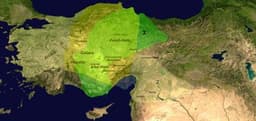
Hattusili I
Emperor · Ancient
57.0Total
Basic Information
Born
170
-1650
Died
224
-1620
Era
Ancient
Ancient
Nationality
Parthian Empire
Hittite Empire
Occupation
Emperor
Emperor
Civilization
Middle Eastern
Middle Eastern
Score Comparison
Military (10%)
47.5
63.3
Political (20%)
30.7
68.0
Influence (20%)
44.0
54.1
Legacy (20%)
34.2
49.2
Leadership (15%)
44.5
64.0
Strategy (15%)
43.7
50.0
TOTAL
39.9
57.0
Artabanus IV of Parthia — Complete Timeline
208 AD
Civil War with Vologases VIWar◆ Major
Artabanus IV fought a civil war against his brother Vologases VI for control of the Parthian throne. The conflict weakened the Parthian Empire, dividing its resources and military strength at a critical time.
Civil WarParthian EmpireDynastic Struggle
Impact: nationaldestructive
216 AD
War with Rome under CaracallaWar◆ Major
Roman Emperor Caracalla invaded Parthia, seeking a pretext for war by demanding the hand of Artabanus IV's daughter in marriage. Artabanus refused, and Caracalla attacked, devastating parts of Media and Adiabene.
Roman-Parthian WarInvasionCaracalla
Impact: regionaldestructive
224 AD
Battle of HormozdganWar
Artabanus IV was defeated and killed in battle by Ardashir I, the founder of the Sassanid Empire. This battle ended the Parthian Empire and marked the beginning of Sassanid rule over Persia.
BattleEnd of Parthian EmpireSassanid Rise
Impact: globaltragic
End of the Parthian EmpirePolitical Action
With the death of Artabanus IV, the Parthian Empire, which had ruled Persia for nearly 500 years, came to an end. The Sassanid Empire under Ardashir I replaced it, ushering in a new era of Persian history.
End of EmpireSassanid EmpireHistorical Transition
Impact: globaltragic
Hattusili I — Complete Timeline
1650 BC
Crossing of the Taurus MountainsWar◆ Major
Hattusili I led the Hittite army across the Taurus Mountains into northern Syria, conquering the kingdom of Alalakh and other cities. This campaign established Hittite control over key trade routes and marked the beginning of the Hittite Old Kingdom's expansion.
Hittite EmpireMilitary CampaignSyria
Impact: regional
Foundation of the Hittite Old KingdomPolitical Action
Hattusili I established the Hittite Old Kingdom by consolidating control over central Anatolia and moving the capital to Hattusa. He initiated a centralized administration and military reforms that laid the foundation for Hittite imperial power.
Hittite EmpireState FormationHattusa
Impact: regionalconstructive
This comparison has not been analyzed yet.
One-time AI generation (~1 minute). Scores and timeline are already available below.
Rankings
🥇
Hattusili ILeader
Mil: 63.3Pol: 68.0Inf: 54.1
57.0
🥈
Artabanus IV of Parthia
Mil: 47.5Pol: 30.7Inf: 44.0
39.9
+17.1 behind
How This Comparison Works
Algorithm
Each figure is scored on 6 dimensions (0—100 scale) based on structured historical data: Military (10%), Political (20%), Influence (20%), Legacy (20%), Leadership (15%), Strategy (15%). The weighted total produces the final ranking.
Data Sources
Scores are computed from structured sub-indicators in the database. Scale factors adjust for era (Ancient ×0.85, Modern ×1.0) and civilization size (Eastern ×1.05, Other ×0.80) to account for differences in population and military scale.
Maximum 3 Figures
Comparisons are limited to 2—3 figures to ensure readability and statistical meaningfulness.
Error Margins
±5 points per dimension — Sub-scores are derived from historical records with inherent uncertainty. Two figures within 5 points on a dimension should be considered roughly equivalent in that area.
Total Score Accuracy
±3 points overall — The weighted combination of 6 dimensions produces a total score with approximately ±3 points of uncertainty. Differences of less than 3 points are not statistically significant— the figures are effectively tied.
Known Limitations
- Historical records are incomplete and uneven across civilizations
- Figures from oral-tradition societies may be underrepresented
- Occupation labels can misclassify multi-role figures
- Scores measure capability and impact, not moral character
- Quantitative scoring is a comparison tool, not absolute truth
Capability Radar
Military (10%) — Battles & Warfare
Battles
30
60
Win Rate
20
65
Expansion
10
65
Political (20%) — Governance & Reform
Reform
10
60
Diplomacy
15
50
Economy
10
45
Influence (20%) — Cultural & Global Reach
Cultural
10
45
Global
10
40
Legacy (20%) — Historical Impact
Historical
20
55
Longevity
5
50
Leadership (15%) — Power & Stability
Tenure
15
55
Stability
5
40
Strategy (15%) — Tactics & Innovation
Strategy
20
60
Tactics
25
55
Reform
10
50
Similar Comparisons
Comments & Discussion
No comments yet. Be the first to share your thoughts!