Loading...
This comparison has not been analyzed yet.
One-time AI generation (~1 minute). Scores and timeline are already available below.
Armando Guebuza vs Washington Luis
Washington Luis leads by 0.9 pts · 2 figures compared
…

Armando Guebuza
Politician · Modern
46.6Total
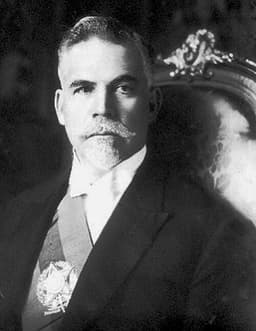
Washington Luis
Politician · Modern
47.5Total
Basic Information
Born
1943
1869
Died
—
1957
Era
Modern
Modern
Nationality
Mozambique
Brazil
Occupation
Politician
Politician
Civilization
Other
Western
Score Comparison
Military (10%)
30.7
34.0
Political (20%)
45.1
43.7
Influence (20%)
50.2
47.1
Legacy (20%)
40.0
38.3
Leadership (15%)
65.7
68.0
Strategy (15%)
43.7
60.0
TOTAL
46.6
47.5
Armando Guebuza — Complete Timeline
1986 AD
Became President of Mozambique after Samora Machel's deathPolitical Action◆ Major
Guebuza succeeded Samora Machel as president of Mozambique after Machel died in a plane crash. He inherited a country devastated by civil war and economic collapse, and his rule would be defined by post-war reconstruction.
SuccessionFRELIMO
Impact: national
1992 AD
Signed the Rome General Peace Accords ending the Mozambican Civil WarPolitical Action◆ Major
As a senior FRELIMO official, Guebuza was a key negotiator in the peace process that ended the 16-year civil war with RENAMO. The accords led to multiparty elections and a period of stability.
Peace AccordsCivil War
Impact: nationalconstructive
2005 AD
Presided over Mozambique's resource boomReform◆ Major
During Guebuza's presidency, Mozambique experienced a major resource boom driven by the discovery of vast natural gas fields. Foreign investment surged, and the economy grew rapidly, though benefits were unevenly distributed.
Natural GasEconomic Growth
Impact: nationalconstructive
2007 AD
Implemented controversial land and mining policiesReform
Guebuza's government enacted policies that favored large-scale foreign investment in mining and agriculture, often at the expense of local communities. These policies led to land disputes and accusations of corruption.
Land PolicyMining
Impact: nationaldestructive
2015 AD
Stepped down after two terms as presidentPolitical Action◆ Major
Guebuza left office after serving the maximum two terms allowed by the constitution. He was succeeded by Filipe Nyusi, but his influence within FRELIMO remained significant, and he faced later corruption allegations.
Transition of PowerNyusi
Impact: national
Washington Luis — Complete Timeline
1926 AD
Elected President of BrazilPolitical Action◆ Major
Washington Lu
PresidencyOld RepublicElection
Impact: national
1927 AD
Implemented the 'Washington Luís' Road Construction ProgramReform◆ Major
Luís launched a major road-building program, including the construction of the Rio-São Paulo highway. This infrastructure project aimed to modernize Brazil's transportation network and promote economic integration.
InfrastructureRoad ConstructionModernization
Impact: nationalconstructive
1930 AD
Supported the 1930 Presidential Election of Júlio PrestesPolitical Action◆ Major
Luís supported the candidacy of Júlio Prestes in the 1930 presidential election, breaking the traditional alternation of power between São Paulo and Minas Gerais. This decision triggered political opposition and led to the Revolution of 1930.
1930 ElectionPolitical CrisisRevolution
Impact: national
Overthrown by the 1930 RevolutionPolitical Action◆ Major
Luís was overthrown by a military coup led by Getúlio Vargas, ending the Old Republic. He was arrested and exiled, marking the end of the First Brazilian Republic and the beginning of the Vargas era.
1930 RevolutionCoupExile
Impact: nationaltragic
Exiled to EuropePolitical Action
After his overthrow, Lu
ExilePost-PresidencyOld Republic
Impact: nationaltragic
This comparison has not been analyzed yet.
One-time AI generation (~1 minute). Scores and timeline are already available below.
Rankings
🥇
Washington LuisLeader
Mil: 34.0Pol: 43.7Inf: 47.1
47.5
🥈
Armando Guebuza
Mil: 30.7Pol: 45.1Inf: 50.2
46.6
+0.9 behind
How This Comparison Works
Algorithm
Each figure is scored on 6 dimensions (0—100 scale) based on structured historical data: Military (10%), Political (20%), Influence (20%), Legacy (20%), Leadership (15%), Strategy (15%). The weighted total produces the final ranking.
Data Sources
Scores are computed from structured sub-indicators in the database. Scale factors adjust for era (Ancient ×0.85, Modern ×1.0) and civilization size (Eastern ×1.05, Other ×0.80) to account for differences in population and military scale.
Maximum 3 Figures
Comparisons are limited to 2—3 figures to ensure readability and statistical meaningfulness.
Error Margins
±5 points per dimension — Sub-scores are derived from historical records with inherent uncertainty. Two figures within 5 points on a dimension should be considered roughly equivalent in that area.
Total Score Accuracy
±3 points overall — The weighted combination of 6 dimensions produces a total score with approximately ±3 points of uncertainty. Differences of less than 3 points are not statistically significant— the figures are effectively tied.
Known Limitations
- Historical records are incomplete and uneven across civilizations
- Figures from oral-tradition societies may be underrepresented
- Occupation labels can misclassify multi-role figures
- Scores measure capability and impact, not moral character
- Quantitative scoring is a comparison tool, not absolute truth
Capability Radar
Military (10%) — Battles & Warfare
Battles
23
46
Win Rate
23
53
Expansion
26
54
Political (20%) — Governance & Reform
Reform
35
20
Diplomacy
30
30
Economy
45
25
Influence (20%) — Cultural & Global Reach
Cultural
20
10
Global
20
10
Legacy (20%) — Historical Impact
Historical
25
20
Longevity
15
10
Leadership (15%) — Power & Stability
Tenure
40
40
Stability
25
15
Strategy (15%) — Tactics & Innovation
Strategy
30
57
Tactics
31
60
Reform
39
60
Similar Comparisons
Comments & Discussion
No comments yet. Be the first to share your thoughts!