Loading...
Aristides Pereira vs Mohammad Khatami
Aristides Pereira leads by 1.9 pts · 2 figures compared
…
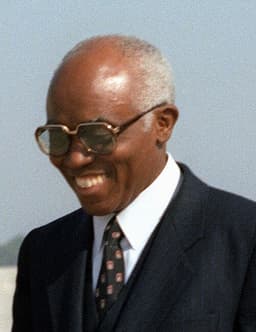
Aristides Pereira
Politician · Modern
54.4Total

Mohammad Khatami
Politician · Modern
52.5Total
Basic Information
Born
1923
1943
Died
—
—
Era
Modern
Modern
Nationality
Cape Verde
Iran
Occupation
Politician
Politician
Civilization
Other
Middle Eastern
Score Comparison
Military (10%)
42.8
14.4
Political (20%)
68.0
68.0
Influence (20%)
53.3
58.3
Legacy (20%)
45.8
48.3
Leadership (15%)
72.0
65.7
Strategy (15%)
43.7
43.4
TOTAL
54.4
52.5
Aristides Pereira — Complete Timeline
1956 AD
Co-founding of the PAIGCPolitical Action
Pereira co-founded the PAIGC with Amilcar Cabral, playing a key role in the independence movement. He later became the party's leader after Cabral's assassination.
Independence MovementPAIGCAnti-Colonialism
Impact: regionalconstructive
1975 AD
First President of Cape VerdePolitical Action◆ Major
Pereira became the first President of independent Cape Verde, serving until 1991. He led the country through nation-building, economic development, and the establishment of a one-party state under the PAIGC.
PresidencyIndependenceCape Verde
Impact: nationalconstructive
1990 AD
Transition to Multi-Party DemocracyPolitical Action◆ Major
Under pressure from internal and external forces, Pereira oversaw the transition to multi-party democracy. He stepped down after losing the 1991 election, marking a peaceful transfer of power.
DemocratizationPolitical ReformCape Verde
Impact: nationalconstructive
Mohammad Khatami — Complete Timeline
1997 AD
Election as President of IranPolitical Action
Mohammad Khatami won a landslide victory in the 1997 presidential election, receiving 70% of the vote. His campaign focused on reform, civil society, and the rule of law, marking a shift from conservative policies.
ElectionReformIran
Impact: nationalprogressive
1998 AD
Reform of Press LawsReform◆ Major
Khatami's government relaxed press restrictions, leading to a flourishing of independent newspapers and magazines. This period, known as the 'Tehran Spring,' saw increased political debate and criticism of the government.
Press FreedomReformCivil Society
Impact: nationalprogressive
Dialogue Among CivilizationsCultural◆ Major
Khatami proposed a 'Dialogue Among Civilizations' at the UN, promoting cultural exchange and reducing tensions with the West. The UN declared 2001 as the Year of Dialogue Among Civilizations.
DiplomacyCultural ExchangeUN
Impact: globalconstructive
1999 AD
Student Protests of 1999Political Action◆ Major
Khatami faced major student protests in July 1999, which were violently suppressed by security forces. The protests highlighted the limits of his reform agenda and the power of conservative hardliners.
ProtestsSuppressionReform Limits
Impact: nationaltragic
2003 AD
Nuclear Program NegotiationsPolitical Action◆ Major
Khatami's government negotiated with the EU-3 (UK, France, Germany) to suspend uranium enrichment activities. This led to the Tehran Declaration, temporarily freezing Iran's nuclear program in exchange for concessions.
Nuclear ProgramDiplomacyEU
Impact: globalconstructive
Expert Analysis
Origins
Aristides Pereira was born on November 17, 1923, on the island of Boa Vista, Cape Verde, then a Portuguese colony. His father was a small farmer and his mother a homemaker. Pereira studied at the Liceu in Mindelo and later attended the Instituto Superior de Agronomia in Lisbon, Portugal. He worked as a civil servant in Guinea-Bissau, where he met Amilcar Cabral. Together, they founded the African Party for the Independence of Guinea and Cape Verde (PAIGC) in 1956. Pereira's early life was marked by exposure to colonial exploitation and the growing nationalist movement.
Mohammad Khatami was born on October 14, 1943, in Ardakan, Iran, into a religious family. His father was a respected ayatollah. Khatami studied at the Qom Seminary and later earned a degree in philosophy from the University of Isfahan. He also studied at the University of Tehran and received a master's degree in educational sciences. During the Iranian Revolution, he was a supporter of Ayatollah Khomeini. His early background in theology and Western philosophy shaped his reformist ideas.
Rise to Power
Pereira rose through the ranks of the PAIGC, becoming the party's secretary-general after Cabral's assassination in 1973. He led the party during the independence war against Portugal. After independence in 1975, Cape Verde and Guinea-Bissau split, and Pereira became the first President of Cape Verde on July 8, 1975. His rise was cemented by his role in the independence movement and his leadership of the PAIGC.
Khatami's rise began with his election as President of Iran on May 23, 1997, winning 70% of the vote. He was a relatively unknown figure before the election, but his campaign focused on civil society, rule of law, and political reform. He had previously served as Minister of Culture and Islamic Guidance under President Hashemi Rafsanjani, where he relaxed censorship, leading to his dismissal by hardliners. His electoral victory was a turning point, representing a popular demand for change.
Leadership & Governance
Pereira led Cape Verde as a single-party state under the PAIGC, but he emphasized national unity and economic development. He pursued a policy of non-alignment and maintained good relations with both the Soviet bloc and the West. Pereira's government focused on infrastructure, education, and healthcare, achieving high literacy rates. However, his rule was authoritarian, with limited political freedoms. He scored 72.0 in leadership and 43.7 in strategy.
Khatami's leadership was reformist but constrained by Iran's theocratic system. He promoted dialogue among civilizations, relaxed press laws, and allowed more social freedoms. His political score is 68.0, matching Pereira's. However, his strategy score of 43.4 reflects his inability to overcome opposition from hardliners. Khatami's governance was marked by a struggle between his reform agenda and the conservative establishment, leading to mixed results.
Triumph & Tragedy
Pereira's greatest triumph was leading Cape Verde to independence and establishing a stable nation. Under his presidency, Cape Verde became a multi-party democracy in 1990, and he peacefully stepped down after losing the 1991 election. This transition was a significant achievement. His tragedy was the economic stagnation and dependence on foreign aid, and the failure to fully democratize earlier. His legacy score is 45.8.
Khatami's triumph was his landslide election and the subsequent reform period, including the flourishing of independent media and the Dialogue Among Civilizations initiative, which earned him international respect. His tragedy was the violent suppression of the 1999 student protests, which exposed the limits of his power, and the failure to achieve lasting political reform. His legacy score is 48.3.
Character & Destiny
Pereira was a pragmatic and cautious leader. He prioritized stability and gradual change, which allowed Cape Verde to avoid the civil wars that plagued other African nations. His character was shaped by his experience as a guerrilla leader and his diplomatic skills. He was not a charismatic figure but a steady hand.
Khatami was an intellectual and a moderate. His character combined religious piety with a belief in democratic values. He was often criticized for being too hesitant and unable to confront hardliners decisively. His destiny was to be a reformer who could not fully reform, leaving a mixed legacy.
Legacy
Pereira is remembered as the founding father of Cape Verde. His peaceful transition of power set a precedent for democracy in Africa. Cape Verde remains one of the most stable and democratic countries on the continent. However, his influence is limited to his country, with a global influence score of 53.3.
Khatami's legacy is more complex. He is celebrated for promoting civil society and dialogue, but his reforms were rolled back after his presidency. The reform movement he inspired continues in Iran. His influence extends beyond Iran, especially through the Dialogue Among Civilizations, giving him a global influence score of 58.3.
Conclusion
While Khatami has a higher influence score (58.3 vs. 53.3) and a slightly higher legacy score (48.3 vs. 45.8), Pereira's overall score (54.4) edges Khatami's (52.5) by 1.9 points. Pereira's leadership score (72.0) is significantly higher than Khatami's (65.7), reflecting his more effective governance in building a nation from scratch. Pereira's peaceful transition to democracy is a concrete achievement, whereas Khatami's reforms were largely reversed. Therefore, Aristides Pereira had a greater impact as a nation-builder who established a stable democracy, while Khatami's impact was more symbolic and temporary.
Rankings
🥇
Aristides PereiraLeader
Mil: 42.8Pol: 68.0Inf: 53.3
54.4
🥈
Mohammad Khatami
Mil: 14.4Pol: 68.0Inf: 58.3
52.5
+1.9 behind
How This Comparison Works
Algorithm
Each figure is scored on 6 dimensions (0—100 scale) based on structured historical data: Military (10%), Political (20%), Influence (20%), Legacy (20%), Leadership (15%), Strategy (15%). The weighted total produces the final ranking.
Data Sources
Scores are computed from structured sub-indicators in the database. Scale factors adjust for era (Ancient ×0.85, Modern ×1.0) and civilization size (Eastern ×1.05, Other ×0.80) to account for differences in population and military scale.
Maximum 3 Figures
Comparisons are limited to 2—3 figures to ensure readability and statistical meaningfulness.
Error Margins
±5 points per dimension — Sub-scores are derived from historical records with inherent uncertainty. Two figures within 5 points on a dimension should be considered roughly equivalent in that area.
Total Score Accuracy
±3 points overall — The weighted combination of 6 dimensions produces a total score with approximately ±3 points of uncertainty. Differences of less than 3 points are not statistically significant— the figures are effectively tied.
Known Limitations
- Historical records are incomplete and uneven across civilizations
- Figures from oral-tradition societies may be underrepresented
- Occupation labels can misclassify multi-role figures
- Scores measure capability and impact, not moral character
- Quantitative scoring is a comparison tool, not absolute truth
Capability Radar
Military (10%) — Battles & Warfare
Battles
23
22
Win Rate
26
30
Expansion
25
33
Political (20%) — Governance & Reform
Reform
55
65
Diplomacy
60
60
Economy
50
40
Influence (20%) — Cultural & Global Reach
Cultural
30
55
Global
30
55
Legacy (20%) — Historical Impact
Historical
40
50
Longevity
35
40
Leadership (15%) — Power & Stability
Tenure
65
30
Stability
55
35
Strategy (15%) — Tactics & Innovation
Strategy
32
37
Tactics
31
37
Reform
37
38
Similar Comparisons
Comments & Discussion
No comments yet. Be the first to share your thoughts!